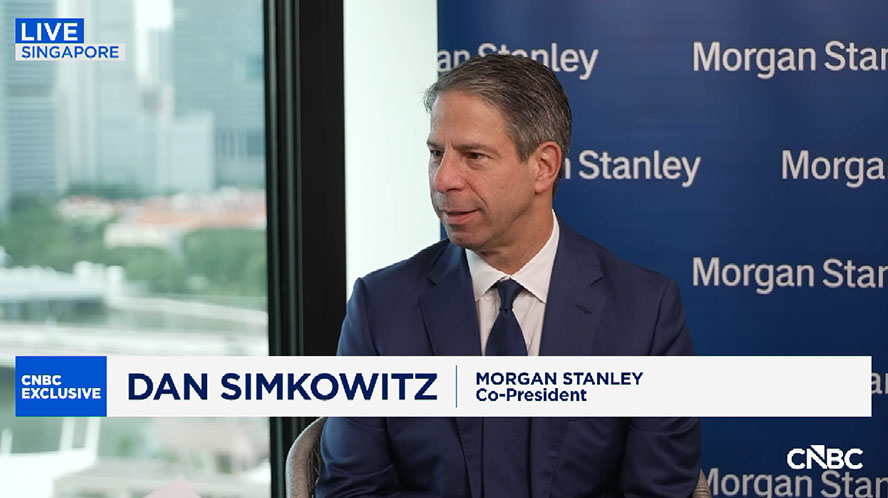
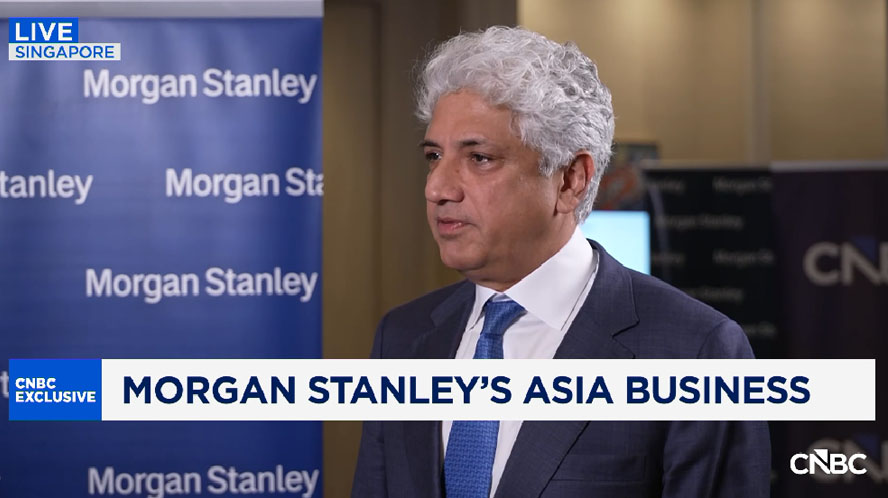
Morgan Stanley's 25th annual Asia Pacific Summit brough together investors and industry leaders in Singapore to discuss what's ahead for the region. Conversations explored AI as a transformative force, evolving investor sentiment and emerging opportunities across Asian capital markets.

The View from Morgan Stanley’s Asia Pacific Summit 2026
Nov 20, 2026
From AI and robotics to industrial growth, investors and corporate leaders discussed the key trends shaping the region at Morgan Stanley's 25th Asia Pacific Summit.


Japan’s Strategic Opportunity
Japan’s recovery is being shaped by the convergence of governance, policy, geopolitics, capital flows and technology—with each reinforcing the others across the economy and markets. For investors, the result is a structural shift worth close attention.




Thoughts on the Market
October 13, 2026
Asia Fixed Income Needs a Bigger Map
Our Head of Asia Credit Strategy Kelvin Pang explains why investors would benefit from a broader f...
View
audio Transcript
Transcript
Welcome to Thoughts on the Market. I’m Kelvin Pang, Head of Asia Credit Strategy [at] Morgan Stanley.
Today – why the challenge in Asia fixed income may not be the region at all, but the way investors have traditionally looked at it.
It’s Tuesday, October 13th at 8am in Hong Kong.
Picture this. You’re shopping in a supermarket. As you walk down the aisles, you notice half of them are off limits. It’s unexpected.
Something similar has happened in Asia fixed income. The region’s fundamentals remain supportive, but the traditional investment universe has become increasingly constrained.
The pressure began in early 2023, when U.S. policy rates rose above those in much of Asia for the first time since before the Global Financial Crisis. The environment that had supported Asian bond markets for years turned upside down.
Consider Asia-dollar credit. Issuers have increasingly turned to cheaper local-currency financing, which is shrinking dollar-bond supply. Asia-dollar credit is now on track for a fifth straight year of negative net supply. At the same time, investment-grade spreads have tightened to 55 basis points. That makes Asia investment-grade credit the most tightly valued major credit market globally.
And investors have taken notice of this. Assets in dedicated Asia credit and high-yield funds have fallen 62 percent from their 2021 peak – from roughly $75 billion USD to around $29 billion USD.
But we feel Asia itself is not the problem. In fact, Asia Pacific nominal GDP could rise from $41 trillion USD in 2025 to [$]54 trillion by 2031. That would account [for] roughly one-third of global nominal GDP growth over that period.
And most importantly investment is also accelerating. Asia’s capital spending could rise from $11 trillion to [$]16 trillion by 2030. That would mark the strongest industrial cycle since the mid-2000s. And we think this extends well beyond AI, with energy, defense, and broader industrial investment all playing major roles.
The key issue here is how investors have traditionally looked at Asia. They basically need a bigger map.
That broader map is what we call APAC fixed income. Traditional Asia fixed income has largely focused on U.S.-dollar credit and local-currency government bonds across emerging Asia. APAC fixed income adds convertible bonds and local-currency corporate credit. It also brings Japan and Australia into the mix.
So, what’s the advantage of this broader map? You see, each of these pieces behaves differently. Convertible bonds let investors participate in regional growth through their equity link. APAC dollar credit plays a more defensive role, with a mostly investment-grade, U.S.-dollar-denominated profile. Local-currency rates provide exposure to interest rates, currencies and the economic cycle. At the same time, local-currency corporate credit broadens credit and sector exposure.
Together, they create a more flexible mix of risks across changing economic conditions. For example, when growth and inflation rise together, convertible bonds can benefit from their equity link. In a recession, currency-hedged local bonds can benefit from falling rates while limiting foreign-exchange risk. During stagflation, dollar credit can offer more defensive characteristics.
Our portfolio analysis since 2023 suggests a diversified APAC fixed-income portfolio could target a 7.5 percent return with a vol[atility] of roughly 4 percent, depending on allocation constraints. Investors also increasingly need to manage currency exposure as the dollar cycle shifts.
For years, investors could navigate Asian bonds with a relatively narrow toolkit. Today’s market demands more flexibility. The opportunity in Asia has not disappeared. The better question may be whether investors are looking at enough of it.
Thanks for listening. If you enjoy the show, please leave us a review wherever you listen and share Thoughts on the Market with a friend or colleague today.

October 6, 2026
Japan’s Banks Enter a New Era of Opportunity
Our Japan Financials Analyst Mia Nagasaka explains why a once-in-30-year investment cycle could tr...
View
audio Transcript
Transcript
Welcome to Thoughts on the Market. I’m Mia Nagasaka, Head of Japan Financials Research at Morgan Stanley MUFG Securities.
Today – a once-in-30-year investment cycle is changing how investors think about Japanese banks.
It’s Tuesday, October 6th, at 10am in Tokyo.
For decades, Japanese companies had more cash than investment opportunities. But now it's changing.
This marks a new chapter for Japanese banks. The first stage of recovery was largely about interest rates. As Japan moved away from negative rates, higher lending yields helped bank margins and earnings. This next stage is about growth in the banking business itself, driven by companies investing more and needing more external capital.
In fact, we think Japan is entering its first meaningful capex cycle in nearly three decades. Investment needs are broadening, from labor-saving technology to the replacement of aging equipment. Companies are also becoming more active in reallocating capital toward businesses where they see stronger returns.
For banks, the most direct opportunity is lending. We expect Japan’s domestic loan market to grow from about 588 trillion yen, or roughly 3.7 trillion U.S. dollars, in the fiscal year ending March 2026 to roughly 712 trillion yen, or about 4.5 trillion dollars, by March 2031. Loan growth could run at around 5 percent annually early in the investment cycle, then settle at about 3 to 4 percent.
And the financing opportunity extends beyond loans. Take Japan’s debt capital markets, where companies raise money by issuing bonds. We expect them to grow from about 52 trillion yen, or roughly 331 billion dollars, to 63 trillion yen, or about 401 billion dollars, by March 2031. We also forecast the M&A market to rise from 23 trillion yen, or roughly 146 billion dollars, to 32 trillion yen, or about 204 billion dollars, over the same period. Large projects often need several forms of financing, so lending can open the door to underwriting and advisory fees as well.
This gives banks more ways to generate earnings. In the early phase, banks can benefit mainly from lending and project finance. As projects mature, fee-based businesses such as capital markets and M&A can contribute more. This makes the opportunity look less like a short-lived lending boom and more like a multi-stage financing cycle.
The key measure to watch is return on equity, which shows how effectively a bank turns shareholder capital into profit. Japan’s megabanks are currently generating ROEs of roughly 10 to 11 percent. We see a path toward around 15 percent over the medium term. Structural growth in corporate financing demand alone could add about 1 to 1.5 percentage points.
So, the bigger story is not simply that rates have risen. Japan may be moving from an economy defined by excess savings and underinvestment toward one where companies need capital to grow. If that transition continues, banks could have substantially more productive opportunities to deploy their balance sheets.
Thanks for listening. If you enjoy the show, please leave us a review wherever you listen and share Thoughts on the Market with a friend or colleague today.
September 29, 2026
China’s $12 Trillion Manufacturing Upgrade
Our China Industrials Analyst Sheng Zhong explains how AI, robotics and a major investment cycle c...
View
audio Transcript
Transcript
Welcome to Thoughts on the Market. I’m Sheng Zhong, Morgan Stanley’s China Industrials analyst.
Today – how AI and automation are transforming China’s factories, and what that could mean for global manufacturing.
It’s Tuesday, September 29th, at 3 PM in Hong Kong.
For decades, Made in China has been shorthand for scale, speed, and low-cost manufacturing. Now the story is shifting toward something more ambitious: using technology, productivity, and industrial know-how to shape not just what gets made, but how it gets made.
We call this transition Industry 5.0. Industry 4.0 was about connecting machines and digitizing production. Industry 5.0 goes a step further, using AI to improve how factories schedule production, manage quality, and maintain equipment.
China is starting from a position of enormous scale. It represents roughly 28 percent of global manufacturing value-added and covers all 666 industrial subcategories defined by the United Nations. There are already more than 30,000 basic-level smart factories and more than 100 million connected industrial devices.
That industrial base also gives China a strong platform for robotics. Traditional industrial robots generally perform fixed tasks. Embodied AI could make machines more flexible, allowing them to gain new capabilities through software and updated models. That could effectively turn some physical labor into software-upgradable capital.
And the numbers give you a sense of how quickly this could scale. China could go from selling about 8 million robots a year in 2025 to 29 million in 2030, and 76 million by 2035. That’s roughly a ninefold increase in annual sales in just a decade.
Scaling robotics and AI across such a large manufacturing base will require a lot of capital. We estimate Industry 5.0 could generate about $12 trillion USD of incremental industrial investment in China from 2026 through 2035. Around $5.5 trillion USD would go toward factory upgrades, including robotics, smart equipment, and software, while roughly $6 trillion USD would support new industrial capacity.
But that investment cycle is likely to build gradually. We expect industrial capex growth of about 4 to 5 percent annually in 2026 and 2027, before accelerating toward 6 to 7 percent from 2028 as excess capacity is absorbed, technology bottlenecks ease, and AI adoption broadens across factories.
If that investment translates into higher productivity, the economic impact could be meaningful. By 2035, China’s industrial profit margin could rise to 8 percent from roughly 5 today. Industry 5.0 could lift China’s potential GDP level by around 3.5 percent, helping cushion some of the drag from an aging population. And China’s share of global manufacturing value-added could increase from about 28 percent to 30 percent.
And those changes would not stop at China’s borders. Final assembly can shift to new locations, but the supplier networks, machinery and production know-how behind it are much harder to replicate. We estimate only around 40 percent of China-to-U.S. exports can be readily substituted.
That means China’s role may increasingly extend beyond exporting finished goods to supplying the equipment, components and industrial systems used to make them elsewhere. That is the move from Made in China toward Made by China.
Thanks for listening. If you enjoy the show, please leave us a review wherever you listen and share Thoughts on the Market with a friend or colleague today.
August 18, 2026
Korean Stocks: From Correction to a Healthy Recovery
After a historic rally and a sharp correction, South Korea’s equity market may be approaching a tu...
View
audio Transcript
Transcript
Welcome to Thoughts on the Market. I’m Joon Seok, Morgan Stanley’s Chief Korea Equity Strategist.
Today: Why Korea’s equity market may be moving from a sharp reset toward a broader and more sustainable recovery.
It’s Tuesday, August 18th, at 2pm in Seoul.
South Korea’s stock market has delivered the kind of ride that makes even long-term investors check their phones more often than they would like. The KOSPI surged 101 percent in the first half of [20]26, then fell more than 38 percent from its peak by July 30th. But the market now appears to be moving toward a more durable recovery.
The first reason is valuation. Take the KOSPI’s forward price-to-earnings ratio, which compares share prices with expected profits over the next year. It fell below five times, its lowest level since 2004. Our capitulation index also dropped to minus 2.53. This index combines market momentum with the breadth of the sell-off, so it helps show whether fear has become widespread. Readings below minus two have often marked troughing territory outside the major crises.
The second reason is that forced selling appears to be easing. Now, we have seen leverage as a double-edged sword as leverage helped fuel the rally, but it also made the decline sharper as investors were forced to cut positions. Assets in leveraged single-stock ETFs have fallen about 70 percent from their June peak, and margin lending has also come down. Now, hedge funds have completed roughly three quarters of a typical risk-reduction cycle. Put simply, the most intense selling may already be behind us.
Still, a healthier recovery needs more than a rebound by the tech sector. Tech remains central because AI infrastructure continues to drive demand for advanced memory. Morgan Stanley Research expects global spending by large tech platforms to reach 805 billion U.S. dollars in [20]26 and 1.2 trillion dollars in [20]27. That creates a lot of opportunity – but it also keeps markets sensitive to any change in capital spending, chip pricing or competition.
The broader Korean economy offers support. Real GDP growth has exceeded 3 percent for two consecutive quarters up sharply from 1.1 percent in 2025. Full-year growth is now likely to land in the mid-3 percent range; and generally, Korea's growth is around 2 percent. Importantly, the improvement is spreading beyond exports. Consumption is recovering, tourism has surpassed pre-pandemic levels, and the government is targeting 23 million foreign tourists this year.
There are trade-offs. Inflation reached 3.2 percent in June, and the Bank of Korea raised its policy rate to 2.75 percent. A measured hiking cycle could take rates to 3.5 percent by the first quarter of 2027. Higher rates may help financial-sector earnings, but they also raise financing costs for households and businesses.
The source of market liquidity is changing as well. Domestic retail investors drove much of the first-half rally, but tighter leverage rules mean foreign investors are likely to determine the next leg higher. Corporate-governance reforms and better capital management could also encourage broader international participation.
We continue to see a path toward a KOSPI target of 9,000 by June 2027, with a bull case of 10,500 and a bear case of 5,500. The next phase should be steadier and more balanced. Industrials, financials, healthcare, communications, and consumer staples should also contribute alongside technology.
Korea still has room to run. But the stronger signal may be quality – meaning earnings resilience, disciplined capital management and broader participation. The stock market’s initial rally was fueled by speed and concentrated leadership. The next phase will require wider and more durable support.
Thanks for listening. If you enjoy the show, please leave us a review wherever you listen and share Thoughts on the Market with a friend or colleague today.