What’s Behind India’s Next Era of Growth
August 19, 2026
Watch, Listen and Subscribe:

August 19, 2026
The success of India’s transformation isn’t just about building rail lines, data centers or chip fabs – it means connecting them into a cohesive strategy that is widely beneficial. “Technology should not be left in the hands of a few,” says Ashwini Vaishnaw, who is India’s Minister for Railways, Electronics and Information Technology and a key figure in India’s development.
In this episode of Exceptional Leaders, Morgan Stanley’s Head of India Research and Chief India Equity Strategist, Ridham Desai, sits down with Minister Vaishnaw in New Delhi to discuss the role of physical and digital infrastructure as a growth engine for India and its goal of becoming a developed nation by 2047.
MINISTER VAISHNAW
When we say democratized technology, we mean that technology should not be left in the hands of a few. It should be accessible to a wide section of the society, and people should be able to use them, create solutions, and make a difference in their own lives.
RIDHAM DESAI
India is the world’s fifth-largest economy, and it’s building at a pace and scale that few countries have attempted simultaneously: new rail corridors, a nationwide 5G rollout, a fast-growing electronics export sector, and an ambitious push into AI and semi-conductors, all at once. One of the architects of this transformation is Ashwini Vaishnaw, India’s Minister for Railways, Electronics, and Information Technology. An engineer and former entrepreneur, Minister Vaishnaw oversees two of the country’s most consequential platforms: the rail network that moves billions of passengers and millions of tons of cargo every year and the digital infrastructure that underpins data, payments, and compute for a country of nearly of nearly 1.5 billion people. As Head of India Research and Chief India Equity Strategist, I was curious to learn more about what it takes to lead ambitious change in a country as large and diverse as India. So I sat down with Minister Vaishnaw in his offices in New Delhi to talk about what it takes to modernize a country’s physical and digital backbone and what this means for India’s continued development.
DESAI
It's great to have you here, Minister Vaishnaw, on Exceptional Leaders.
MINISTER VAISHNAW
Thank you, Ridham, for having me here.
DESAI
You have been at the helm of what I would consider as the world's largest scale transformation: Indian Railways. How did you do this? And that too, in such a short span of time?
MINISTER VAISHNAW
It is a very complex organization and a very large organization: 1.2 million employees, 135,000 km of railway track, 7.4 billion people traveling on the network. Very complex network. The biggest challenge that we faced was to understand how this organization operates and then find out where the constraints are, then making sure that the solution is accepted by the people, and then go forward. Everywhere we looked at, “What is the constraint? What are the problems?” Go down to the root of the problem. Solve for the root. Whether you have to make a change in the process, whether you have to make a change in technology, whether you have to make a change in the machines which are used, whether you have to make a change in the training: it's like going deep dive practically in every part of this huge, big organization.
DESAI
How critical is this transformation to India's manufacturing aspirations? And also on tech diffusion?
MINISTER VAISHNAW
Manufacturing competitiveness has logistics cost and logistics efficiency as a major element. And when we are improving the railway operations, this is directly impacting the cost of logistics and the efficiency of logistics. A decade ago, we used to carry just about 1,000 million tonnes of cargo. Today, we are carrying 1,670 million tonnes of cargo. This directly impacts the way industries operate. If the industries are located close to a railway terminal, then it becomes very easy for them to manufacture straight away, put it on the wagons, and ship it to the place they would like it to go.
DESAI
India now operates one of the largest rail freight networks and one of the largest 5G ecosystems in the world and has done both on an impressive timeline. The Minister makes the case that these aren’t separate initiatives but a single coordinated growth engine. The question now is whether India can extend that momentum into the next frontier: artificial intelligence.
DESAI
On the two foundational networks you run: rail and digital. At first sight, they seem very different from each other, but they do intersect.
MINISTER VAISHNAW
They look very different, but basically, they are part of that same growth strategy that India is following for the last decade. These two networks are basically increasing India's productivity, improving the efficiency in our economy, and third, they are making a big difference in people's lives. Railway: today, we are the second-largest goods career in the entire world. If we invest in this network, then it makes a huge difference in the growth. Second, it is bringing the logistics efficiency. Third, we can have affordable travel for our people.
If you look at this Vande Bharat Express: designed in India, made in India, semi-high-speed 180 km/h speed potential. We are able to provide this kind of service at 2.3 cents a kilometer. Go to China: it is about seven times. Go to Japan: it is about ten times this price. Go to Europe: it is about twenty times. So we are able to provide very good service at a very affordable price at the income level at which we are in our country today.
Same is the case of the digital network. We focused on making sure that 5G reaches every part of the country. Practically 90% of the country has 5G today: second-largest 5G ecosystem in the world. And look at the digital public infra, the payment system, the DigiLocker, the document management system: all these things have ensured that our people get the benefits of digital economy, which normally would have accrued only to the developed countries. So both sectors in that sense are very important for India's growth and very important for making a difference in people's lives. So that way they are interconnected.
DESAI
What is it that India is doing on AI? The world seems to have the view that India is falling behind. Would you agree, disagree, and how would you inform that view?
MINISTER VAISHNAW
Our biggest strength is in the applications layer. The biggest strength of our IT industry is to go into any enterprise, understand the enterprise, understand the operating system of the enterprise, and provide a solution based on that operating system. Almost 80% of the startups which are coming up now are basically providing AI-based solutions. The second layer in which we are playing well is the data center. We are one of those few countries which have more than half the power generation capacities from clean power: about 250 gigawatts is from renewable energy sources.
DESAI
A decade ago, mobile phones ranked168th on India’s export list. Today, they’re number one. That trajectory is now being applied to semiconductors, where India already accounts for 20% of the global chip design workforce. For investors watching supply chain diversification away from China, this is one of the most significant manufacturing stories in the emerging world.
DESAI
The success that we have had in electronics is unbelievable. Ten years ago, phones was 168th on our list of export items. It is now number one. What has driven this success, and is this the template for semiconductors for chips?
MINISTER VAISHNAW
We started electronics manufacturing in a very, very methodical way. We started with getting the finished products assembly in our ecosystem. Then we went to the module level, then we went to the submodule level, and now we are at the component level. So step-by-step, building this entire ecosystem. Because of this strategy, in a period of [the] last decade, we have been able to establish ourselves as an important electronics manufacturing destination.
The second big advantage that we have is the trust that the world has on India. We have a very strong copyright and IP right protection system. The third point is our capabilities in design. We are a country which is where our engineers are designing products for practically the entire world. That has given us the template which we are using in multiple sectors, for example, in the case of semiconductors. In the case of chip manufacturing, we focused a lot on the design capabilities, which where we are very strong already. Already 20% of the global design workforce is in India, so we decided to take it to a totally, totally next level. So we gave the best of the design tools to 318 universities now. The students are using Synopsys, Cadence, and so many other tools. These are the chips designed by students. Look at the names of the places: Kolkata, Surat, Jalandhar, Gwalior, Indore. Throughout the country, these chips are manufactured in a semiconductor laboratory. In that laboratory, the chips are manufactured, fabricated, and then they are assembled, and the final chip is tested so the students get to see the result of what they have designed.
DESAI
You have often said that we need to democratize technology. What does that exactly mean, and how is it informing India’s progress in technology?
MINISTER VAISHNAW
When we looked at the 5G rollout, we decided that we will not limit 5G to the big cities, but we will make sure that 5G goes out to the villages. So practically 90% of the country is today covered under 5G. When we created this DPI structure, the entire structure is built in a way that, let’s say, the payment system: it should not be monopoly of one or two companies. It should be any startup which wants to come up with a new solution. They must get the opportunity to prove their solution.
DESAI
The ground level input that the Minister’s office is capturing on these reforms is in service of a broader goal. 2047 marks the 100th anniversary of India’s independence, and the Indian government has made it the target date for what it calls Viksit Bharat, or Developed India, a national vision to transform the country into a fully developed economy.
DESAI
How do you see India’s transformation? How will it look like in 2047?
MINISTER VAISHNAW
We have taken a target of making our country as a developed nation, then converting that target into sector-specific goals, then looking at a short-term, medium-term, long-term strategy, then building those, that basic growth engine, which is built on the four pillars: investment in physical, digital and social infra, inclusive growth, focus on innovation, and manufacturing.
That kind of thinking and that kind of execution is helping us move consistently in our journey towards a developed nation. More than 250 million people have come out of extreme poverty in the last decade. That’s a huge achievement for the country. We will become leaders in some of the technologies that we have selected for us. We will have equal opportunities for a large section of this society. In 2047, we’ll be 37 years median age. We will still be a young country at 2047, when we will be about anywhere between $25 to $30 trillion economy, and we will have another 50 years of growth ahead of us because of our demography. So all these factors together, and the foundation that is being built today, will give us that growth path for the many decades going forward.
DESAI
It's fantastic. Okay, my final question. Are there any projects, either personal or professional, that you are going to tackle next?
MINISTER VAISHNAW
Developing the 350 km/h bullet train is on top of my agenda. So it is very important to have this entire technological base in our country.
And second, going to the seven nanometers from 28 nanometers. That's again going to be a very big challenge for the country because between seven nanometer and 19 nanometers, we will have practically maybe 85% of the entire volume of semiconductor chips. So making sure that that much capability of the country is developed in the next few years.
These two are the most complex ones which I am working on. On personal front, I am very focused on reducing my weight to 69 kilos. Be like you: fit always.
DESAI
Thank you, Minister Vaishnaw, for this really insightful conversation. It was great having you on the show.
MINISTER VAISHNAW
Same here. I thoroughly enjoyed the conversation, Ridham. Thank you so much for having me here. Thank you.
In this engaging series from Morgan Stanley, experts from across the firm sit down with leaders at world-class companies for insightful conversations covering everything from leadership lessons to foundational changes in industries, markets and society.

SCOTT KIRBY
Most people confuse management and leadership. If you can inspire 120,000 people with a vision, you can accomplish a whole lot more than if you’re going through a checklist every day.
RAVI SHANKER
Since its inaugural flight a century ago, United Airlines has defined commercial air travel, with a history of firsts, spanning everything from the modern airliner and flight attendants to computerized flight planning. Today, United connects more people to more destinations than any carrier on the planet. But it isn’t just about growth; United is focused on improving the travel experience for all passengers. Behind this vision, CEO Scott Kirby has spent his career thinking differently about what it means to run and lead an airline. When the industry was impacted by Covid, United invested for growth and emerged stronger. Even as corporate boards began confronting deglobalization, Kirby leaned into international expansion. And now, as many leaders view AI as a way to cut headcount, Kirby sees technology as a way to improve human interactions, not replace them. As Morgan Stanley’s lead North American airlines analyst, I want to learn more about how Kirby makes decisions in an industry that faces constant uncertainty. So I traveled to United’s headquarters in Chicago, where I sat down with Kirby on the day United turned one hundred and got a close look at Kirby’s approach to leadership and discussed some Sambas.
RAVI
Thank you, Scott, for having me here today on the actual one hundredth anniversary of United. Congratulations.
SCOTT
Yeah, today’s the day: a hundred years.
RAVI
Happy birthday!
SCOTT
Thank you. And how do you like the shoes? Hundred-year anniversary Sambas.
RAVI
That is fantastic. You graduated from the Air Force Academy. Did you originally aspire to fly professionally? And what prompted you to go a different direction?
SCOTT
I went to the Air Force Academy intending to be a pilot and then an astronaut, and while there, you get to fly, and I was out in an F-4—dogfighting, aerial, broke the sound barrier-
RAVI
Wow.
SCOTT
-and at the end of it, the pilot told me to close my eyes and fly straight and level by feel, and I was at a 30-degree left bank and he said, “Use the instruments,” and I did, and I felt like I was going to fall out of the seat to the right, and he laughed at me and said, “You’re never going to be a fighter pilot. You’re going to be a cargo pilot.” And that moment, I decided, “I’m sure you’re right about the first one, but you are dead wrong about the second one.” So I didn’t go to pilot training.
RAVI
To the present day: you may not be a fighter pilot, but you operate in an environment of near-constant volatility. So how do you handle the daily realities of this environment we are in right now?
SCOTT
You’re trying to figure out on the fly what’s going to happen, trying to look over the horizon, trying to read extensively—I’ve done that my whole life, I read three hours a day on average—but I’m genuinely curious, and when you do that, you connect the dots I think that other people can’t connect and don’t see. I think this has happened a lot of times in my career: to try to see things earlier and how to take advantage of stuff when I have a view that is different than the consensus view.
RAVI
How do you carve out the space and time to think long term, with everything going on?
SCOTT
I’m really good at time management, and I don’t waste time: in my personal life, professional life, I’m not on social media—what a time suck—I don’t really watch TV, another time suck. But in business, less than four hours of meetings a day on my calendar is my rule. It gives you time to think, it gives you time to read, it gives me time to just call people and ask questions, but also, I have a great team. And I feel like if I am trying to micromanage, I’ve done something wrong.
RAVI
You’re known as a highly data-driven leader. So as data has become more pervasive, has your approach to leadership changed as well?
SCOTT
I don’t think it’s changed so much because of data—in fact, I probably use data less explicitly the further I go in my career. I could tell you pretty close what it’s been for the last thirty days; I know about the operation; I know what we’ve done; I know what each of the other airlines have done. But I really use that more to paint the palette of thinking about other bigger decisions. And I draw a big distinction between management and leadership.
Management is about compliance; it’s about running the checklist: how many people showed up for work on time. But leadership is different; it’s about inspiration and vision. And compliance is really important; you need people to do that. But leadership is more rare.
The further you move up anywhere in your career, the more your job indexes from management functions to leadership functions.
RAVI
Is that your leadership version? Did you have a mentor? How did you, kind of frame that?
SCOTT
I’ve learned a lot more from watching people make mistakes. And I’ve learned a lot, more of the positive examples, from reading: you know, Winston Churchill’s top of my list of heroes. You know, like, what would Winston Churchill do in a situation like this? Abraham Lincoln is another one. But I also learn from myself too, like mistakes that I’ve made, like you make a mistake like, “To thine own self be true,” what a great line. When you screw something up, like I don’t mind making a mistake; I hate making a mistake twice.
RAVI
What are the feedback systems that you have, to maybe see some of the things that you're not seeing?
SCOTT
You have to spend a lot of time out, talking with people. I have the easiest job of anyone at United because I have only really one responsibility: create a company that our employees are proud of. And so I look for that pride, and I spend a lot of time out in the operation, you know, I—every week I'm out, you know, either virtually or in person, talking to groups of new captains and talking to groups of new pursers at United, and you can tell if people feel proud of the company. People want to be on a winning team, and winning is contagious.
RAVI
Can you give us an example of an instance where the data pointed one way, but your gut or instinct kind of said there was something different?
SCOTT
Covid. You know, when Covid started, the data to me pointed to like, this is a global pandemic, and it was hard for me to understand why no one else knew it. We were just a couple weeks ahead of the globe-
RAVI
-you were the first.
SCOTT
-but, you know, we went off and raised two billion dollars at three percent interest two days before the NBA walked off the court and it would’ve been impossible, and we shrunk more than everyone else quickly. But then during Covid, the data got wrong. All the experts believed that air travel demand would never recover, and all the surveys—if you did surveys—people said they were never going to fly again.
And so, literally every global long-haul airline in the world, except United, permanently retired part of their global long haul wide-bodied fleet and shrunk. And we looked at that, and I said, “I think that’s just the wrong decision.” Instead, we did the biggest aircraft orders in history during Covid.
RAVI
If you were not the CEO, what job would you like to have and why would you be good at it?
SCOTT
The foundation of an airline is the route network. That is our asset. You have to learn the whole airline; you have to learn what makes it tick, what makes it work, what makes it profitable, what doesn’t work, what works operationally. You really have to learn the whole network to be good at route planning.
RAVI
Global expansion is obviously a major focus for United. You fly to 385 destinations globally. What are some of the unique challenges and opportunities?
SCOTT
Flying globally is—it’s what customers want, so that's the starting point. But it also creates unique challenges and opportunities. I mean, you know, we're just exposed to everything that happens anywhere in the world. You know, if there's war in the Middle East, you know, we're not just hit by fuel prices, we fly to those places. When the war in Ukraine started, we, you know, flew over Russia. Anytime something happens in the globe, we're exposed to it, but it's where our customers want.
When you’re an airline as large as United, it actually—to find new destinations, it means that we can’t just use data. We’re flying to places like Nuuk, Greenland, which no US airline has ever flown to. And so, you have to find other sources and other ideas and make bets on what will work. This summer, we’re starting two destinations in Spain and Portugal that are part of pilgrimages: where people fly into Lisbon and they walk two hundred miles to another destination. We’d seen a lot of one-way traffic in but not return traffic in and realized that, and it’s been booked up like crazy, so it’s done really well.
RAVI
What gives United an edge when it comes to recruiting pilots, flight attendants, or anybody else who wants to work for United, and kind of pass that culture through?
SCOTT
We really are at the top of the food chain for aviation and for industries at large. We're growing faster every year in absolute than any airline in history has done, which gives you lots of opportunities. And if you come to United, it feels like you're on the winning team. I just came from speaking to a group of new hires. We had people from all of the major airlines. A lot of them were talking about, “In my area, United is doing this, and you're the leader here.” And so they're all excited to come. People that come to United are usually coming for a career. We still create the kind of careers that used to be common in the United States. But, you know, a pilot, a mechanic, a gate agent, you know, can start here when they're twenty years old. And when they get to the top of the scale, and certainly with a little bit of overtime, they can make six digits; they have great benefits; you know, they can work for a lifetime. They can buy a house; they can send their kids to college. It's an important part of the fabric of America. And being able to create those kinds of careers, it’s—we're proud to do it.
RAVI
Just given the thought and effort you guys put into recruitment, kind of how does that translate into customer experience? Kind of that culture of United coming through?
SCOTT
What we've tried to do is actually hire people for attitude, instead of hiring for technical skills. We can train someone to be a flight attendant. We can train someone to be a gate agent. What we can't train is to be a people person that cares. So we try to hire people that have that attitude that are really our “people people.” I mean, we're in the business of connecting people and uniting the world.
RAVI
The premiumization of air travel is a major theme in the industry, kind of a big change versus the last decade. So how is United kind of building brand loyalty across all segments?
SCOTT
So I pushed back actually a little bit on the premiumization of the industry. It is happening, but I start by saying, “We're investing nose to tail for all customers.” And I think that actually the gap between our Economy and other airlines’ Economies is probably bigger even than the gap between Premium to Premium; there's a gap in both places. But, you know, with things like Starlink throughout the airplane, seatback entertainment throughout the airplane, the app—you know, we have the best technology of any airline in the world, the app. Anyone that uses it knows it. So we're really focused on creating products, technology service that all customers like. We have a lot of Premium demand, and we’re investing more heavily. You know, the latest 797, you know, I think is probably the best airplane flying in the Western world. The CRJ 450, you know, when you're flying to small cities, you know, it's like flying on a private airplane. It's the opposite trend of what most airlines do, and we took 18% of the seats off the airplane.
RAVI
So when it comes to innovation, kind of either on board or on the ground or offline, how do you come up with kind of innovative new ideas in terms of customer offerings?
SCOTT
I try to go by the philosophy that Henry Ford had and Steve Jobs had. Henry Ford said something along the lines of, “If you ask people what they want, they’d tell you, a faster horse.” And Steve Jobs famously eschewed any kind of consumer survey stuff because he wanted to invent something that they didn't know they wanted yet. Some of the things that we put in the app are not the kind of things that people ask questions about. You know, we put a scorecard in for frequent fliers last year: How many flights did you take? How many hours? How many miles did you fly? We’ve started putting the airport map, so you can see when you're on the ground where you have to taxi.
I want us to surprise and wow our customers every year with something new. So then they get on the airplane, they say, “I've never seen an airline do that; I never even thought of this before.” So we're trying to figure out what people will love, even if they haven't asked for it yet.
RAVI
You just added the TSA wait times to the app. I didn't know that was possible.
SCOTT
We've also added technology on the app that if you opt in, we’ll track you, so we can know to wait for you for connecting gates. We want to do things like deliver food to your gate, if you need a connecting flight and you want to be able to order food. But one of the other things is, it'll give real time waits, trying to get really real-time data to customers, and we're the only airline that’s doing it.
RAVI
Moving to the topic of AI. So how does AI improve how United operates? And what does that mean for your passengers?
SCOTT
It's a great tool. It's going to do a lot of things—it does do a lot of things—really well. But I do not think that the primary use case of AI is replacing the work that everyone does. And if that's the primary use case, like, it's for sure a bubble, because we're spending way too much for that. Too many people are getting dependent on AI, and like thing that people are using AI for is summarizing documents. Like, that seems to me to be the number one use case. I actually want to read the book. Because all the cool learnings are, you know, on page 312 in a little paragraph that there's some cool insight, and I think you're going to miss all that.
The cool thing about AI is the things that you can do that were impossible or impractical before. One of my favorite examples is, anytime there's a delay or cancellation, I want the team to pretend I'm on the airplane and I've called the network operating center: “Why is my flight delayed?” Whatever they would tell me, I want to tell customers 100% of the time. We're better at it than any other airline in the world, but we're not even into the game yet. We're still in the pre-game. [It’s] really hard to do without AI. It's also going to help us, I think, in our network operating center, when we’re deciding which flights—when stuff happens, you know, when weather hits and airports close, like it's one of those problems that has multiple tentacles that can last for days: crew and maintenance and all kinds of other implications. And they're all stochastic, like you know, you don't know for sure what's going to happen down the line.
RAVI
Scott, you mentioned that Covid was an instance where the data pointed one direction, but your instinct took another direction. What is that moment today?
SCOTT
Oh, oil prices and the war in Iran. From the time that MEU left Asia for the Middle East, I thought the forward curve was wrong. I thought oil was going to be higher for longer. And so we’ve been preparing for that at United. The experts that I talked to back then all told me: worst case, the Straits of Hormuz are open by the end of March. I think oil prices are going to be higher for longer. We at United are preparing for that. That's our base case planning assumption. I think there may be an opportunity to take advantage of it when our competitors are managing more by hope instead of reality.
RAVI
Scott, so when you eventually do step out of the CEO role, what do you hope people would say that you changed about United and the industry?
SCOTT
I want to have United to have launched a new era in aviation—what it means to be an airline. A lot of it's going to be technology—the technology that takes all of the uncertainty and stress of travel. Make travel fun. And my second one is to leave behind a CEO who's better than me.
RAVI
Well, we won’t be making that change anytime soon. Scott, thank you for joining us. It has been real fun.
SCOTT
Thank you.
RAVI
Appreciate it.
Salem
The concept of wellness is no longer just about burning fat and building muscle. It’s expanded into something far more holistic, including how we eat, how we sleep and how we manage stress. Corporate attitudes towards well-being have also changed.
Carvalho
Employee well-being is being discussed at boards now because the liability of not having employee well-being is super high. And it’s going to be even more relevant going forward.
Salem
One leader who saw this shift long before it became mainstream is Wellhub’s CEO and co-founder, Cesar Carvalho.
Carvalho
The next step is corporate well-being becoming a standard that every single company has to offer, that every single employee demands their employer to do.
Salem
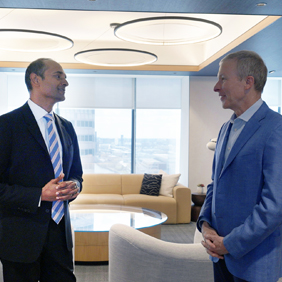
His vision turned the company into a multi-billion-dollar business that is reshaping how organizations and employees think about wellness. As part of Morgan Stanley’s Investment Banking team, I’ve had a front-row seat to Wellhub’s remarkable expansion. I sat down with Cesar recently to talk about the company’s journey and where the future of wellness is headed.
Salem
Cesar, it's great to have you here.
Carvalho
Thank you for having me. Great to be here as well.
Salem
For those who are not familiar with Wellhub, tell us a little bit about what you guys do.
Carvalho
Wellhub is a technology company that's making well-being accessible to every single employee. And we're also helping change behaviors for the better at scale. And right now, we work with more than 40,000 corporate clients, and we have over 5 million paid subscribers. Those subscribers are visiting more than 100,000 partners—different gyms, studios and apps—more accessible, more flexible, and have more options than any traditional gym membership.
Salem
What was it that inspired you to do this?
Carvalho
Growing up in the countryside in a rural area, I've always had well-being close to heart. I was a super active kid with sports and etcetera, and when I started working, they all went away and I completely forgot about that part of my life. I was doing my MBA, and I took a break. And I noticed there was an opportunity here to bring those two worlds together again and help not only myself but every single other employee who was struggling with not keeping up with well-being. And that was when I decided to drop out of my MBA to pursue this amazing mission. And 13 years later, here I am still driving it forward.
Salem
How has corporate well-being evolved, you know, across all companies and their attitudes towards offering this type of thing to employees?
Carvalho
It started as a cost center, and now it has already moved into an investment strategy and part of the overall strategy for companies. Well-being used to be an app for meditation, an app for nutrition, an app for physical activity, some partnerships with gyms nearby the office, or maybe an in-company gym. And the problem with those legacy solutions is that the employee participation on those are extremely low. The new version of employee well-being is very different. It's about engagement. It's about the products employees would use every single month, many times per week.
Salem
The ecosystem that Wellhub has, from the companies to the wellness partners to the employees: it's very powerful. And I want you to talk through a little bit the interplay across those three groups.
Carvalho
Starting with the employees: they have access to a membership that never existed in the well-being space. It costs less than a traditional gym membership but gives every single employee access to thousands of locations, many different wellness apps for physical activity, nutrition, sleep, meditation, and therapy. The companies that are clients of Wellhub love the products we bring to them, because we get a lot of those people who were not previously active, were not previously engaging with well-being, to sign up for the first time. They want to invest, to get those people to change behaviors for the better, and they reap the benefits as well. And the last part of the equation here are our wellness partners: the different gyms, studios, and apps we work with that are included in our memberships. Because we're getting a lot of new people into this ecosystem, they're getting incremental revenue, they're increasing their earnings. Our ecosystem is the reason why our model is so robust and why also it's growing super-fast.
Salem
In December of 2025, Wellhub reached a significant milestone: one billion check-ins, representing a tenfold increase in just three years. That means one billion moments when subscribers visited a gym, took an online fitness class, or paused for a mindfulness break. For Cesar, this growth reflects a broader shift: companies and employees are placing ever greater value on health and fitness.
Salem
What is the business case to the company itself?
Carvalho
We help people change behaviors and get to a healthier life. And we track ROI in three different fronts. The first one is health care costs. Health care cost is probably the single largest expense after payroll for every single company. That cost is growing at a very fast pace, and prevention is the key to save 70% of those costs. And even though that's obvious, only 4% of all spend goes into prevention. A second part is on employee retention and the acquisition of talent. And it's going to be quite clear, for the employees currently working in the company and for prospective employees, that those companies who are embracing well-being, that they care about them. And those companies are going to have an amazing ability to attract people over time and retain the best talent. The last part is on sick leaves. Employees who are active or constantly exercising our engagement with well-being take fewer days off, and therefore they contribute more, not only to their families, to their lives because they're being productive, not sick, but also to their companies as well.
Salem
In 2019, Cesar decided to move the company’s headquarters from Sao Paulo to New York. Since then, Wellhub has rapidly expanded into major U.S. markets. But growth doesn’t stop in the Americas.
Talk to me about your strategy for further international expansion.
Carvalho
Most companies start in the U.S., they grow very fast, and then they sort the international piece afterwards, and then they struggle with the different currencies, languages, and the localization strategy for every single small market. I think the benefit of Wellhub is that we sorted that international piece first. We sorted the complexity, and we solved for it. And now our most important challenge, which we're executing successfully, is scaling very fast in the U.S., a huge market where well-being is more prevalent than in other places, and it's at the forefront of innovation in this space.
Salem
The fact that wellness partners are incentivized to join the platform does make you very insulated from the different things that change in the fitness and wellness industry.
Carvalho
I've been doing this for 13 years. It happens all the time. It's like the movies industry: there's a new blockbuster every year. You know, pickleball was the most recent one in the U.S. There are new ones coming. You know, CrossFit was at the peak at some point in time. Zumba, you know, and it will keep happening. And this is what keeps well-being fresh and why companies are better off picking a platform that's constantly getting better over time, versus trying to build each one of these solutions on their own to each of their employees.
Salem
After stepping away from a traditional corporate path to build a company that reimagines work-life balance, Cesar is now on a mission to turn every organization into a wellness company: one where employees check in with their well-being every day. And that philosophy starts with him.
Salem
I’ve gotta know, a day-in-the-life of the CEO of Wellhub, what are you doing start to finish?
Carvalho
It starts with a high-intensity workout, a sauna and a shower, before I jump into calls with my team. I try to have a healthy lunch, some meditation, calls with our clients and partners to get feedback and build a better product. I try to use Headspace so I can meditate and to hear sleep stories so I can go to bed on a high note. Look, I use Wellhub every single day: visiting our partners, trying different activities. And to me, that is what makes me a better CEO. But in addition to using Wellhub every single day, even when I'm traveling—last week I was in Germany, used our international check-ins to visit Holmes Place there. This morning we're here at Life Time. I already did my check in the morning, you know, to exercise before I work, so I try to integrate it in my routine. I try to meet with my team in healthy events. You know, so instead of going to a bar, why don't we do a yoga class together or a meditation session together? Meeting with our partners or vendors: why not to do it in a healthy way so that we build on those habits?
Salem
Can you talk a little bit about your leadership style? How are you able to inspire your employees?
Carvalho
If I had to pick two words, I would pick “empower” and “trust.” Empower because I deeply believe all the decisions in the company, they need to be made, either by my direct reports or by their direct reports. And I'm very big on pushing decision-making down so that we can be the best at making those decisions, considering the perspective of whoever is running the business closest to action. The second thing about trust is about treating employees like adults, giving them flexibility if they need the chance to, like, prioritize well-being and still deliver the results that are expected of them.
Salem
If I were to go 20 years into the future and look back, what is the type of legacy that you personally and your company would like to leave?
Carvalho
What we're building here is not only critical for individuals themselves—you know, if you're active, if you're exercising, we're going to live longer and we're going to live better lives as well—but this is also critical for society and for companies. My legacy, I want it to be to have every single company be also perceived as a wellness company. And I want well-being not to be something employees do twice a week but for it to be a daily habit. And if that happens in the world, I think my kids are going to live in a better world 20 years from today, and that will be an amazing legacy every person would be very proud to live.
Salem
Cesar, thank you so much for being here. It was great catching up and learning more about the company.
Carvalho
Thank you for having me, Emeel.
Salem
The day is not over, though, until we do a workout.
Carvalho
Let’s go for a workout together.
Sign up to get Morgan Stanley’s Five Ideas newsletter delivered weekly to your inbox.
Subscribed!
Thank you for subscribing to our blog newsletter. Stay tuned to hear about Morgan Stanley ideas!
The proceeding preceding content is informational only and based on information available when created. It is not an offer or a solicitation nor is it tax or legal advice. It does not consider your financial circumstances and objectives and may not be suitable for you.
©2026 Morgan Stanley Smith Barney LLC. Member SIPC.


