Shake Shack: Hospitality at Scale
October 16, 2026
Watch, Listen and Subscribe:

October 16, 2026
In this episode of Exceptional Leaders, Danny Meyer, Founder and Executive Chairman of Union Square Hospitality Group, reflects on the journey from opening one restaurant to launching the global chain Shake Shack, and shares how companies can maintain their culture and core principles as they scale.
DANNY MEYER
I always felt—incorrectly—I felt that growing was going to be selling out. And I had to convince myself that you can also sell up; you don’t have to sell out. And if you can actually use your growth to advance your culture and get better and create more jobs and do better things for more neighborhoods, that’s not a bad thing.
JOHN MOORE
Union Square Hospitality Group is behind some of New York’s most acclaimed restaurants and bars, including Gramercy Tavern, The Modern, Eleven Madison Park, and Union Square Café. But the business goes well beyond restaurants, spanning events, consulting, and professional development. And of course, there’s Shake Shack: a casual concept that grew from a hot-dog cart in Madison Square Park into a global brand. Today, Shake Shack is a publicly traded company that operates more than 700 locations across 24 countries with annual sales approaching $1.5 billion in 2025. Behind that growth is a business philosophy that founder and chairman Danny Meyer calls Enlightened Hospitality: putting people and culture at the center of how you build and scale a company. As a New Yorker and as part of Morgan Stanley’s Global Capital Markets team, I’ve followed the evolution of Union Square Hospitality Group and Meyer’s journey as an entrepreneur and author for many years. So we sat down to talk about hospitality, culture, growth, his new book, and what it takes to build a business that can scale. And we did it right here at the restaurant where it all began.
JOHN MOORE
So good morning, Danny. Thank you very much for joining us here at Union Square Cafe for the Morgan Stanley Exceptional Leaders series.
DANNY MEYER
I'm honored to be here.
JOHN
How was that idea of hospitality born in your thinking, your growing up, and how you made it a part of Union Square Cafe?
DANNY
Growing up in Saint Louis in the 60s and 70s, I loved going to restaurants, but it wasn't so much because the food was great back then. It was much more because of how we were treated. I always loved cooking. I always loved eating. My dad was in the travel business, primarily in Europe. And meanwhile, I moved to New York. The food was really good here but the hospitality wasn't. And meanwhile, I started thinking about some of the experiences I had had when I was cooking in Rome and some of the time I had spent in France also going to bistros. And then about the same time, I’d traveled a few times to California, where you started to see this café and bar and grill movement happening, and what all those places had in common—trattorias, bistros, and the bar and grill of, you know, the Bay Area in California—was that the food was really good. It was a very simple. But what they also had in common was the people who worked there were genuinely happy to see you. And so, it just hit me: wait a minute, why can't I take what I grew up with in Saint Louis, match it with the experiences that at that point I had had with really good food in France, Italy, California, and do something fresh? Which, by the way, today, there are thousands of restaurants that occupy this kind of space. But it may be hard to believe, but there just weren't that many in 1985.
JOHN
And the magic I always thought—because I started as an analyst in 1985 with Morgan
Stanley, and, you know, with some of those first paychecks, going to Union Square Cafe was a big deal—but the people were friendly.
DANNY
A whole paycheck?
JOHN
Yeah, well, not quite.
DANNY
Our prices were pretty low back then.
JOHN
But the environment was different. It was friendly. It was neighborhood. I meet people to this day who talk about the Tuesday night group that gathered at Union Square Cafe, but the magic really was in the staff, the welcoming.
So there were 10 years between Union Square Cafe and this restaurant. That was a tough move for you.
DANNY
It was a very tough move to go from one to two. And it was a tough move because I had promised myself that I didn't want to end up bankrupt, as I had seen my dad go a couple times, and I always associated his bankruptcy with growing his business. For right or for wrong.
JOHN
Thank you. Always beautiful.
DANNY
This restaurant is now 32 years old.
JOHN
It's incredible.
DANNY
And there's something kind of magical where the older it gets, the better it looks. And I wish that were true of me.
JOHN
You're doing—you’re doing fine.
JOHN
Union Square Café in 1985; Gramercy Tavern in 1994; Eleven Madison Park and Tabla in 1998. Meyer was becoming an icon in a specific New York neighborhood, running from Union Square to Madison Square Park. And during all this time, Meyer was developing his principles of hospitality and how to scale it, setting the scene for his biggest expansion yet.
JOHN
You're at Eleven Madison, this gorgeous restaurant, Tabla, and you decide, for really philanthropic reasons, to get behind a campaign to improve Madison Square Park. What wasn't back then, or some in a decade and a half ago, what it looks like today. And as part of that renewal campaign, you offered to start a hot dog cart.
DANNY
We created something called the Campaign for the New Madison Square Park. We brought in the Public Art Fund of New York City—wonderful public-private partnership—and asked them to curate a piece of art. The Target Corporation decided to get behind this community project. So, Target actually sponsored bringing in this artist from Thailand, had this idea of having four taxicabs on stilts, and he wanted to have a working hot dog cart that he designed right underneath the taxicabs. They came to me, and they said, “We need someone to operate this guy's hot dog cart.” And I said, “Well, sure, we'll do it. Let's make Chicago-style hot dogs with eight toppings so we can see if hospitality actually works at a hot dog cart.” It was the same thing we were doing in our full-service restaurants. And the lines for this hot dog cart were like 100 people long every single day. And we did that for three consecutive years; even when they took down the piece of art, the community said, “Please bring back the hot dog carts.” We did it again in 2002, 2003. And that's when I said, “Wait a minute, let's turn this into a permanent kiosk.”
DANNY
I had gone to these burger shacks and frozen custard places growing up in St. Louis. And so, really all I wanted to do was to kind of honor what I had loved growing up. How do you get independence from the telephone at home? You get in your car and go meet friends in the parking lot of a burger place. So, this is simply taking that idea and saying alright, “New Yorkers don't necessarily have an automobile culture…”
JOHN
But we have parks.
DANNY
But we have parks. And why not use the park as a gathering place?
JOHN
Yep.
DANNY
I’d read this book by a friend named Billy Shore, called The Cathedral Within, about creating community wealth. And so, I wanted what I would call Shake Shack to be a community wealth project. And here's what it meant: it lives somewhere between capitalism and philanthropy. The model was that we would gift this building to the park so the park would become our landlord. And so, a percentage of every sale would go right back into the park to make the park more beautiful and safer. And lo and behold, all these years later, we got a big company out of it. That was never the goal to do that. In fact, we didn't open a second Shake Shack for five years.
JOHN
I want you to describe for us a little bit about how fine dining and all the skills of a fine dining enterprise informed a more casual dining.
DANNY
We don't have tablecloths, we don't have flowers, we don't have waiters or waitresses. We don't have art on the walls. But here's what they all have in common: what they all have in common is a real devotion to sourcing the best possible ingredients. When we first started working with Pat LaFrieda the butcher, who had a lot to do with the success and why people fell in love with the Shack Burger—it’s only because we had been using his beef, both at Union Square Cafe and at Tabla. But you're also getting a dedication and commitment to hospitality. You're getting a commitment that the way someone makes you feel while they're handing you your tray of food is at least as important as how great that food tastes. And it's something that I learned a long time ago in the fine dining business, which is that having great food is table stakes; that what really, really matters even more is: how did we make you feel while we were creating that experience? And the big challenge and the big opportunity for a business like Shake Shack is: how do you scale that feeling over many, many places in many, many different cities? One of the ways we've learned to do that is to make each Shake Shack feel like it's your Shake Shack. We have something called the 80-20 rule: 80% of the design, 80% of the menu is going to be the same everywhere, but 20% of the design and 20% of the menu should be customized to where we are. So, for example, I'll never forget when we opened in New Haven. We found reclaimed wood from the bleachers at the original Yale Bowl. They became the walls of the restaurant. And then we had a special hot dog. It's called the Handsome Dan, which is the nickname of the Yale mascot. And guess what? Sometimes that kind of innovation leads to something that you can use throughout the whole company.
Once we decided to grow, which was a really hard thing for me to do, because again, I just… I always felt that—incorrectly—I felt that growing was going to be selling out, and I had to really convince myself that you can also sell up. You don't have to sell out. And that if you can actually use your growth to advance your culture and get better and create more jobs and do better things for more neighborhoods, that's not a bad thing.
JOHN
Well, it goes back to the whole question about profitability and growth, and you sort of make a point in the book that it took time, but you convinced your management team: not mutually exclusive concepts and that the profitability would fuel the growth and the growth would fuel the profitability, as long as it was done with the right culture. And your expansion at Shake Shack was incredible. I mean leading up to the IPO, which we had the good fortune of
of leading with-
DANNY
We had the good fortune of hiring you to do that.
JOHN
It was great. And 73—63—stores, I think, at the time of the IPO or so in 2015?
DANNY
63 or 65, I forget.
JOHN
What did it feel like to go public?
DANNY
First of all, I have this tremendous—had, still have—a push-me, pull-you relationship with growth, because I want to stay pure to who we are. And I don't ever want the growth to either dilute our excellence or our hospitality and certainly not our culture. And it took me a long time to figure out that you can do it all.
JOHN
And you also had internal succession, as sort of natural growth. How did you manage that?
DANNY
The hardest choice for me was really a foolish ego choice, which is: what happens when you lose the three letters CEO by your name? And it's the greatest thing I ever did. But it was, it was not an easy Rubicon to cross? Now I don't focus on the operations nearly as much as I used to. I focus much, much more on three things. They all start with C: one is culinary, one is creative, and the third is the big C, which is culture.
JOHN
Twenty years after publishing his bestseller, Setting the Table, Meyer is back with a new book: What Could Possibly Go Right? In it, he looks back at the highs and lows of his journey, sharing candid stories about the challenges, setbacks, and successes that shaped Union Square Hospitality Group. At the heart of the book is an idea Meyer calls Practical Optimism: not ignoring what can go wrong but choosing to focus on what could go right. It’s also the story of how he took his philosophy of Enlightened Hospitality and built a culture that could grow far beyond a single restaurant.
[BACKGROUND CONVERSATION WITH RESTAURANT STAFF]
JOHN
One of the things that always struck me, and it's through both books, is how you managed and dealt with mistakes. Things go wrong in restaurants. You tell hilarious anecdotes about ways-
DANNY
Hilarious to you.
JOHN
I know at the time they were hard, but you have a very deliberate philosophy about how to address mistakes.
DANNY
What if you could actually end up in a better spot because of how you handled the mistake, than if the mistake had never happened in the first place? And so that's when we created the five “A”s of mistake making. That's also when we created a whole concept of writing a great next chapter, which is that when we make a mistake, can we write a great next chapter? You're going to say, “Well, I went to Union Square Cafe last night. Do you know what happened? The owner spilled a glass of champagne all over my lap,” which I've done. You're going to tell everyone that story. I need to make sure that when you tell that story—because you will—
JOHN
That there’s a next chapter.
DANNY
-that you say, “But you want to know how they handled it?” And so that's why we have the five “A”s of mistake making, which is: number one, be aware, because if you're not aware, you're nowhere; number two, acknowledge it; number three, apologize for it; number four, act on it, like fix it; and number five, apply additional generosity so that when John tells the whole world Danny Meyer spilled champagne all over his lap, “You won't believe how those guys handled it.” I think that mistakes are a lot like waves. There's just one after the next in the ocean, and you don't distinguish yourself as a surfer because you tame the ocean of its waves. You distinguish yourself because when there is a wave, you don't get knocked off your surfboard.
JOHN
I was fascinated in the recent book about how you talk about interviewing people and some of the questions you asked. And one question that's stuck in my mind was asking an interviewee: what's the best gift they ever gave?
DANNY
I also would ask people a question about how they've used their sense of humor to further either their work life or their personal life, because I always thought that was, that was an essential thing. I never really wanted to work with people who were—whose default was—defensiveness. I wanted to work with people who understood that life is about surfing the waves and sometimes having a good sense of humor is good for everybody else on the team. So that's the kind of questions I was asking back then. The game we were playing was hospitality—how we made other people feel—and that we had a recipe. It only had two ingredients. It was 49 parts performance—how well we did the thing we did—and it was 51 parts hospitality—how well we made people feel. And at the heart of hospitality is a spirit of generosity. It's believing that when you give a gift to someone else, it's actually going to come back and pay you. And so, I was hiring people who had the kind of emotional skills that, interestingly, lent themselves to being great at hospitality.
Shake Shack allows us to really double down on the whole theory of 49 and 51 percent. We've never asked anyone to please show us on their resume where they've had experience making milkshakes.
JOHN
What do you ask them?
DANNY
Who they are. So we're really focused on the 51% when we hire people through here, because unlike The Modern, which is a two-star Michelin restaurant where you need to have had a lot of culinary training before you're going to get the job, we can teach people pretty quickly how to make a milkshake here. A really good milkshake. And so what we're really hiring for here is the 51%.
JOHN
Talk about that essentiality—what you're trying to sort of be the legacy, the touchstone of the culture.
DANNY
Hospitality is not the end. It's a means for something much more important, which I call essentially. And when I create a restaurant with my team—and sometimes we've succeeded at this and other times we haven't, by the way—but the goal is to create an essential restaurant, a restaurant that actually, because of its very existence, made people's lives better. And if, God forbid, it went out of business, people would actually miss it. So, I'm focused on that word essentiality. And I think maybe if ever I write another book—I didn't just say that because I'm not, I'm not planning that at all—but I would want to write about how essentially then leads to legacy, because that's what people remember the most.
JOHN
So, thank you again, Danny. And congratulations on the publication of What Could Possibly Go Right? And thank you for spending time this morning with us.
DANNY
I've enjoyed it. Thank you, John.
JOHN
Thank you, Danny.
In this engaging series from Morgan Stanley, experts from across the firm sit down with leaders at world-class companies for insightful conversations covering everything from leadership lessons to foundational changes in industries, markets and society.

MINISTER VAISHNAW
When we say democratized technology, we mean that technology should not be left in the hands of a few. It should be accessible to a wide section of the society, and people should be able to use them, create solutions, and make a difference in their own lives.
RIDHAM DESAI
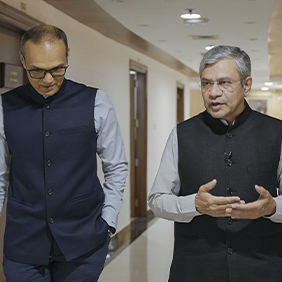
India is the world’s fifth-largest economy, and it’s building at a pace and scale that few countries have attempted simultaneously: new rail corridors, a nationwide 5G rollout, a fast-growing electronics export sector, and an ambitious push into AI and semi-conductors, all at once. One of the architects of this transformation is Ashwini Vaishnaw, India’s Minister for Railways, Electronics, and Information Technology. An engineer and former entrepreneur, Minister Vaishnaw oversees two of the country’s most consequential platforms: the rail network that moves billions of passengers and millions of tons of cargo every year and the digital infrastructure that underpins data, payments, and compute for a country of nearly of nearly 1.5 billion people. As Head of India Research and Chief India Equity Strategist, I was curious to learn more about what it takes to lead ambitious change in a country as large and diverse as India. So I sat down with Minister Vaishnaw in his offices in New Delhi to talk about what it takes to modernize a country’s physical and digital backbone and what this means for India’s continued development.
DESAI
It's great to have you here, Minister Vaishnaw, on Exceptional Leaders.
MINISTER VAISHNAW
Thank you, Ridham, for having me here.
DESAI
You have been at the helm of what I would consider as the world's largest scale transformation: Indian Railways. How did you do this? And that too, in such a short span of time?
MINISTER VAISHNAW
It is a very complex organization and a very large organization: 1.2 million employees, 135,000 km of railway track, 7.4 billion people traveling on the network. Very complex network. The biggest challenge that we faced was to understand how this organization operates and then find out where the constraints are, then making sure that the solution is accepted by the people, and then go forward. Everywhere we looked at, “What is the constraint? What are the problems?” Go down to the root of the problem. Solve for the root. Whether you have to make a change in the process, whether you have to make a change in technology, whether you have to make a change in the machines which are used, whether you have to make a change in the training: it's like going deep dive practically in every part of this huge, big organization.
DESAI
How critical is this transformation to India's manufacturing aspirations? And also on tech diffusion?
MINISTER VAISHNAW
Manufacturing competitiveness has logistics cost and logistics efficiency as a major element. And when we are improving the railway operations, this is directly impacting the cost of logistics and the efficiency of logistics. A decade ago, we used to carry just about 1,000 million tonnes of cargo. Today, we are carrying 1,670 million tonnes of cargo. This directly impacts the way industries operate. If the industries are located close to a railway terminal, then it becomes very easy for them to manufacture straight away, put it on the wagons, and ship it to the place they would like it to go.
DESAI
India now operates one of the largest rail freight networks and one of the largest 5G ecosystems in the world and has done both on an impressive timeline. The Minister makes the case that these aren’t separate initiatives but a single coordinated growth engine. The question now is whether India can extend that momentum into the next frontier: artificial intelligence.
DESAI
On the two foundational networks you run: rail and digital. At first sight, they seem very different from each other, but they do intersect.
MINISTER VAISHNAW
They look very different, but basically, they are part of that same growth strategy that India is following for the last decade. These two networks are basically increasing India's productivity, improving the efficiency in our economy, and third, they are making a big difference in people's lives. Railway: today, we are the second-largest goods career in the entire world. If we invest in this network, then it makes a huge difference in the growth. Second, it is bringing the logistics efficiency. Third, we can have affordable travel for our people.
If you look at this Vande Bharat Express: designed in India, made in India, semi-high-speed 180 km/h speed potential. We are able to provide this kind of service at 2.3 cents a kilometer. Go to China: it is about seven times. Go to Japan: it is about ten times this price. Go to Europe: it is about twenty times. So we are able to provide very good service at a very affordable price at the income level at which we are in our country today.
Same is the case of the digital network. We focused on making sure that 5G reaches every part of the country. Practically 90% of the country has 5G today: second-largest 5G ecosystem in the world. And look at the digital public infra, the payment system, the DigiLocker, the document management system: all these things have ensured that our people get the benefits of digital economy, which normally would have accrued only to the developed countries. So both sectors in that sense are very important for India's growth and very important for making a difference in people's lives. So that way they are interconnected.
DESAI
What is it that India is doing on AI? The world seems to have the view that India is falling behind. Would you agree, disagree, and how would you inform that view?
MINISTER VAISHNAW
Our biggest strength is in the applications layer. The biggest strength of our IT industry is to go into any enterprise, understand the enterprise, understand the operating system of the enterprise, and provide a solution based on that operating system. Almost 80% of the startups which are coming up now are basically providing AI-based solutions. The second layer in which we are playing well is the data center. We are one of those few countries which have more than half the power generation capacities from clean power: about 250 gigawatts is from renewable energy sources.
DESAI
A decade ago, mobile phones ranked168th on India’s export list. Today, they’re number one. That trajectory is now being applied to semiconductors, where India already accounts for 20% of the global chip design workforce. For investors watching supply chain diversification away from China, this is one of the most significant manufacturing stories in the emerging world.
DESAI
The success that we have had in electronics is unbelievable. Ten years ago, phones was 168th on our list of export items. It is now number one. What has driven this success, and is this the template for semiconductors for chips?
MINISTER VAISHNAW
We started electronics manufacturing in a very, very methodical way. We started with getting the finished products assembly in our ecosystem. Then we went to the module level, then we went to the submodule level, and now we are at the component level. So step-by-step, building this entire ecosystem. Because of this strategy, in a period of [the] last decade, we have been able to establish ourselves as an important electronics manufacturing destination.
The second big advantage that we have is the trust that the world has on India. We have a very strong copyright and IP right protection system. The third point is our capabilities in design. We are a country which is where our engineers are designing products for practically the entire world. That has given us the template which we are using in multiple sectors, for example, in the case of semiconductors. In the case of chip manufacturing, we focused a lot on the design capabilities, which where we are very strong already. Already 20% of the global design workforce is in India, so we decided to take it to a totally, totally next level. So we gave the best of the design tools to 318 universities now. The students are using Synopsys, Cadence, and so many other tools. These are the chips designed by students. Look at the names of the places: Kolkata, Surat, Jalandhar, Gwalior, Indore. Throughout the country, these chips are manufactured in a semiconductor laboratory. In that laboratory, the chips are manufactured, fabricated, and then they are assembled, and the final chip is tested so the students get to see the result of what they have designed.
DESAI
You have often said that we need to democratize technology. What does that exactly mean, and how is it informing India’s progress in technology?
MINISTER VAISHNAW
When we looked at the 5G rollout, we decided that we will not limit 5G to the big cities, but we will make sure that 5G goes out to the villages. So practically 90% of the country is today covered under 5G. When we created this DPI structure, the entire structure is built in a way that, let’s say, the payment system: it should not be monopoly of one or two companies. It should be any startup which wants to come up with a new solution. They must get the opportunity to prove their solution.
DESAI
The ground level input that the Minister’s office is capturing on these reforms is in service of a broader goal. 2047 marks the 100th anniversary of India’s independence, and the Indian government has made it the target date for what it calls Viksit Bharat, or Developed India, a national vision to transform the country into a fully developed economy.
DESAI
How do you see India’s transformation? How will it look like in 2047?
MINISTER VAISHNAW
We have taken a target of making our country as a developed nation, then converting that target into sector-specific goals, then looking at a short-term, medium-term, long-term strategy, then building those, that basic growth engine, which is built on the four pillars: investment in physical, digital and social infra, inclusive growth, focus on innovation, and manufacturing.
That kind of thinking and that kind of execution is helping us move consistently in our journey towards a developed nation. More than 250 million people have come out of extreme poverty in the last decade. That’s a huge achievement for the country. We will become leaders in some of the technologies that we have selected for us. We will have equal opportunities for a large section of this society. In 2047, we’ll be 37 years median age. We will still be a young country at 2047, when we will be about anywhere between $25 to $30 trillion economy, and we will have another 50 years of growth ahead of us because of our demography. So all these factors together, and the foundation that is being built today, will give us that growth path for the many decades going forward.
DESAI
It's fantastic. Okay, my final question. Are there any projects, either personal or professional, that you are going to tackle next?
MINISTER VAISHNAW
Developing the 350 km/h bullet train is on top of my agenda. So it is very important to have this entire technological base in our country.
And second, going to the seven nanometers from 28 nanometers. That's again going to be a very big challenge for the country because between seven nanometer and 19 nanometers, we will have practically maybe 85% of the entire volume of semiconductor chips. So making sure that that much capability of the country is developed in the next few years.
These two are the most complex ones which I am working on. On personal front, I am very focused on reducing my weight to 69 kilos. Be like you: fit always.
DESAI
Thank you, Minister Vaishnaw, for this really insightful conversation. It was great having you on the show.
MINISTER VAISHNAW
Same here. I thoroughly enjoyed the conversation, Ridham. Thank you so much for having me here. Thank you.
SCOTT KIRBY
Most people confuse management and leadership. If you can inspire 120,000 people with a vision, you can accomplish a whole lot more than if you’re going through a checklist every day.
RAVI SHANKER
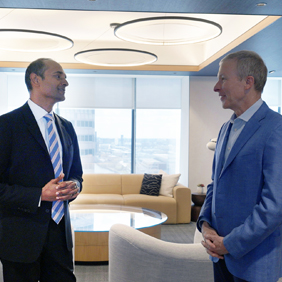
Since its inaugural flight a century ago, United Airlines has defined commercial air travel, with a history of firsts, spanning everything from the modern airliner and flight attendants to computerized flight planning. Today, United connects more people to more destinations than any carrier on the planet. But it isn’t just about growth; United is focused on improving the travel experience for all passengers. Behind this vision, CEO Scott Kirby has spent his career thinking differently about what it means to run and lead an airline. When the industry was impacted by Covid, United invested for growth and emerged stronger. Even as corporate boards began confronting deglobalization, Kirby leaned into international expansion. And now, as many leaders view AI as a way to cut headcount, Kirby sees technology as a way to improve human interactions, not replace them. As Morgan Stanley’s lead North American airlines analyst, I want to learn more about how Kirby makes decisions in an industry that faces constant uncertainty. So I traveled to United’s headquarters in Chicago, where I sat down with Kirby on the day United turned one hundred and got a close look at Kirby’s approach to leadership and discussed some Sambas.
RAVI
Thank you, Scott, for having me here today on the actual one hundredth anniversary of United. Congratulations.
SCOTT
Yeah, today’s the day: a hundred years.
RAVI
Happy birthday!
SCOTT
Thank you. And how do you like the shoes? Hundred-year anniversary Sambas.
RAVI
That is fantastic. You graduated from the Air Force Academy. Did you originally aspire to fly professionally? And what prompted you to go a different direction?
SCOTT
I went to the Air Force Academy intending to be a pilot and then an astronaut, and while there, you get to fly, and I was out in an F-4—dogfighting, aerial, broke the sound barrier-
RAVI
Wow.
SCOTT
-and at the end of it, the pilot told me to close my eyes and fly straight and level by feel, and I was at a 30-degree left bank and he said, “Use the instruments,” and I did, and I felt like I was going to fall out of the seat to the right, and he laughed at me and said, “You’re never going to be a fighter pilot. You’re going to be a cargo pilot.” And that moment, I decided, “I’m sure you’re right about the first one, but you are dead wrong about the second one.” So I didn’t go to pilot training.
RAVI
To the present day: you may not be a fighter pilot, but you operate in an environment of near-constant volatility. So how do you handle the daily realities of this environment we are in right now?
SCOTT
You’re trying to figure out on the fly what’s going to happen, trying to look over the horizon, trying to read extensively—I’ve done that my whole life, I read three hours a day on average—but I’m genuinely curious, and when you do that, you connect the dots I think that other people can’t connect and don’t see. I think this has happened a lot of times in my career: to try to see things earlier and how to take advantage of stuff when I have a view that is different than the consensus view.
RAVI
How do you carve out the space and time to think long term, with everything going on?
SCOTT
I’m really good at time management, and I don’t waste time: in my personal life, professional life, I’m not on social media—what a time suck—I don’t really watch TV, another time suck. But in business, less than four hours of meetings a day on my calendar is my rule. It gives you time to think, it gives you time to read, it gives me time to just call people and ask questions, but also, I have a great team. And I feel like if I am trying to micromanage, I’ve done something wrong.
RAVI
You’re known as a highly data-driven leader. So as data has become more pervasive, has your approach to leadership changed as well?
SCOTT
I don’t think it’s changed so much because of data—in fact, I probably use data less explicitly the further I go in my career. I could tell you pretty close what it’s been for the last thirty days; I know about the operation; I know what we’ve done; I know what each of the other airlines have done. But I really use that more to paint the palette of thinking about other bigger decisions. And I draw a big distinction between management and leadership.
Management is about compliance; it’s about running the checklist: how many people showed up for work on time. But leadership is different; it’s about inspiration and vision. And compliance is really important; you need people to do that. But leadership is more rare.
The further you move up anywhere in your career, the more your job indexes from management functions to leadership functions.
RAVI
Is that your leadership version? Did you have a mentor? How did you, kind of frame that?
SCOTT
I’ve learned a lot more from watching people make mistakes. And I’ve learned a lot, more of the positive examples, from reading: you know, Winston Churchill’s top of my list of heroes. You know, like, what would Winston Churchill do in a situation like this? Abraham Lincoln is another one. But I also learn from myself too, like mistakes that I’ve made, like you make a mistake like, “To thine own self be true,” what a great line. When you screw something up, like I don’t mind making a mistake; I hate making a mistake twice.
RAVI
What are the feedback systems that you have, to maybe see some of the things that you're not seeing?
SCOTT
You have to spend a lot of time out, talking with people. I have the easiest job of anyone at United because I have only really one responsibility: create a company that our employees are proud of. And so I look for that pride, and I spend a lot of time out in the operation, you know, I—every week I'm out, you know, either virtually or in person, talking to groups of new captains and talking to groups of new pursers at United, and you can tell if people feel proud of the company. People want to be on a winning team, and winning is contagious.
RAVI
Can you give us an example of an instance where the data pointed one way, but your gut or instinct kind of said there was something different?
SCOTT
Covid. You know, when Covid started, the data to me pointed to like, this is a global pandemic, and it was hard for me to understand why no one else knew it. We were just a couple weeks ahead of the globe-
RAVI
-you were the first.
SCOTT
-but, you know, we went off and raised two billion dollars at three percent interest two days before the NBA walked off the court and it would’ve been impossible, and we shrunk more than everyone else quickly. But then during Covid, the data got wrong. All the experts believed that air travel demand would never recover, and all the surveys—if you did surveys—people said they were never going to fly again.
And so, literally every global long-haul airline in the world, except United, permanently retired part of their global long haul wide-bodied fleet and shrunk. And we looked at that, and I said, “I think that’s just the wrong decision.” Instead, we did the biggest aircraft orders in history during Covid.
RAVI
If you were not the CEO, what job would you like to have and why would you be good at it?
SCOTT
The foundation of an airline is the route network. That is our asset. You have to learn the whole airline; you have to learn what makes it tick, what makes it work, what makes it profitable, what doesn’t work, what works operationally. You really have to learn the whole network to be good at route planning.
RAVI
Global expansion is obviously a major focus for United. You fly to 385 destinations globally. What are some of the unique challenges and opportunities?
SCOTT
Flying globally is—it’s what customers want, so that's the starting point. But it also creates unique challenges and opportunities. I mean, you know, we're just exposed to everything that happens anywhere in the world. You know, if there's war in the Middle East, you know, we're not just hit by fuel prices, we fly to those places. When the war in Ukraine started, we, you know, flew over Russia. Anytime something happens in the globe, we're exposed to it, but it's where our customers want.
When you’re an airline as large as United, it actually—to find new destinations, it means that we can’t just use data. We’re flying to places like Nuuk, Greenland, which no US airline has ever flown to. And so, you have to find other sources and other ideas and make bets on what will work. This summer, we’re starting two destinations in Spain and Portugal that are part of pilgrimages: where people fly into Lisbon and they walk two hundred miles to another destination. We’d seen a lot of one-way traffic in but not return traffic in and realized that, and it’s been booked up like crazy, so it’s done really well.
RAVI
What gives United an edge when it comes to recruiting pilots, flight attendants, or anybody else who wants to work for United, and kind of pass that culture through?
SCOTT
We really are at the top of the food chain for aviation and for industries at large. We're growing faster every year in absolute than any airline in history has done, which gives you lots of opportunities. And if you come to United, it feels like you're on the winning team. I just came from speaking to a group of new hires. We had people from all of the major airlines. A lot of them were talking about, “In my area, United is doing this, and you're the leader here.” And so they're all excited to come. People that come to United are usually coming for a career. We still create the kind of careers that used to be common in the United States. But, you know, a pilot, a mechanic, a gate agent, you know, can start here when they're twenty years old. And when they get to the top of the scale, and certainly with a little bit of overtime, they can make six digits; they have great benefits; you know, they can work for a lifetime. They can buy a house; they can send their kids to college. It's an important part of the fabric of America. And being able to create those kinds of careers, it’s—we're proud to do it.
RAVI
Just given the thought and effort you guys put into recruitment, kind of how does that translate into customer experience? Kind of that culture of United coming through?
SCOTT
What we've tried to do is actually hire people for attitude, instead of hiring for technical skills. We can train someone to be a flight attendant. We can train someone to be a gate agent. What we can't train is to be a people person that cares. So we try to hire people that have that attitude that are really our “people people.” I mean, we're in the business of connecting people and uniting the world.
RAVI
The premiumization of air travel is a major theme in the industry, kind of a big change versus the last decade. So how is United kind of building brand loyalty across all segments?
SCOTT
So I pushed back actually a little bit on the premiumization of the industry. It is happening, but I start by saying, “We're investing nose to tail for all customers.” And I think that actually the gap between our Economy and other airlines’ Economies is probably bigger even than the gap between Premium to Premium; there's a gap in both places. But, you know, with things like Starlink throughout the airplane, seatback entertainment throughout the airplane, the app—you know, we have the best technology of any airline in the world, the app. Anyone that uses it knows it. So we're really focused on creating products, technology service that all customers like. We have a lot of Premium demand, and we’re investing more heavily. You know, the latest 797, you know, I think is probably the best airplane flying in the Western world. The CRJ 450, you know, when you're flying to small cities, you know, it's like flying on a private airplane. It's the opposite trend of what most airlines do, and we took 18% of the seats off the airplane.
RAVI
So when it comes to innovation, kind of either on board or on the ground or offline, how do you come up with kind of innovative new ideas in terms of customer offerings?
SCOTT
I try to go by the philosophy that Henry Ford had and Steve Jobs had. Henry Ford said something along the lines of, “If you ask people what they want, they’d tell you, a faster horse.” And Steve Jobs famously eschewed any kind of consumer survey stuff because he wanted to invent something that they didn't know they wanted yet. Some of the things that we put in the app are not the kind of things that people ask questions about. You know, we put a scorecard in for frequent fliers last year: How many flights did you take? How many hours? How many miles did you fly? We’ve started putting the airport map, so you can see when you're on the ground where you have to taxi.
I want us to surprise and wow our customers every year with something new. So then they get on the airplane, they say, “I've never seen an airline do that; I never even thought of this before.” So we're trying to figure out what people will love, even if they haven't asked for it yet.
RAVI
You just added the TSA wait times to the app. I didn't know that was possible.
SCOTT
We've also added technology on the app that if you opt in, we’ll track you, so we can know to wait for you for connecting gates. We want to do things like deliver food to your gate, if you need a connecting flight and you want to be able to order food. But one of the other things is, it'll give real time waits, trying to get really real-time data to customers, and we're the only airline that’s doing it.
RAVI
Moving to the topic of AI. So how does AI improve how United operates? And what does that mean for your passengers?
SCOTT
It's a great tool. It's going to do a lot of things—it does do a lot of things—really well. But I do not think that the primary use case of AI is replacing the work that everyone does. And if that's the primary use case, like, it's for sure a bubble, because we're spending way too much for that. Too many people are getting dependent on AI, and like thing that people are using AI for is summarizing documents. Like, that seems to me to be the number one use case. I actually want to read the book. Because all the cool learnings are, you know, on page 312 in a little paragraph that there's some cool insight, and I think you're going to miss all that.
The cool thing about AI is the things that you can do that were impossible or impractical before. One of my favorite examples is, anytime there's a delay or cancellation, I want the team to pretend I'm on the airplane and I've called the network operating center: “Why is my flight delayed?” Whatever they would tell me, I want to tell customers 100% of the time. We're better at it than any other airline in the world, but we're not even into the game yet. We're still in the pre-game. [It’s] really hard to do without AI. It's also going to help us, I think, in our network operating center, when we’re deciding which flights—when stuff happens, you know, when weather hits and airports close, like it's one of those problems that has multiple tentacles that can last for days: crew and maintenance and all kinds of other implications. And they're all stochastic, like you know, you don't know for sure what's going to happen down the line.
RAVI
Scott, you mentioned that Covid was an instance where the data pointed one direction, but your instinct took another direction. What is that moment today?
SCOTT
Oh, oil prices and the war in Iran. From the time that MEU left Asia for the Middle East, I thought the forward curve was wrong. I thought oil was going to be higher for longer. And so we’ve been preparing for that at United. The experts that I talked to back then all told me: worst case, the Straits of Hormuz are open by the end of March. I think oil prices are going to be higher for longer. We at United are preparing for that. That's our base case planning assumption. I think there may be an opportunity to take advantage of it when our competitors are managing more by hope instead of reality.
RAVI
Scott, so when you eventually do step out of the CEO role, what do you hope people would say that you changed about United and the industry?
SCOTT
I want to have United to have launched a new era in aviation—what it means to be an airline. A lot of it's going to be technology—the technology that takes all of the uncertainty and stress of travel. Make travel fun. And my second one is to leave behind a CEO who's better than me.
RAVI
Well, we won’t be making that change anytime soon. Scott, thank you for joining us. It has been real fun.
SCOTT
Thank you.
RAVI
Appreciate it.
Sign up to get Morgan Stanley’s Five Ideas newsletter delivered weekly to your inbox.
Subscribed!
Thank you for subscribing to our blog newsletter. Stay tuned to hear about Morgan Stanley ideas!
The preceding content was informational only and is not an offer nor a solicitation to purchase or sell any security, commodity, instrument, or fund or to participate in any investment or trading strategy. The appropriateness of a particular investment or strategy will depend on an investor’s individual circumstances and objectives. Morgan Stanley does not render advice on legal or tax and tax accounting matters to clients. Clients should always consult their own legal or tax advisor for information concerning their individual situation.
Opinions expressed by third parties are solely their own. All opinions are subject to change without notice.
©2026 Morgan Stanley, all rights reserved.


