Exceptional Leaders: United Airlines CEO Scott Kirby
June 9, 2026
Watch, Listen and Subscribe:

June 9, 2026
Leading a global airline isn’t just about overseeing complex operations in an environment of near-constant volatility – it means having a vision. “If you can inspire 120,000 people with a vision, you can accomplish a whole lot more than if you're going through a checklist every day,” says United Airlines CEO Scott Kirby.
That mindset has defined some of United’s biggest decisions since Kirby took the helm in May of 2020. Today, the 100-year-old airline is expanding internationally, investing in technology that can enhance – not replace – human decision-making and seeking novel ways to improve the travel experience for all passengers.
In this episode of Exceptional Leaders, Morgan Stanley’s Lead North American Airlines analyst, Ravi Shanker, sits down with Kirby at United’s headquarters in Chicago to discuss what it means to head a global airline, why leadership—not management—defines success, and how United is investing in growth and innovation.
SCOTT KIRBY
Most people confuse management and leadership. If you can inspire 120,000 people with a vision, you can accomplish a whole lot more than if you’re going through a checklist every day.
RAVI SHANKER
Since its inaugural flight a century ago, United Airlines has defined commercial air travel, with a history of firsts, spanning everything from the modern airliner and flight attendants to computerized flight planning. Today, United connects more people to more destinations than any carrier on the planet. But it isn’t just about growth; United is focused on improving the travel experience for all passengers. Behind this vision, CEO Scott Kirby has spent his career thinking differently about what it means to run and lead an airline. When the industry was impacted by Covid, United invested for growth and emerged stronger. Even as corporate boards began confronting deglobalization, Kirby leaned into international expansion. And now, as many leaders view AI as a way to cut headcount, Kirby sees technology as a way to improve human interactions, not replace them. As Morgan Stanley’s lead North American airlines analyst, I want to learn more about how Kirby makes decisions in an industry that faces constant uncertainty. So I traveled to United’s headquarters in Chicago, where I sat down with Kirby on the day United turned one hundred and got a close look at Kirby’s approach to leadership and discussed some Sambas.
RAVI
Thank you, Scott, for having me here today on the actual one hundredth anniversary of United. Congratulations.
SCOTT
Yeah, today’s the day: a hundred years.
RAVI
Happy birthday!
SCOTT
Thank you. And how do you like the shoes? Hundred-year anniversary Sambas.
RAVI
That is fantastic. You graduated from the Air Force Academy. Did you originally aspire to fly professionally? And what prompted you to go a different direction?
SCOTT
I went to the Air Force Academy intending to be a pilot and then an astronaut, and while there, you get to fly, and I was out in an F-4—dogfighting, aerial, broke the sound barrier-
RAVI
Wow.
SCOTT
-and at the end of it, the pilot told me to close my eyes and fly straight and level by feel, and I was at a 30-degree left bank and he said, “Use the instruments,” and I did, and I felt like I was going to fall out of the seat to the right, and he laughed at me and said, “You’re never going to be a fighter pilot. You’re going to be a cargo pilot.” And that moment, I decided, “I’m sure you’re right about the first one, but you are dead wrong about the second one.” So I didn’t go to pilot training.
RAVI
To the present day: you may not be a fighter pilot, but you operate in an environment of near-constant volatility. So how do you handle the daily realities of this environment we are in right now?
SCOTT
You’re trying to figure out on the fly what’s going to happen, trying to look over the horizon, trying to read extensively—I’ve done that my whole life, I read three hours a day on average—but I’m genuinely curious, and when you do that, you connect the dots I think that other people can’t connect and don’t see. I think this has happened a lot of times in my career: to try to see things earlier and how to take advantage of stuff when I have a view that is different than the consensus view.
RAVI
How do you carve out the space and time to think long term, with everything going on?
SCOTT
I’m really good at time management, and I don’t waste time: in my personal life, professional life, I’m not on social media—what a time suck—I don’t really watch TV, another time suck. But in business, less than four hours of meetings a day on my calendar is my rule. It gives you time to think, it gives you time to read, it gives me time to just call people and ask questions, but also, I have a great team. And I feel like if I am trying to micromanage, I’ve done something wrong.
RAVI
You’re known as a highly data-driven leader. So as data has become more pervasive, has your approach to leadership changed as well?
SCOTT
I don’t think it’s changed so much because of data—in fact, I probably use data less explicitly the further I go in my career. I could tell you pretty close what it’s been for the last thirty days; I know about the operation; I know what we’ve done; I know what each of the other airlines have done. But I really use that more to paint the palette of thinking about other bigger decisions. And I draw a big distinction between management and leadership.
Management is about compliance; it’s about running the checklist: how many people showed up for work on time. But leadership is different; it’s about inspiration and vision. And compliance is really important; you need people to do that. But leadership is more rare.
The further you move up anywhere in your career, the more your job indexes from management functions to leadership functions.
RAVI
Is that your leadership version? Did you have a mentor? How did you, kind of frame that?
SCOTT
I’ve learned a lot more from watching people make mistakes. And I’ve learned a lot, more of the positive examples, from reading: you know, Winston Churchill’s top of my list of heroes. You know, like, what would Winston Churchill do in a situation like this? Abraham Lincoln is another one. But I also learn from myself too, like mistakes that I’ve made, like you make a mistake like, “To thine own self be true,” what a great line. When you screw something up, like I don’t mind making a mistake; I hate making a mistake twice.
RAVI
What are the feedback systems that you have, to maybe see some of the things that you're not seeing?
SCOTT
You have to spend a lot of time out, talking with people. I have the easiest job of anyone at United because I have only really one responsibility: create a company that our employees are proud of. And so I look for that pride, and I spend a lot of time out in the operation, you know, I—every week I'm out, you know, either virtually or in person, talking to groups of new captains and talking to groups of new pursers at United, and you can tell if people feel proud of the company. People want to be on a winning team, and winning is contagious.
RAVI
Can you give us an example of an instance where the data pointed one way, but your gut or instinct kind of said there was something different?
SCOTT
Covid. You know, when Covid started, the data to me pointed to like, this is a global pandemic, and it was hard for me to understand why no one else knew it. We were just a couple weeks ahead of the globe-
RAVI
-you were the first.
SCOTT
-but, you know, we went off and raised two billion dollars at three percent interest two days before the NBA walked off the court and it would’ve been impossible, and we shrunk more than everyone else quickly. But then during Covid, the data got wrong. All the experts believed that air travel demand would never recover, and all the surveys—if you did surveys—people said they were never going to fly again.
And so, literally every global long-haul airline in the world, except United, permanently retired part of their global long haul wide-bodied fleet and shrunk. And we looked at that, and I said, “I think that’s just the wrong decision.” Instead, we did the biggest aircraft orders in history during Covid.
RAVI
If you were not the CEO, what job would you like to have and why would you be good at it?
SCOTT
The foundation of an airline is the route network. That is our asset. You have to learn the whole airline; you have to learn what makes it tick, what makes it work, what makes it profitable, what doesn’t work, what works operationally. You really have to learn the whole network to be good at route planning.
RAVI
Global expansion is obviously a major focus for United. You fly to 385 destinations globally. What are some of the unique challenges and opportunities?
SCOTT
Flying globally is—it’s what customers want, so that's the starting point. But it also creates unique challenges and opportunities. I mean, you know, we're just exposed to everything that happens anywhere in the world. You know, if there's war in the Middle East, you know, we're not just hit by fuel prices, we fly to those places. When the war in Ukraine started, we, you know, flew over Russia. Anytime something happens in the globe, we're exposed to it, but it's where our customers want.
When you’re an airline as large as United, it actually—to find new destinations, it means that we can’t just use data. We’re flying to places like Nuuk, Greenland, which no US airline has ever flown to. And so, you have to find other sources and other ideas and make bets on what will work. This summer, we’re starting two destinations in Spain and Portugal that are part of pilgrimages: where people fly into Lisbon and they walk two hundred miles to another destination. We’d seen a lot of one-way traffic in but not return traffic in and realized that, and it’s been booked up like crazy, so it’s done really well.
RAVI
What gives United an edge when it comes to recruiting pilots, flight attendants, or anybody else who wants to work for United, and kind of pass that culture through?
SCOTT
We really are at the top of the food chain for aviation and for industries at large. We're growing faster every year in absolute than any airline in history has done, which gives you lots of opportunities. And if you come to United, it feels like you're on the winning team. I just came from speaking to a group of new hires. We had people from all of the major airlines. A lot of them were talking about, “In my area, United is doing this, and you're the leader here.” And so they're all excited to come. People that come to United are usually coming for a career. We still create the kind of careers that used to be common in the United States. But, you know, a pilot, a mechanic, a gate agent, you know, can start here when they're twenty years old. And when they get to the top of the scale, and certainly with a little bit of overtime, they can make six digits; they have great benefits; you know, they can work for a lifetime. They can buy a house; they can send their kids to college. It's an important part of the fabric of America. And being able to create those kinds of careers, it’s—we're proud to do it.
RAVI
Just given the thought and effort you guys put into recruitment, kind of how does that translate into customer experience? Kind of that culture of United coming through?
SCOTT
What we've tried to do is actually hire people for attitude, instead of hiring for technical skills. We can train someone to be a flight attendant. We can train someone to be a gate agent. What we can't train is to be a people person that cares. So we try to hire people that have that attitude that are really our “people people.” I mean, we're in the business of connecting people and uniting the world.
RAVI
The premiumization of air travel is a major theme in the industry, kind of a big change versus the last decade. So how is United kind of building brand loyalty across all segments?
SCOTT
So I pushed back actually a little bit on the premiumization of the industry. It is happening, but I start by saying, “We're investing nose to tail for all customers.” And I think that actually the gap between our Economy and other airlines’ Economies is probably bigger even than the gap between Premium to Premium; there's a gap in both places. But, you know, with things like Starlink throughout the airplane, seatback entertainment throughout the airplane, the app—you know, we have the best technology of any airline in the world, the app. Anyone that uses it knows it. So we're really focused on creating products, technology service that all customers like. We have a lot of Premium demand, and we’re investing more heavily. You know, the latest 797, you know, I think is probably the best airplane flying in the Western world. The CRJ 450, you know, when you're flying to small cities, you know, it's like flying on a private airplane. It's the opposite trend of what most airlines do, and we took 18% of the seats off the airplane.
RAVI
So when it comes to innovation, kind of either on board or on the ground or offline, how do you come up with kind of innovative new ideas in terms of customer offerings?
SCOTT
I try to go by the philosophy that Henry Ford had and Steve Jobs had. Henry Ford said something along the lines of, “If you ask people what they want, they’d tell you, a faster horse.” And Steve Jobs famously eschewed any kind of consumer survey stuff because he wanted to invent something that they didn't know they wanted yet. Some of the things that we put in the app are not the kind of things that people ask questions about. You know, we put a scorecard in for frequent fliers last year: How many flights did you take? How many hours? How many miles did you fly? We’ve started putting the airport map, so you can see when you're on the ground where you have to taxi.
I want us to surprise and wow our customers every year with something new. So then they get on the airplane, they say, “I've never seen an airline do that; I never even thought of this before.” So we're trying to figure out what people will love, even if they haven't asked for it yet.
RAVI
You just added the TSA wait times to the app. I didn't know that was possible.
SCOTT
We've also added technology on the app that if you opt in, we’ll track you, so we can know to wait for you for connecting gates. We want to do things like deliver food to your gate, if you need a connecting flight and you want to be able to order food. But one of the other things is, it'll give real time waits, trying to get really real-time data to customers, and we're the only airline that’s doing it.
RAVI
Moving to the topic of AI. So how does AI improve how United operates? And what does that mean for your passengers?
SCOTT
It's a great tool. It's going to do a lot of things—it does do a lot of things—really well. But I do not think that the primary use case of AI is replacing the work that everyone does. And if that's the primary use case, like, it's for sure a bubble, because we're spending way too much for that. Too many people are getting dependent on AI, and like thing that people are using AI for is summarizing documents. Like, that seems to me to be the number one use case. I actually want to read the book. Because all the cool learnings are, you know, on page 312 in a little paragraph that there's some cool insight, and I think you're going to miss all that.
The cool thing about AI is the things that you can do that were impossible or impractical before. One of my favorite examples is, anytime there's a delay or cancellation, I want the team to pretend I'm on the airplane and I've called the network operating center: “Why is my flight delayed?” Whatever they would tell me, I want to tell customers 100% of the time. We're better at it than any other airline in the world, but we're not even into the game yet. We're still in the pre-game. [It’s] really hard to do without AI. It's also going to help us, I think, in our network operating center, when we’re deciding which flights—when stuff happens, you know, when weather hits and airports close, like it's one of those problems that has multiple tentacles that can last for days: crew and maintenance and all kinds of other implications. And they're all stochastic, like you know, you don't know for sure what's going to happen down the line.
RAVI
Scott, you mentioned that Covid was an instance where the data pointed one direction, but your instinct took another direction. What is that moment today?
SCOTT
Oh, oil prices and the war in Iran. From the time that MEU left Asia for the Middle East, I thought the forward curve was wrong. I thought oil was going to be higher for longer. And so we’ve been preparing for that at United. The experts that I talked to back then all told me: worst case, the Straits of Hormuz are open by the end of March. I think oil prices are going to be higher for longer. We at United are preparing for that. That's our base case planning assumption. I think there may be an opportunity to take advantage of it when our competitors are managing more by hope instead of reality.
RAVI
Scott, so when you eventually do step out of the CEO role, what do you hope people would say that you changed about United and the industry?
SCOTT
I want to have United to have launched a new era in aviation—what it means to be an airline. A lot of it's going to be technology—the technology that takes all of the uncertainty and stress of travel. Make travel fun. And my second one is to leave behind a CEO who's better than me.
RAVI
Well, we won’t be making that change anytime soon. Scott, thank you for joining us. It has been real fun.
SCOTT
Thank you.
RAVI
Appreciate it.
In this engaging series from Morgan Stanley, experts from across the firm sit down with leaders at world-class companies for insightful conversations covering everything from leadership lessons to foundational changes in industries, markets and society.

JAMES QUINCEY
The future belongs to the discontented. Robert Woodruff wrote that in 1936 on the 50th anniversary of Coke. If we rest on our laurels. If we think the future is owed to us, it'll be a catastrophe. The people who are trying to think a little harder about how to satisfy the consumer needs is going to win.
V.O. (DARA MOHSENIAN)
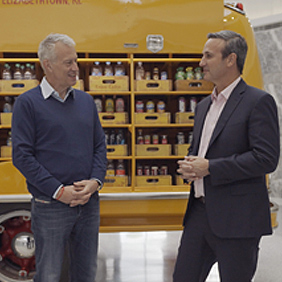
From its pharmacy beginnings in 1886, Coca-Cola has become more than just a beverage company. It's one of the most iconic brands of all time, simultaneously evoking nostalgia as well as optimism for a brighter future. Of course, enduring brands need visionary leaders. And that's where James Quincey comes in. Since stepping into Coke’s CEO role in 2017, Quincey has guided the company through a period of profound transformation, refocusing Coke as a total beverage company, flattening the corporate structure, and emboldening the organization to take smart risks. All while keeping up with ever evolving consumer tastes. As an analyst covering U.S. Beverages and Household Products, I've been closely following Quincy's career and was eager to meet with him ahead of his March 2026 retirement. So, I traveled to Coca-Cola's global headquarters in Atlanta, saw more than a century's worth of memorabilia, visited the vault holding Coke's original secret formula, and sat down for a fascinating conversation with Quincey about leadership, legacy, and the enduring power of an exceptional brand.
DARA MOHSENIAN
James, thank you so much for being here, this is an incredible opportunity. We're excited about it.
JAMES QUINCEY
Pleasure.
DARA MOHSENIAN
So, Coke has 30 separate billion-dollar brands. You've locked away the secret formula in your vault, which I saw this morning. But what's the secret to building billion-dollar brands in your mind?
JAMES QUINCEY
you need to have a sort of messianic belief in an idea. The brand, what it does, what problem it solves the consumer. If you don't have a messianic belief in it, you'll never go through all the hard things that are ahead on building a brand. And yet, on the other hand, it's very rarely right first time. You know, you can name zillions of companies, they came up with an idea. And then through three, four, five iterations, they ended up with something really, really good. And that's what they're famous for now, but they generally started as something else. And that's true of brands as well.
How do you manage the tension between believing in something and yet still being adaptable to the feedback from the consumer? And that's kind of key to creating these brands. I mean, you think about Coca-Cola, it's not the first formula we tried. Right, you know, John Poundland, he used to go down to the port of Savannah and buy different spices and ingredients and go back and mix them together. So, there was an iterative process there of coming up, not just with the brand, but with the product that typifies it. It's not all, it's not all science. There's definitely some art to it, too, and listening to the consumer.
DARA MOHSENIAN
At a consumer level. How do you really conceptualize what can work in a big way in this environment?
JAMES QUINCEY
in the end, you're trying to solve a problem for the consumer. They may not know they've got the problem. They're not answering it directly from the need. it's like, how do you solve the problems they've got with dealing with, all the people coming through the doors trying to buy beverages. And that's, you know, the advent of the fountain machine or the vending machine. Really, starting with the consumer. I think it's a great enduring lesson of the importance of understanding deeply what is the consumer really interested in?
DARA MOHSENIAN
Let's go back to 1996, when you joined Coca-Cola as an organization.
JAMES QUINCEY
Coca-Cola was a bit of iconography around, you know, the American dream or the dream of freedom and all those things. So, of course, it was kind of embedded in my mind. And, you know, I can remember playing squash with my dad and drinking a Coke afterwards. So again, everyone has an integration of the brand into their life. It was clearly a brand I loved and therefore - and there was this moment of serendipity - so I came in and joined the company. I thought, let's give it a try. Let's see what happens.
DARA MOHSENIAN
Talk about your leadership style and how it's evolved at Coke over time.
JAMES QUINCEY
I mean, I've been here almost 30 years. And, you know, you learn and mature. You learn from your own experiences. Like, ‘okay, this works. This doesn't work. That's not so smart. And let's do something better.’ You learn from seeing leaders you admire, and frankly, leaders you don't admire. Okay. Well, I'm not going to follow that example. And so there's been a natural process of learning and growing, and maturing over the 30 years and to some extent, you know, as you go up in the organization, you start off kind of very focused on getting stuff done. And it gets a little more conceptual as you get up to the top of the organization. But it's really been a steady process of learning and growing, which at the end, what does it require? It means it requires you to be open to getting the feedback, and incorporating new ideas and new ways of doing things.
DARA MOHSENIAN
Coke's truly a global beverage company. How does that impact the way you manage the company, your leadership, the global orientation?
JAMES QUINCEY
Well, firstly, I think that that experience, talks to the possibilities at Coke, which is you can go almost anywhere in the world and have different management experiences. And it demonstrates the globalness of the organization that you can be almost anywhere. But each of those experiences was different. And that talks to the localness of the business. You know, running Argentina is very different to running Mexico is different to running Europe. Each of these businesses in each of these countries has something very unique about it. You know, and I was the Argentine country manager in their crisis in 2001- 2002.
DARA MOHSENIAN
Fun times.
JAMES QUINCEY
Yeah, I arrived in the country - it was one of the most expensive places in the world. A few years later when I left, it was one of the cheapest. And, you know, everything can change overnight in some of these countries. The premium on agility, the willingness to reconsider everything from first principles, having a very broad view of the organization because all variables can come into play at any time. You need to be much more holistic, and much quicker, and much more willing, to change things on a dime. And also, the results can be much better on the way up. And they can be much worse on the way down. And then you go to a Europe where that generally is not true. Not all variables at play at the same time.
The difference between good and bad is a much smaller margin of error. It feels more institutional and set piece. But then of course it puts the premium or puts the intensity on the of the competition on those few variables that are in play at a much higher level than perhaps you would have in a Latin America or an emerging market. So, I think being able to learn each of those different experiences makes it much better as a platform to then try and run the global company.
DARA MOHSENIAN
Can you highlight the emerging markets opportunity you see over time?
JAMES QUINCEY
The simplest way, I think, to think about the global beverage market. And as we're talking beverages, think two bottles. You’ve got one bottle that's the developed economies. That's about 20% of the world's population. In that bottle people are paying for about 75% of what they drink each day.
So commercial beverages largely fills the bottle in the developed economies. Of course, that's made up of alcohol, nonalcoholic drinks, coffee, tea, etc., etc.. And our share is, you know, in the low teens of the total commercial beverages. We don't play in every piece, but it's a relatively low share of the total money. So, we got lots of opportunities to continue to gain share of the money that's being spent in the developed economies for the beverage share. But that's just the developed market, which is 20% of the world's population.
The other bottle actually represents largely the emerging markets. That's 80% of the world's population. And there they are only paying for two and a half of the drinks out of ten that they're consuming. And our share is, I think, high single digits. So, actually, the most important feature of the global beverage industry is it's yet to be created, is the empty emerging market bottle. As the industry leader, we can help grow. And obviously, we think we can gain share in both the developed and the emerging markets as we do.
DARA MOHSENIAN
When you came in as Coke’s CEO, you really refocused the company from primarily a soft drinks focus. And you talked a lot about making Coke a ‘total beverage company.’ Could you talk about the genesis behind that thinking and how you've evolved the company?
JAMES QUINCEY
People had realized we needed to be a broader beverage company before, and had tried to break out. But it was left at the intellectual level. And the culture basically ate the idea and stopped it. The company was very much culturally - Coke first, second and third without any opportunity. And every country gets to decide and they can keep changing everything.
Once you've got that, it’s very difficult to galvanize about a new idea that you need to move around. Because everything got relitigated. And everything got subsumed to Coke's. Actually, the insight in a way and the action was to resell the idea of a total beverage company in a compelling way, and bring with that a cultural change strategy that allowed it to then prosper and thrive within the evolved company.
DARA MOHSENIAN
Culture has been a huge focus for you at Coke. One of the seminal moments was when you showed up for the first analyst day in jeans.
JAMES QUINCEY
The jeans moment was, in a way, leveraging the simple idea that everything communicates. To say ‘things are going to be different’ because it was a very formal, hierarchical, but very formal organization. Here's the moment of change. It was reinforcing the idea ‘We’ve got to be different.’ And the culture had become very inward looking. It's a large organization. It became inward looking because things got very hard to do. So of course, you direct more energy internally. And we very much had to push the idea of a growth mindset, and understanding that everything we did communicated or reinforced that strategy. And the simple mechanism I used to give to people is ‘every time you do something that is coherent with what you said you wanted, you score a point. And every time you do something that's not coherent with what you said you wanted, you get minus ten.’ If you can't get into positive numbers, you’ve got zero chance of changing the culture.
DARA MOHSENIAN
AI seems to be transforming everything at this point. Where do you think it could be most impactful for Coke?
JAMES QUINCEY
in the long run, I think it's most interesting as a demand creation, consumer engagement, retailer engagement vehicle. In the short term, I think it's more likely to be productivity. That's where it's easier to see it's impact, whether it's the effectiveness with which you make the Christmas ad or some of the other things we've been doing, helping the salespeople be much more effective.
I think those sorts of examples, are the near-in ones, which are kind of easy to grasp. As it goes forward and as AI systems of Coke can talk to the AI systems at the retailer, can interact with the consumer's AI systems, then really it's about demand creation and competitive advantage.
DARA MOHSENIAN
You've had an incredible tenure as CEO over the last decade.
JAMES QUINCEY
Thank you.
DARA MOHSENIAN
How do you ensure the organization is positioned for success post your tenure?
JAMES QUINCEY
Actually, it starts on day one. It's one of those kind of weird experiences on being a CEO. You start and immediately begin the conversation of how to replace yourself. It's kind of, it's sort of unique in that way. And you do. That's what we and you know, the board and I have been doing ongoing all through my tenure is stewarding all the talent down through organization.
Think of it as a huge kind of funnel, if you like, giving people opportunities to grow, promoting the ones with the best and the most long-term potential, and constantly looking for a stream of successes to each job and ultimately successes to the CEO job. So, it’s been an ongoing process. You can't start the day before you want it. It has to be something both for the CEO and the organization that's an enduring and ongoing piece of the management development program.
DARA MOHSENIAN
Looking ahead, what's still on your agenda?
JAMES QUINCEY
I used to say something like, ‘well, hopefully there'll be nothing left to do,’ but that is a wildly naive thing to say because the reality is the world keeps changing. Consumers needs have an enduring part to them, but they also have, kind of, they come in new forms of manifestations. How and where you will engage with them has changed. So, if you just look at the journey of marketing over the hundred and four years of the Coke Company, it's gone from, you know, started with sampling, then it's got ads in newspapers, then it's got billboards, then it's got radio, then it's got TV, then it's got social media. Now we're kind of on the verge of the agentic agent. The consumer is still there with a need to drink liquids.
But how you engage is changed every time. So, really the challenge will always be, and it will be an enduring challenge, is how do you make the brands relevant to every generation of consumers? How and where do you make that happen? And that'll be an eternal job.
DARA MOHSENIAN
How do you think you'll be remembered as Coke’s CEO?
JAMES QUINCEY
I used to say, ‘I hope I'm not remembered.’ But I'm not sure that's a very good answer. I hope there's a degree of fondness and success and respect. But at the end, the important thing about history is that recent history should not be marshaled in service of the future.
JAMES QUINCEY
You know, I hope they forget me. Not because they didn't like me or they didn't think it was good what I did. But the future is so full of growth, has so many opportunities, and they're so successful that they're looking forward and not looking at the recent past.
DARA MOHSENIAN
Well as always, that was very informative. Thank you so much for being here.
JAMES QUINCEY
Thank you.
SIMEON GUTMAN (V.O.)
When Ed Stack took over Dick's Sporting Goods in 1984, his main objective was keeping the family business afloat.
ED STACK
We weren’t very well capitalized. Certain brands wouldn’t sell us at the time.
SIMEON GUTMAN (V.O.)
Today, Dick’s is the dominant player in sporting goods, with more than 850 stores across nearly every state in America. And it is one of the most innovative names in retail, connecting with customers through immersive experiences in the store, on the playing field, and digitally. Ed's vision.
ED STACK
To be the best sports company in the world.
SIMEON GUTMAN (V.O.)
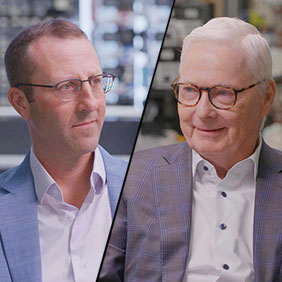
As an analyst covering hard lines in broadline retail, I wanted to learn more about how Ed, whose father founded Dick's in 1948, has led the company through pivotal periods, and how he's setting the pace for its future. So I traveled to Pittsburgh, where I met Ed at a House of Sport for a fascinating conversation and some friendly competition.
SIMEON GUTMAN
Ed, thank you so much for doing this. Good to see you.
ED STACK
Yeah, good to see you, too. Thanks.
SIMEON GUTMAN
Let's get into it.
ED STACK
Sure.
SIMEON GUTMAN
So what was your first job at Dick's, and growing up, did you imagine yourself joining the family business?
ED STACK
My father put me to work here when I was 13 because he was going to teach me responsibility. So I worked in the warehouse, and I was unloading trucks and sweeping floors. And when I was 15 years old, he put me on the sales floor, starting to wait on customers. I hated every minute of it. I wanted nothing to do with the family business. And when I went off to college, I never expected that I would come back.
As I was getting ready to get out of school, my dad got really sick, and I came back into the business. And, somewhere along the line, I fell in love with the business. And it's a love affair that's alive and well today.
SIMEON GUTMAN
So you took over Dick's in 1984. What were your aspirations back then?
ED STACK
To be honest with you, it was a small family business. We had two little stores in Binghamton, New York. And the vision was really merely: survive. You know, we really weren't very well capitalized. We had a line of credit from the bank that we had to clean up every single year for 30 days. And Adidas wouldn't sell us, Puma wouldn't sell us. And they were the two hot athletic brands at that time.
SIMEON GUTMAN
How has Dick’s become more intentional about culture, and how do you scale that across 850 plus stores?
ED STACK
Culture is difficult to define because you can't pick up and look at culture. You can't kind of put it in a box and distribute it out to the stores. It's something that's got to be learned through osmosis. It's got to be led through the values that the company has.
And one of the things that I think helped with our culture: the easiest thing to say when you're having a business conversation of a new idea is to say, “No, you know, no, that won't work.”
And we made a change, probably, I don't know, six, seven, eight years ago, and said, whenever there's an idea—we're having a meeting and somebody comes up with a new idea—nobody can lead with, “No, because.” Every comment after that has to be, “Yes, if. Yes, we could do that, if we can do this, this, and this.” And it's made a huge change.
SIMEON GUTMAN
So we're sitting in this House of Sport. For those that haven't experienced [it], how would you describe it? And then what is the return on the experience here?
ED STACK
If you see pictures of it or you try to describe it, it's very difficult. You have to get into the space to really understand it, because of the—not only the size of it, but the products that are here, the interactivity that's here. This has really been a journey that's ten years in the making.
As we did that, we designed it and we walked through it. I said, “It's not different enough from what we're doing today.” So we scrapped it, put it on hold, and came back about six years ago and started the project again.
The first one we did was roughly 100,000 square feet. There is a field right next to it: have kids come and practice. You can have events there. We've got 25 now, we'll have 35 by the end of the year, and by the end of ‘27, we'll have somewhere between 75 and 100. We couldn't be more excited about it.
SIMEON GUTMAN
In a retail industry that's struggling to get people to come to stores, here’s a category sporting goods and a physical box that people want to come to and experience.
ED STACK
If you're an athlete, this is the place you want to come to. If you talked to an analyst five, six, seven years ago, they would say, “I don't really know how many stores you have, but you have too many. And I don't really know how big your store is, but it's too big, because you should shrink your store and have less stores.”
And when people would ask me, you know, six, seven years ago, “In ten years, what will your footprint look like?” I would tell them, “I think we will have approximately the same amount of stores, but we'll have a lot more square footage.” They didn't particularly like that because they didn't understand what House of Sport was going to become. When Nike first came in to see the store, they said, “This is the best expression of sport anywhere in the world.”
In 2016, we thought there was a huge opportunity to be the ecosystem of youth sports. GameChanger has been just terrific.
SIMEON GUTMAN
It's grown into $100 million SaaS business with 9 million members. Did you always see it as a scalable platform, or did it evolve into something bigger than it is?
ED STACK
Every month we stream more baseball games—Little League games, high school games—than all the Major League Baseball games played since the beginning of time. We're doing this now with basketball. We're looking at soccer. Technology is an important part of our business. So we want to be involved with the customer, who we refer to as athletes. We want to be involved with the athletes and their entire journey, whether that's what they're doing from a research standpoint, what we can do from provid[ing] them suggestions on what they should buy or how they can get better, what we can do from a retail standpoint of the product, how we can interact with them. People love GameChanger. You know, the satisfaction level is extremely high. If you're a mom or dad and you're traveling for work, you can stream that game right on your phone. And that's why the business continues to grow at roughly 40% a year. And that's what we're really heading toward with this idea to be the best sports company in the world. We’ll be evolving more into a platform where you can research product, you can buy product, you can try product. GameChanger would be involved with sports throughout the entire journey. We continue to expand what this whole youth platform could be.
SIMEON GUTMAN
Youth sports participation has faced some headwinds in recent years. What do you see as the biggest barriers, and how is Dick's working to address it?
ED STACK
Sports and culture is at an intersection: it’s never been like this before. And that's happening all around the world. We're seeing our youth sports business on fire right now. Our baseball business has been great. Our soccer business has been great. The lacrosse business, basketball business. The World Cup is going to be the biggest sporting event this country has ever seen, and that's going to really help drive youth participation. What's going on in women's basketball right now? With Caitlin Clark and A’ja and Sabrina. Our number one selling basketball shoe is Sabrina's basketball shoe. Because boys are buying that shoe too. We run a camp every year for five and six-year-olds that they come and every day, they play a different sport. So we introduce them to basketball one day, golf another day, baseball, football. There's a groundswell of what's going on in youth sports participation, and I think we're right at the center of that.
SIMEON GUTMAN
The Foot Locker acquisition has raised some eyebrows. What's the rationale behind it? And what do you say to the skeptics?
ED STACK
Foot Locker gives us the opportunity to have a global presence, which we don't have today. It gives us an opportunity to engage with the consumer that we don't have today. And we've always talked about this, that we don't make investments from one quarter to the next. We make investments for a lifetime. And we think the Foot Locker acquisition is an investment for a lifetime. People are starting to understand that, starting to get that, and I think as we go forward and we get Foot Locker turned around, I think they'll look back and say, “That was a pretty good idea.”
SIMEON GUTMAN
Dick's made headlines in 2018 with its decision to remove firearms, a move that cost the company more than $250 million. Would you make the same call today?
ED STACK
Absolutely. You know, after Sandy Hook, we really started to look differently at how we sold firearms, how we marketed it, take a bit of a backseat. And then when Parkland happened, I was on Good Morning America with Stephanopoulos, and he asked me, “You know, will you ever put these guns back in the store?” And I said, “Never.” I just didn't want to be a part of that story any longer. We exited the high-capacity magazines, the assault style weapons. We wouldn't sell a firearm to anybody under 21 years old. And then a number of people were really upset with us, and it cost us well over a quarter of $1 million. We then said, “Okay, you know what? Let's just test if we take all firearms out.”
We looked at every store, what was selling, what would be best for that community, and the margin rates were so much lower in the firearms business. We only had to recoup 60% of the sales to have the same kind of earnings number. When we did this, the team did such a good job on this that we captured about 110% of the sales. So it was a huge win for the company. And yes, I’d do it exactly the same way again.
SIMEON GUTMAN
What do you hope your legacy will be? Not just at Dick's, but in how retail leaders think about culture, innovation, and impact?
ED STACK
I don't really think about the legacy that I'm trying to leave. I think about how the business will grow and survive going forward when I'm not involved any longer. When my dad was on his deathbed, and he'd been sick for a long time, I said, “If it's time to go, it's okay for you to go. And I know you worry about the business, but I promise I will take care of the business. We'll continue this business for generations to come and set it up to be able to do that.”
And so what I'd like my legacy to be is to be able to fulfill that promise I made to my father on the day he died. And I think we're in really good shape. And to be able to do that, you have to have the right people. And Lauren Hobart is absolutely the right person. I couldn't be more proud of the team. The legacy for our company and for me would be that this continues to go on for generations.
SIMEON GUTMAN
Well, it's been a pleasure to watch a retail leader take a business through all the phases of retail evolution. Thanks for doing this.
ED STACK
Simeon, thanks. That was great. Yeah, that's great. Let's walk around the store a little bit.
SIMEON GUTMAN
Yeah, I’d love it.
So this is what happens on the executive board?
ED STACK
[Laughs] Yeah.
Sign up to get Morgan Stanley’s Five Ideas newsletter delivered weekly to your inbox.
Subscribed!
Thank you for subscribing to our blog newsletter. Stay tuned to hear about Morgan Stanley ideas!
The proceeding preceding content is informational only and based on information available when created. It is not an offer or a solicitation nor is it tax or legal advice. It does not consider your financial circumstances and objectives and may not be suitable for you.
©2026 Morgan Stanley Smith Barney LLC. Member SIPC.


