Morgan Stanley Technology, Media and Telecom | Barcelona 20256

Morgan Stanley Technology, Media and Telecom | Barcelona 2026

Across technology, media and telecom, business models are being tested, infrastructure is being built and capital is being redirected. Who adapts? Who enables it? And can the investment cycle deliver measurable returns? These and other questions take center stage at Morgan Stanley's 26th annual European TMT Conference in Barcelona. Follow the ideas and debates, including AI adoption and monetization, AI infrastructure and data-center investment, productivity gains from AI deployment, telecom consolidation and European competitiveness.

Live from the Conference

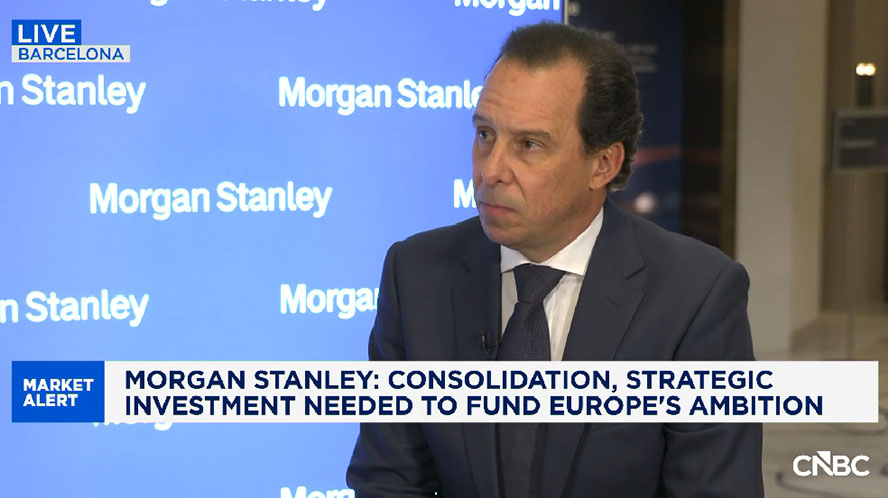
CNBC interviewer: Enrique Perez Hernandez, so thank you very much for joining.

Enrique: Thank you, Annette. Good morning.

CNBC interviewer: We were just saying, or Karen was just saying in the studio, that record ever biggest IPO Anthropic has succeeded. Do you think that's a sea change for sentiment?

Enrique: I mean, without commenting specifically on Anthropic, I think we've seen throughout the year very strong support for the development of AI infrastructure across equity and debt markets. And I think on the equity side, we've seen another large IPO getting priced earlier in the year.

Even if you look at the amount of equity being deployed by public markets against AI infrastructure, I think it's in the order of 360 billion year to date, even preceding this week's activity. So I think the direction of travel doesn't necessarily change with the events of this week.

I think AI is here to stay. It's not something that's just, there's real demand for it, which is probably what investors were trying to figure out over the last year, year and a half.

I think now there's also—the sentiment is shifting towards how do you think about returns? How do you think about, you know, cash generation on the back of all this infrastructure being deployed?

And that, I think, you know, comes with a degree of selectivity and discipline around how capital is getting deployed, not just on the equity side. I think the same applies on the debt side.

CNBC interviewer: Yeah, but there's much more funding need coming into the whole game, and we see more debt actually being used because the cash flow is not enough. And at the same time, like the regulators, like the ECB, is warning that it can actually be too much. So what's your view?

Enrique: We saw the news obviously overnight from the ECB report. I think there is real discipline, and I think we need to make a distinction around what CapEx is being funded as it relates to AI infrastructure.

The CapEx budgets are massive, no question. I think it's probably the biggest CapEx cycle we've seen in a long, long time, if not in history. But I think importantly, that is getting funded primarily by very large businesses with very well-established cash flows, with very strong balance sheets.

And importantly, most of the AI infrastructure funding on the debt side is getting raised against contracts with real revenue behind those contracts and backed by effectively investment-grade type businesses. So there's strong financial backing, if you will, to the debt that's being raised. And it's also being, you know, diversified across a number of players, very large players.

I think, you know, as we look forward, we do expect the market to remain disciplined, and, you know, it'll be harder to finance more speculative investments. But I think where you have real strong balance sheets with cash flows, it'll be easier to do.

CNBC interviewer: Just one quick question again on those business models. What is a business model that is good for you? Kind of where do you look at?

Enrique: I think what's proven out so far is AI—I mean, you obviously need to build out the AI infrastructure to have the compute, and then it's all about how that gets deployed from an application perspective.

And the businesses we expect to be most active in deploying AI are those who are sitting on proprietary data, which they can use to fuel and kind of educate the models and develop very specific, more verticalized type applications.

These are companies which are providing solutions that, you know, help automate workflows, particularly more complex business processes. And those are the sort of characteristics we're seeing in terms of where AI is getting adopted at scale and producing already, you know, positive returns, which is going to make, you know, all these investments viable into the long term.

CNBC interviewer: Yeah. We also need to talk about consolidation, I assume, because obviously bigger players have it much easier in that space. So especially in Europe, we still see quite a fragmentation. Do you think there'll be more consolidation, M&A, in the new year?

Enrique: I would say yes. We've seen M&A more broadly grow this year versus last year. I think we're already at close to 450 billion dollars of M&A volume in tech, which is already in excess of what we saw in '25.

A meaningful part of that has been driven by AI. We've seen some of the larger players making very large investments, and we're increasingly now seeing more consolidation amongst similar-sized businesses, where maybe they're looking for certain AI capabilities.

Scale does matter in today's world. You know, technology is becoming more capital intensive on a relative basis, and therefore scale, I think, does matter, and it will be a driver of further consolidation.

CNBC interviewer: Yeah, especially in Europe where we have that whole debate about European sovereignty. Do you think that's just a lip service because in the end we can't be sovereign in the tech world?

Enrique: No, I think—listen, sovereignty is a very hot topic. It's here at the conference. We're hearing about it every day. Almost every corporate is talking about it. I think there is real focus both at the corporate and the political level.

We're seeing progress. You know, you saw recently the European Scale-Up Fund being launched. I think there are a number of initiatives to try and support further that sovereignty.

It does come down a little bit to how you define sovereignty. Are you going to have, you know, all these projects scale up exclusively with European capital? No. Capital is actually very global in nature, and we see a lot of US capital flowing into Europe. I think that's a good thing.

I think what we do have to drive that sovereignty is the quality of innovation "and" entrepreneurship in Europe. You know, we've seen a number of businesses succeed and frankly, you know, be able to compete head-to-head with American companies, or for that matter, even Chinese companies in the world of AI.

CNBC interviewer: Yeah. I'd love to talk more about that with you, but we need to wrap it here. Well, thank you so much.

Enrique: Thank you very much. Thank you, Annette.

CNBC interviewer: Guys, with that, back over to you.


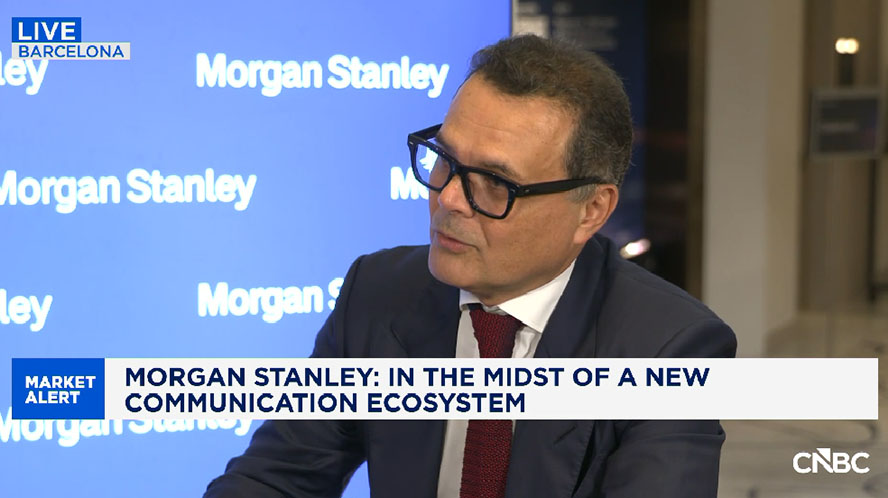
CNBC interviewer: Jean Abergel, who is global co-head of media and communications here at Morgan Stanley. So we're just saying that I don't know where to start because there are so many topics which are actually in your remit, but perhaps we start with the traditional telecoms, because clearly with all that satellite investment, how do you think will they get disrupted throughout that rollout?

Jean: Good morning, Annette. Thanks for having me.

So we have two big themes in telecoms. One of them is, as you said, satellite and D2C, and the other one is consolidation.

With respect to satellite, it's true that satellite is today part of the telecoms value chain. If you remember in the old days, satellite network used to be the network of last resort for ships and rural areas, remote areas. But today, it's part of the core network.

And what I mean there is with the low orbit broadband and D2C that connects directly a handset to a satellite, it's part of the mobile service.

This is not to say that satellite is going to replace terrestrial networks. What it does, in fact, it redefines what good communications means at the edge of the network and who owns the customer at that level.

The other big trend, of course, is about consolidation. I think we have to keep on repeating that the telecoms industry is an extremely capital-intensive industry. Globally, every year, telecoms operators spend around 300 billion dollars in their network. And generally, over the last 20 years, the returns have struggled to match the cost of capital of those companies.

And therefore, the consolidation is a key topic in the boardroom. It's really about efficiency, squeezing more out of every kilometer of fiber, every mast, and generally every dollar or euro that's invested in those networks.

CNBC interviewer: Yeah. How does the whole investment need for the AI buildup is playing into that mix?

Jean: Well, definitely, the telecoms infrastructure is part of the digital and AI infrastructure. And we've seen on fiber—fiber is a very important part of that value chain. And what we've seen in Europe, in many markets, too many fiber networks have been built.

And today, in order for those networks to earn their cost of capital, they're going to have to consolidate. That will also enable them to put in place a capital structure that will be sustainable for the long run.

I know you spoke a lot about data centers with Enrique, so I won't repeat what he said.

CNBC interviewer: Yeah, that's true. I mean, we spoke a lot about AI and data centers, and I'd like to talk a bit more with you about as well space and the satellite network, because clearly Europe has been actually waking up to the fact that they don't really have a proper network. So how is that buildup going, and do you also see more consolidation in that space?

Jean: It's a great question, and it's true that for government, satellites have become strategic infrastructure. So there is a question of sovereignty there.

Look, if you step back, Europe has everything it needs to have its own solution. It has spectrum, it has regulatory will, it has large operators, it has large manufacturers. What it needs maybe is the speed of an integrated player.

So you might see some M&A there, but you might also see joint ventures, partnerships, hybrid solutions where local players, with the control of spectrum and ground infrastructure, partner with the constellations.

I would also note that operators have pooled their resources. I'm sure you saw that Deutsche Telekom, Orange, Telefonica, and Vodafone have announced an MOU to jointly bid for satellite spectrum when it comes for sale.

CNBC interviewer: Yeah. But do you think that the public sphere is investing enough in that space? Because clearly, I mean, there are quite a lot of smaller companies as well who, like Isar Aerospace, for example, but they still need scaling up capital.

Jean: Yeah. And those, you know, those companies are attracting private capital. Isar has raised a lot of private capital. And also those large telecom companies and large manufacturers that I mentioned also have the balance sheet and the access to capital to finance those projects.

CNBC interviewer: Yeah, we need to talk about media as well. So you are saying that there are some assets which are actually resilient to AI and others who are getting badly disrupted. So perhaps you can tell us which is actually winning and which not.

Jean: Absolutely. So AI is really redistributing value across the chain. But, in fact, it's quite simple. The businesses that have rerated thanks to AI are the businesses that rely on things that can't be replicated by AI.

So for instance, scarce physical assets, live experiences, businesses that operate in a regulated environment, businesses that have their own proprietary data, businesses that have strong customer relationships. All those businesses have rerated.

Well, you know the prices that are being paid for sports team, right, in the US and in Europe.

Take B2B events, for instance. This conference, we have 550 investors. We have 400 corporate clients over three days. The amount of knowledge, the amount of human interaction that's happening over three days in this building, thousands of one-on-ones, AI cannot replicate this, right?

We can talk about K-12 and certifications, regulated environment. So those businesses are quite insulated, and they actually benefit from AI because AI makes them more efficient.

Now, there are other businesses that are being challenged, at least in the minds of investors. There are some questions on sustainability of long-term margin and growth, but we haven't seen those pressures in the financials.

Take classifieds, for instance. The classified space has derated quite significantly over the last couple of years. But look, we see that they are still generating very strong cash flows. They're still generating growth.

And why is that? It's because they own strong inventory. They have strong customer relationships and have access to the data. So here the question is, you know, long-term expectations versus, you know, those companies still delivering in the short term.

CNBC interviewer: Well, thank you so much for your insight and your time, Jean Abergel.

Jean: Thank you, Annette.

CNBC interviewer: With that, guys, I'm sending it back over to you, and that wraps our coverage here in Barcelona at the Morgan Stanley conference. 

Thoughts on the Market

Get our experts’ perspectives on the forces shaping markets on Morgan Stanley’s daily podcast, with our latest episodes on technology, media and telecom.

Finding Opportunity in AI’s Evolution
Europe's AI Moment
Recorded live at Morgan Stanley's European Tech, Media and Telecom Conference in Barcelona, our analysts discuss data center rollout, Europe's push for sovereign AI, the rise of agentic AI and the race for power efficiency.