Can AI Learn to Fly?
E4
•
October 12, 2026

E4 • October 12, 2026
The robotics revolution is not confined to the ground. See how and where drones and autonomous air systems are creating new opportunities across infrastructure, agriculture, logistics and defense, and discover the technologies, regulations and market signals investors should be watching.
Adam Jonas: In 1903, two brothers from Dayton, Ohio, achieved first flight over the sand dunes of Kitty Hawk, North Carolina. Just 8 years later, aircraft are being used in battle in the Italo-Turkish War. By 1914, we have the first commercial airline flights from St. Petersburg to Tampa.
Fast forward to 1967, the Boeing 737 was first introduced into service. Nearly 60 years later, we have a plane so similar in design and function they didn't even bother changing the name.
Next time you're flying in an airplane on a clear day, take a look down at the Earth. Look how much of our planet's surface area is devoted to vehicle transport. If AI can drive thousands of times better than humans in two dimensions in the pedestrian-filled chaos of our cities, navigating in three dimensions is a walk in the park.
We estimate electric low-altitude aviation can eventually surpass the size of the global car market. One eVTOL can generate as much revenue as 15 Ubers. Advances in e-motors, energy storage, material science, communication, and AI and compute will make flying cars ubiquitous and take stress off the surface of our planet.
Are you near a window? If so, look up at the sky. No, seriously, I want you to actually look up at the sky. Do you see any aircraft? How many? One or two? Zero.
From the ground, a 6-ft tall observer can see nearly 30 square miles of sky in a 360° radius unobstructed. There are approximately 14,000 commercial aircraft in the sky globally at any one time. Assuming 200 passengers per aircraft, that would imply 2.8 million airborne travelers simultaneously at one time. 2.8 million people is equal to the metropolitan area of St. Louis.
It's been 122 years since Kitty Hawk. The low-altitude economy is practically empty, and it's all about to change.
Elon Musk recently tweeted that China makes more drones in a day than the United States makes in a year. All future wars will be fought with drones. Let that sink in. All future wars will be fought with drones. Not only drones, but therewill be drones.
With conventional technology, it takes a hundred people to operate one $30 million drone. With AI, one person can operate a hundred drones. Redundant, resilient, if necessary, attritable, working as a team, and an autonomous swarm. Asymmetric capability that may call into question the very nature of defense budgets around the world.
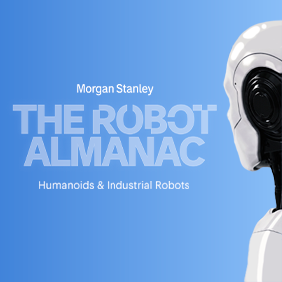
Volume four of the Morgan Stanley Global Robot Almanac shares insights across a number of consequential topics as we enter this new chapter of the low-altitude economy.
Unmanned aircraft aren't exactly new, but AI-enabled systems are significantly expanding the use case. AI is moving the technology from consumer to commercial to a host of military missions. Drones are proving to be a game-changer in recent campaigns, and we're paying attention to some new takes on the theme that may challenge conventional military planning.
China currently dominates, with DJI holding a 70% share of the global drone market. China also holds pole position in drone component supply that will take many years to disentangle and diversify. Moreover, China is nurturing a culture that celebrates innovation in key dual-purpose technologies, including drones, across its population.
This has not escaped the attention of the US government, with recent efforts from the Department of War to encourage development in domestic drone capability with a substantial increase in targeted acquisition.
Beyond military applications, drones are used across a range of industries, including mapping and inspection, agriculture, and delivery. In our Global Robot Model, we forecast a logarithmic growth of drone deliveries to 130 million units by 2030, 900 million units by 2040, and 2 billion drones by 2050, driven mainly by consumer, commercial, and transport logistics.
The Almanac also includes insights on urban air mobility, eVTOLs, supersonics, hypersonics, and exoatmospheric point-to-point transport that could take you from Florida to New Zealand in 45 minutes.
Importantly, the Almanac addresses the many impediments to the development of the low-altitude economy, spanning from the technological and regulatory that gate our forecast of large eVTOL volume grinding at an excruciatingly low volume before reaching 2.5 million units by 2040 and 17 million units by 2050.
These gating factors include grasping the complexity of the nation's multi-layered air traffic control system and its accompanying departmental and bureaucratic apparatus. Our air traffic control systems have been in use for the better part of a century, and many of these legacy technologies are still in use today, contributing to a growing consensus that the system needs a major overhaul.
The Morgan Stanley embodied AI team continues to identify a range of expressions across small drone enablers, including manufacturing, autonomy, delivery and logistics, and components. Within larger aerial vehicles, we discuss expressions across eVTOLs and e-planes, super and hypersonics, point-to-point space, and critical suppliers.
The Morgan Stanley Global Robot Team is here to help you navigate your journey of AI-enabled aviation across altitudes and missions.
The robots are coming. Stay human.

Follow AI's move from software into the physical world, one episode at a time. The Robot Almanac is a multi-part video series that breaks down robotics, embodied AI, automation and the technologies powering their evolution. Drawing from Morgan Stanley Research, each concise episode helps investors identify the trends, risks and opportunities that may shape the next era of global economic growth.

Adam Jones: Robots have been around for a while. General Motors first introduced industrial robots in a body shop ina New Jersey factory back in 1961. Yes, once upon a time cars were made in New Jersey. In the first century AD, Hero of Alexandria described robotics in great detail in his book, “Automata,” around the same time he invented the steam engine.
Pre-AI, robots executed highly predictable and repeatable tasks with limited use cases, a lack of awareness and adaptability. Post-AI, robots are on a path to execute more diverse and open-ended tasks, enabling these electromechanical wonders to escape from the factory and proliferate throughout the physical world, becoming part of our daily lives.
In Volume 2 of the Morgan Stanley Robot Almanac, we go deeper into AI-enabled robots, showing you the difference between a Foundational Model and a World Model, and the exquisite interrelationships between the two. We show you the difference between Large Language Models and Vision Language Action Models to help understand the value of historic data, or “priors,” versus the value of arising data, or “context,” continuously improving the predictive decision-making of your robot.
The multiple ways that robots learn through teleoperation, simulation, and two- or three-dimensional videos. And how video game engines play a potentially critical role in narrowing the sim-to-real gap for robotics.
Nvidia enables robots through three critical compute domains spanning data center, simulation, and inference at the edge. Tesla, a robot company, is building a distributed inference cloud that interconnects its cars and humanoids into a giant mobile, swarming, intelligent data center. An extraordinary wide range of firms are trying to capture real-world data to train robot models across thousands of use cases.
In the near future, your face and upper body will be increasingly adorned with a range of sensors. We expect the number of Meta Glasses in use will double the number of Teslas on the road in just a few years, using millions of exaflops of edge compute by 2050.
Is it any wonder that robotics are attracting an enormous acceleration of venture funding over the past two years? Our Robot Almanac tracks hundreds of public and private companies driving the birth of this
new Industrial Revolution, including deeper dives into key foundational model players such as Google DeepMind, Meta, Apple, Physical Intelligence, and Skilled AI.
Competition for AI supremacy between China and the United States is a powerful force vector of innovation. And while the U.S. may have an apparent lead in AI compute and AI models, China is in a dead sprint on the physical side, rapidly converting conventional manufacturing processes to make AI-enabled robots at high volumes, installing more industrial robots than all other countries combined.
China will soon lead the world in robot density, if they haven’t already. China is prioritizing scientific education over its chief economic rivals, continuing a pattern where the United States invents a novel
technology only for China to scale it to broad adoption and economic dominance. In 2024, China installed 1.5 times the solar capacity of the entire existing installed base of the United States. Let that sink in.
But while the United States needs China for rare earth magnets, China needs the United States for its insatiable consumer and bleeding-edge AI technologies, keeping the rivalry in a rather delicate, if at times precarious, balance.
Rare earths. Some of the names of the metals may be hard to pronounce, but they’re even harder to live without. The use cases? Let’s start with every physical sector: autos, A&D, robots, boats, C.E., energy, healthcare. Basically, everything that moves.
And guess who controls around 60% of the world’s rare earth mining? And that’s just the mining. Who refines over 90% of the world’s rare earth metals? And you better get used to it because it takes about two decades to spool up a new rare earth mine. Our Global Robot Model, or GRoM, estimates the rare earth magnet content across all key categories of robots, projecting 1.7 megatonnes of magnets by 2050.
In 1995, astronomer and planetary scientist Carl Sagan made a disturbing prophecy in his book, “The Demon-Haunted World,” about a future United States where nearly all of its manufacturing industries slipped away to other countries, leading to adverse geopolitical and societal outcomes.
Well, we may not be there quite yet, but judging by the last 80 years of U.S. manufacturing slipping from 28% of GDP to less than 10% of GDP today suggests we’re well on our way. The intersection of AI and the physical economy offers the chance to disprove Sagan’s prophecy, and we’re all part of the story, however it ends up.
The robots are coming. Stay human.

Adam Jonas: In 1921, Czech playwright Karel Čapek published R.U.R., a futuristic story where human-shaped machines did all the world’s work. Life was wonderfully abundant until the machines started to make certain demands. It’s the first time the word “robot” was ever introduced to popular culture.
People have been trying to make human-shaped robots for centuries, with more intelligent attempts in the late 20th century. What’s changed today is that we are witnessing the intersection of generative AI and robotics working together, where data and compute accelerate a robot’s ability to learn, enabling more advanced manipulation and perception of the real world and feeding the AI flywheel in a recursive loop.
Humanoid development is driven by the collision of two powerful and orthogonal forces: labor shortage and AI, accelerating societal adoption and economic paybacks.
What’s the addressable market for humanoids? Well, we’ve got four billion workers in the global labor market at an annual average wage of $10,000, driving a $40 trillion global TAM. Humanoids may be particularly useful for boring, dangerous, and repetitive tasks that require a range of flexibility.
We estimate the global installed population of humanoids will exceed one billion units by 2050, driven largely by Asia.
Our Almanac outlines the trade-offs between specialized robots and humanoids, and the differences between LLMs that train on internet data and humanoid foundation models that train on real-world data from physical environments.
Manufacturing of the robot probe cannot be separated from the data collection of the probe. You need to make the probe to collect the data, to improve the probe, to collect more data, to improve the probe. I think you get the idea here.
Data defines the software. Software defines the hardware. Hardware defines the manufacturing.
A recurring theme in our Robot Almanac is the dominance of China over the rest of the world. Humanoids are no exception. We’re following over a dozen Chinese firms that have unveiled robots to date. There may be over a thousand firms below the surface in China.
Our team’s tracking of patents suggests an increase in humanoid development and a total domination of patent filings in China versus all other countries.
Beijing has made humanoids a national security priority for the PRC in the country’s 15th Five-Year Plan, unveiled this year. These efforts address a host of national security risks, including China’s unique demographic challenges.
China is nurturing a culture that celebrates robotic competition, showcasing the ever-improving speed, strength, and agility of the humanoid form factor. China’s mature and vertically integrated auto industry is aggressively testing, developing, or manufacturing its own humanoid robots.
The Trump administration has acknowledged the strategic importance of establishing a redundant domestic supply of humanoid robots, while major U.S. technology firms are entering the arena directly or as enabling partners.
Our Robot Almanac draws intriguing comparisons between human biology and humanoid morphology, including joints, metabolism, the nervous system, sensory capability, and skeletal structure.
Our proprietary robot model explodes the humanoid into its component parts, including motors, reducers, screws, bearings, vision systems, chips, and other sensors. Our Robot Team has applied values to these components that help inform our identification of key stock exposures.
Working closely with our China Robots Team, the Almanac pays close attention to humanoid component suppliers across actuators, as well as tracking key sensor content across a range of humanoid companies.
Morgan Stanley’s Global Semis Team is highly focused on the humanoid theme due to a wide range of inference compute, control, sensing, power management, and charging requirements driving the semiconductor bill-of-materials assumptions in our Global Robot Model and supporting our humanoid semiconductor stock expressions.
With respect to economics, one humanoid leased at $5 an hour can replace two human workers making $25 an hour, supporting an NPV of approximately $200,000 per humanoid.
Humanoid robots seem to have captured the attention of private equity, with more than a doubling of global venture funding for the theme in 2025, following nearly a tripling of funding the year before.
The Morgan Stanley Global Robot Team is carefully tracking a range of humanoid robot efforts in both public and private markets globally.
On the public side, Morgan Stanley continues to curate and maintain the Humanoid 100, a global mapping of equities across a range of sectors and regions that may have an important role in bringing robots from the lab to your living room.
We divide the robot into the brain, body, and integrators: semiconductors, sensors, batteries, actuators, encoders, harmonic reducers, screws, bearings, connectors, and rare earths.
These include each of the Magnificent Seven, Palantir, Timken, Harmonic Drive, Hexagon, Regal Rexnord, Aptiv, Mobileye, NSK, SKF, STMicro, Samsung, Xiaomi, CATL, JL Mag, MP Materials, and many more.
We look forward to an exciting year of scientific innovation and capital formation as we follow the next chapters in the autonomous Industrial Revolution.
The robots are coming.
Stay human.
Sign up to get Morgan Stanley’s Five Ideas newsletter delivered weekly to your inbox.
Subscribed!
Thank you for subscribing to our blog newsletter. Stay tuned to hear about Morgan Stanley ideas!
This material has been prepared for informational purposes only. It does not provide individually tailored investment advice. It has been prepared without regard to the individual financial circumstances and objectives of persons who receive it. Morgan Stanley Smith Barney LLC (“Morgan Stanley”) recommends that investors independently evaluate particular investments and strategies, and encourages investors to seek the advice of a Financial Advisor. The appropriateness of a particular investment or strategy will depend on an investor’s individual circumstances and objectives.
Information contained herein is based on data from multiple sources considered to be reliable and Morgan Stanley Smith Barney LLC (“Morgan Stanley”) makes no representation as to the accuracy or completeness of data from sources outside of Morgan Stanley.
Morgan Stanley Smith Barney LLC is not implying an affiliation, sponsorship, endorsement with/of the third party or that any monitoring is being done by Morgan Stanley Smith Barney LLC (“Morgan Stanley”) of any information contained within the website. Morgan Stanley is not responsible for the information contained on the third party website or the use of or inability to use such site. Nor do we guarantee their accuracy or completeness.
Artificial intelligence (AI) is subject to limitations, and you should be aware that any output from an IA-supported tool or service made available by the Firm for your use is subject to such limitations, including but not limited to inaccuracy, incompleteness, or embedded bias. You should always verify the results of any AI-generated output.
Important disclosures regarding the relationship between the companies that are the subject of Morgan Stanley Research and Morgan Stanley Smith Barney LLC or Morgan Stanley or any of their affiliates, are available on the Morgan Stanley Wealth Management disclosure website at www.morganstanley.com/online/researchdisclosures. For Morgan Stanley specific disclosures, you may refer to www.morganstanley.com/researchdisclosures.
NOTICE: Morgan Stanley is not acting as a municipal advisor and the opinions or views contained herein are not intended to be, and do not constitute, advice within the meaning of Section 975 of the Dodd-Frank Wall Street Reform and Consumer Protection Act. If you have received this communication in error, please destroy all electronic and paper copies and notify the sender immediately. Mistransmission is not intended to waive confidentiality or privilege. Morgan Stanley reserves the right, to the extent permitted under applicable law, to monitor electronic communications. This message is subject to terms available at the following link: https://www.morganstanley.com/disclaimers. If you cannot access these links, please notify us by reply message and we will send the contents to you. By communicating with Morgan Stanley you acknowledge that you have read, understand and consent, (where applicable), to the foregoing and the Morgan Stanley General Disclaimers. Please see our Privacy Pledge for details about how Morgan Stanley handles personal information. If you would like to update your email preferences or unsubscribe from marketing emails from Morgan Stanley Wealth Management, you may do so here. Please note, you will still receive service emails from Morgan Stanley Wealth Management.
Morgan Stanley, its affiliates and Morgan Stanley Financial Advisors do not provide tax or legal advice. Clients should consult their tax advisor for matters involving taxation and tax planning.
Not all products and services may be available to persons living outside of the United States. Morgan Stanley Wealth Management 2000 Westchester Avenue, Purchase, NY 10577-2530 USA
Morgan Stanley Wealth Management is a business of Morgan Stanley Smith Barney LLC.
©2026 Morgan Stanley Smith Barney LLC. Member SIPC.
CRC# 6003843 (10/2026)


