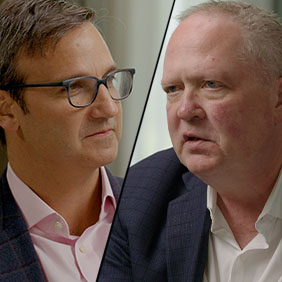
Exceptional Leaders Series

Dick’s Sporting Goods: A New Arena for Retail

November 10, 2025
Video

Dick’s Sporting Goods: A New Arena for Retail

November 10, 2025

Dick’s Sporting Goods Executive Chairman Ed Stack shares how the company is transforming retail through immersive experiences, digital platforms like GameChanger, and a commitment to youth sports and culture.

SIMEON GUTMAN (V.O.)

When Ed Stack took over Dick's Sporting Goods in 1984, his main objective was keeping the family business afloat.


ED STACK

We weren’t very well capitalized. Certain brands wouldn’t sell us at the time.


SIMEON GUTMAN (V.O.)

Today, Dick’s is the dominant player in sporting goods, with more than 850 stores across nearly every state in America. And it is one of the most innovative names in retail, connecting with customers through immersive experiences in the store, on the playing field, and digitally. Ed's vision.


ED STACK

To be the best sports company in the world.


SIMEON GUTMAN (V.O.)

As an analyst covering hard lines in broadline retail, I wanted to learn more about how Ed, whose father founded Dick's in 1948, has led the company through pivotal periods, and how he's setting the pace for its future. So I traveled to Pittsburgh, where I met Ed at a House of Sport for a fascinating conversation and some friendly competition.


SIMEON GUTMAN 

Ed, thank you so much for doing this. Good to see you.


ED STACK

Yeah, good to see you, too. Thanks.


SIMEON GUTMAN

Let's get into it.


ED STACK

Sure. 


SIMEON GUTMAN

So what was your first job at Dick's, and growing up, did you imagine yourself joining the family business?


ED STACK

My father put me to work here when I was 13 because he was going to teach me responsibility. So I worked in the warehouse, and I was unloading trucks and sweeping floors. And when I was 15 years old, he put me on the sales floor, starting to wait on customers. I hated every minute of it. I wanted nothing to do with the family business. And when I went off to college, I never expected that I would come back.

As I was getting ready to get out of school, my dad got really sick, and I came back into the business. And, somewhere along the line, I fell in love with the business. And it's a love affair that's alive and well today. 


SIMEON GUTMAN

So you took over Dick's in 1984. What were your aspirations back then?


ED STACK

To be honest with you, it was a small family business. We had two little stores in Binghamton, New York. And the vision was really merely: survive. You know, we really weren't very well capitalized. We had a line of credit from the bank that we had to clean up every single year for 30 days. And Adidas wouldn't sell us, Puma wouldn't sell us. And they were the two hot athletic brands at that time.


SIMEON GUTMAN

How has Dick’s become more intentional about culture, and how do you scale that across 850 plus stores? 


ED STACK

Culture is difficult to define because you can't pick up and look at culture. You can't kind of put it in a box and distribute it out to the stores. It's something that's got to be learned through osmosis. It's got to be led through the values that the company has.

And one of the things that I think helped with our culture: the easiest thing to say when you're having a business conversation of a new idea is to say, “No, you know, no, that won't work.”

And we made a change, probably, I don't know, six, seven, eight years ago, and said, whenever there's an idea—we're having a meeting and somebody comes up with a new idea—nobody can lead with, “No, because.” Every comment after that has to be, “Yes, if. Yes, we could do that, if we can do this, this, and this.” And it's made a huge change.


SIMEON GUTMAN

So we're sitting in this House of Sport. For those that haven't experienced [it], how would you describe it? And then what is the return on the experience here?


ED STACK

If you see pictures of it or you try to describe it, it's very difficult. You have to get into the space to really understand it, because of the—not only the size of it, but the products that are here, the interactivity that's here. This has really been a journey that's ten years in the making.

As we did that, we designed it and we walked through it. I said, “It's not different enough from what we're doing today.” So we scrapped it, put it on hold, and came back about six years ago and started the project again.

The first one we did was roughly 100,000 square feet. There is a field right next to it: have kids come and practice. You can have events there. We've got 25 now, we'll have 35 by the end of the year, and by the end of ‘27, we'll have somewhere between 75 and 100. We couldn't be more excited about it. 


SIMEON GUTMAN

In a retail industry that's struggling to get people to come to stores, here’s a category sporting goods and a physical box that people want to come to and experience.


ED STACK

If you're an athlete, this is the place you want to come to. If you talked to an analyst five, six, seven years ago, they would say, “I don't really know how many stores you have, but you have too many. And I don't really know how big your store is, but it's too big, because you should shrink your store and have less stores.” 

And when people would ask me, you know, six, seven years ago, “In ten years, what will your footprint look like?” I would tell them, “I think we will have approximately the same amount of stores, but we'll have a lot more square footage.” They didn't particularly like that because they didn't understand what House of Sport was going to become. When Nike first came in to see the store, they said, “This is the best expression of sport anywhere in the world.” 

In 2016, we thought there was a huge opportunity to be the ecosystem of youth sports. GameChanger has been just terrific.


SIMEON GUTMAN

It's grown into $100 million SaaS business with 9 million members. Did you always see it as a scalable platform, or did it evolve into something bigger than it is?


ED STACK

Every month we stream more baseball games—Little League games, high school games—than all the Major League Baseball games played since the beginning of time. We're doing this now with basketball. We're looking at soccer. Technology is an important part of our business. So we want to be involved with the customer, who we refer to as athletes. We want to be involved with the athletes and their entire journey, whether that's what they're doing from a research standpoint, what we can do from provid[ing] them suggestions on what they should buy or how they can get better, what we can do from a retail standpoint of the product, how we can interact with them. People love GameChanger. You know, the satisfaction level is extremely high. If you're a mom or dad and you're traveling for work, you can stream that game right on your phone. And that's why the business continues to grow at roughly 40% a year. And that's what we're really heading toward with this idea to be the best sports company in the world. We’ll be evolving more into a platform where you can research product, you can buy product, you can try product. GameChanger would be involved with sports throughout the entire journey. We continue to expand what this whole youth platform could be.


SIMEON GUTMAN

Youth sports participation has faced some headwinds in recent years. What do you see as the biggest barriers, and how is Dick's working to address it?


ED STACK

Sports and culture is at an intersection: it’s never been like this before. And that's happening all around the world. We're seeing our youth sports business on fire right now. Our baseball business has been great. Our soccer business has been great. The lacrosse business, basketball business. The World Cup is going to be the biggest sporting event this country has ever seen, and that's going to really help drive youth participation. What's going on in women's basketball right now? With Caitlin Clark and A’ja and Sabrina. Our number one selling basketball shoe is Sabrina's basketball shoe. Because boys are buying that shoe too. We run a camp every year for five and six-year-olds that they come and every day, they play a different sport. So we introduce them to basketball one day, golf another day, baseball, football. There's a groundswell of what's going on in youth sports participation, and I think we're right at the center of that.


SIMEON GUTMAN

The Foot Locker acquisition has raised some eyebrows. What's the rationale behind it? And what do you say to the skeptics? 

ED STACK

Foot Locker gives us the opportunity to have a global presence, which we don't have today. It gives us an opportunity to engage with the consumer that we don't have today. And we've always talked about this, that we don't make investments from one quarter to the next. We make investments for a lifetime. And we think the Foot Locker acquisition is an investment for a lifetime. People are starting to understand that, starting to get that, and I think as we go forward and we get Foot Locker turned around, I think they'll look back and say, “That was a pretty good idea.”


SIMEON GUTMAN

Dick's made headlines in 2018 with its decision to remove firearms, a move that cost the company more than $250 million. Would you make the same call today? 

ED STACK

Absolutely. You know, after Sandy Hook, we really started to look differently at how we sold firearms, how we marketed it, take a bit of a backseat. And then when Parkland happened, I was on Good Morning America with Stephanopoulos, and he asked me, “You know, will you ever put these guns back in the store?” And I said, “Never.” I just didn't want to be a part of that story any longer. We exited the high-capacity magazines, the assault style weapons. We wouldn't sell a firearm to anybody under 21 years old. And then a number of people were really upset with us, and it cost us well over a quarter of $1 million. We then said, “Okay, you know what? Let's just test if we take all firearms out.”

We looked at every store, what was selling, what would be best for that community, and the margin rates were so much lower in the firearms business. We only had to recoup 60% of the sales to have the same kind of earnings number. When we did this, the team did such a good job on this that we captured about 110% of the sales. So it was a huge win for the company. And yes, I’d do it exactly the same way again.


SIMEON GUTMAN

What do you hope your legacy will be? Not just at Dick's, but in how retail leaders think about culture, innovation, and impact? 

ED STACK

I don't really think about the legacy that I'm trying to leave. I think about how the business will grow and survive going forward when I'm not involved any longer. When my dad was on his deathbed, and he'd been sick for a long time, I said, “If it's time to go, it's okay for you to go. And I know you worry about the business, but I promise I will take care of the business. We'll continue this business for generations to come and set it up to be able to do that.”

And so what I'd like my legacy to be is to be able to fulfill that promise I made to my father on the day he died. And I think we're in really good shape. And to be able to do that, you have to have the right people. And Lauren Hobart is absolutely the right person. I couldn't be more proud of the team. The legacy for our company and for me would be that this continues to go on for generations. 


SIMEON GUTMAN 

Well, it's been a pleasure to watch a retail leader take a business through all the phases of retail evolution. Thanks for doing this.


ED STACK

Simeon, thanks. That was great. Yeah, that's great. Let's walk around the store a little bit. 


SIMEON GUTMAN

Yeah, I’d love it. 

So this is what happens on the executive board?


ED STACK

[Laughs] Yeah.

Transcript

SIMEON GUTMAN (V.O.)

When Ed Stack took over Dick's Sporting Goods in 1984, his main objective was keeping the family business afloat.


ED STACK

We weren’t very well capitalized. Certain brands wouldn’t sell us at the time.


SIMEON GUTMAN (V.O.)

Today, Dick’s is the dominant player in sporting goods, with more than 850 stores across nearly every state in America. And it is one of the most innovative names in retail, connecting with customers through immersive experiences in the store, on the playing field, and digitally. Ed's vision.


ED STACK

To be the best sports company in the world.


SIMEON GUTMAN (V.O.)

As an analyst covering hard lines in broadline retail, I wanted to learn more about how Ed, whose father founded Dick's in 1948, has led the company through pivotal periods, and how he's setting the pace for its future. So I traveled to Pittsburgh, where I met Ed at a House of Sport for a fascinating conversation and some friendly competition.


SIMEON GUTMAN 

Ed, thank you so much for doing this. Good to see you.


ED STACK

Yeah, good to see you, too. Thanks.


SIMEON GUTMAN

Let's get into it.


ED STACK

Sure. 


SIMEON GUTMAN

So what was your first job at Dick's, and growing up, did you imagine yourself joining the family business?


ED STACK

My father put me to work here when I was 13 because he was going to teach me responsibility. So I worked in the warehouse, and I was unloading trucks and sweeping floors. And when I was 15 years old, he put me on the sales floor, starting to wait on customers. I hated every minute of it. I wanted nothing to do with the family business. And when I went off to college, I never expected that I would come back.

As I was getting ready to get out of school, my dad got really sick, and I came back into the business. And, somewhere along the line, I fell in love with the business. And it's a love affair that's alive and well today. 


SIMEON GUTMAN

So you took over Dick's in 1984. What were your aspirations back then?


ED STACK

To be honest with you, it was a small family business. We had two little stores in Binghamton, New York. And the vision was really merely: survive. You know, we really weren't very well capitalized. We had a line of credit from the bank that we had to clean up every single year for 30 days. And Adidas wouldn't sell us, Puma wouldn't sell us. And they were the two hot athletic brands at that time.


SIMEON GUTMAN

How has Dick’s become more intentional about culture, and how do you scale that across 850 plus stores? 


ED STACK

Culture is difficult to define because you can't pick up and look at culture. You can't kind of put it in a box and distribute it out to the stores. It's something that's got to be learned through osmosis. It's got to be led through the values that the company has.

And one of the things that I think helped with our culture: the easiest thing to say when you're having a business conversation of a new idea is to say, “No, you know, no, that won't work.”

And we made a change, probably, I don't know, six, seven, eight years ago, and said, whenever there's an idea—we're having a meeting and somebody comes up with a new idea—nobody can lead with, “No, because.” Every comment after that has to be, “Yes, if. Yes, we could do that, if we can do this, this, and this.” And it's made a huge change.


SIMEON GUTMAN

So we're sitting in this House of Sport. For those that haven't experienced [it], how would you describe it? And then what is the return on the experience here?


ED STACK

If you see pictures of it or you try to describe it, it's very difficult. You have to get into the space to really understand it, because of the—not only the size of it, but the products that are here, the interactivity that's here. This has really been a journey that's ten years in the making.

As we did that, we designed it and we walked through it. I said, “It's not different enough from what we're doing today.” So we scrapped it, put it on hold, and came back about six years ago and started the project again.

The first one we did was roughly 100,000 square feet. There is a field right next to it: have kids come and practice. You can have events there. We've got 25 now, we'll have 35 by the end of the year, and by the end of ‘27, we'll have somewhere between 75 and 100. We couldn't be more excited about it. 


SIMEON GUTMAN

In a retail industry that's struggling to get people to come to stores, here’s a category sporting goods and a physical box that people want to come to and experience.


ED STACK

If you're an athlete, this is the place you want to come to. If you talked to an analyst five, six, seven years ago, they would say, “I don't really know how many stores you have, but you have too many. And I don't really know how big your store is, but it's too big, because you should shrink your store and have less stores.” 

And when people would ask me, you know, six, seven years ago, “In ten years, what will your footprint look like?” I would tell them, “I think we will have approximately the same amount of stores, but we'll have a lot more square footage.” They didn't particularly like that because they didn't understand what House of Sport was going to become. When Nike first came in to see the store, they said, “This is the best expression of sport anywhere in the world.” 

In 2016, we thought there was a huge opportunity to be the ecosystem of youth sports. GameChanger has been just terrific.


SIMEON GUTMAN

It's grown into $100 million SaaS business with 9 million members. Did you always see it as a scalable platform, or did it evolve into something bigger than it is?


ED STACK

Every month we stream more baseball games—Little League games, high school games—than all the Major League Baseball games played since the beginning of time. We're doing this now with basketball. We're looking at soccer. Technology is an important part of our business. So we want to be involved with the customer, who we refer to as athletes. We want to be involved with the athletes and their entire journey, whether that's what they're doing from a research standpoint, what we can do from provid[ing] them suggestions on what they should buy or how they can get better, what we can do from a retail standpoint of the product, how we can interact with them. People love GameChanger. You know, the satisfaction level is extremely high. If you're a mom or dad and you're traveling for work, you can stream that game right on your phone. And that's why the business continues to grow at roughly 40% a year. And that's what we're really heading toward with this idea to be the best sports company in the world. We’ll be evolving more into a platform where you can research product, you can buy product, you can try product. GameChanger would be involved with sports throughout the entire journey. We continue to expand what this whole youth platform could be.


SIMEON GUTMAN

Youth sports participation has faced some headwinds in recent years. What do you see as the biggest barriers, and how is Dick's working to address it?


ED STACK

Sports and culture is at an intersection: it’s never been like this before. And that's happening all around the world. We're seeing our youth sports business on fire right now. Our baseball business has been great. Our soccer business has been great. The lacrosse business, basketball business. The World Cup is going to be the biggest sporting event this country has ever seen, and that's going to really help drive youth participation. What's going on in women's basketball right now? With Caitlin Clark and A’ja and Sabrina. Our number one selling basketball shoe is Sabrina's basketball shoe. Because boys are buying that shoe too. We run a camp every year for five and six-year-olds that they come and every day, they play a different sport. So we introduce them to basketball one day, golf another day, baseball, football. There's a groundswell of what's going on in youth sports participation, and I think we're right at the center of that.


SIMEON GUTMAN

The Foot Locker acquisition has raised some eyebrows. What's the rationale behind it? And what do you say to the skeptics? 

ED STACK

Foot Locker gives us the opportunity to have a global presence, which we don't have today. It gives us an opportunity to engage with the consumer that we don't have today. And we've always talked about this, that we don't make investments from one quarter to the next. We make investments for a lifetime. And we think the Foot Locker acquisition is an investment for a lifetime. People are starting to understand that, starting to get that, and I think as we go forward and we get Foot Locker turned around, I think they'll look back and say, “That was a pretty good idea.”


SIMEON GUTMAN

Dick's made headlines in 2018 with its decision to remove firearms, a move that cost the company more than $250 million. Would you make the same call today? 

ED STACK

Absolutely. You know, after Sandy Hook, we really started to look differently at how we sold firearms, how we marketed it, take a bit of a backseat. And then when Parkland happened, I was on Good Morning America with Stephanopoulos, and he asked me, “You know, will you ever put these guns back in the store?” And I said, “Never.” I just didn't want to be a part of that story any longer. We exited the high-capacity magazines, the assault style weapons. We wouldn't sell a firearm to anybody under 21 years old. And then a number of people were really upset with us, and it cost us well over a quarter of $1 million. We then said, “Okay, you know what? Let's just test if we take all firearms out.”

We looked at every store, what was selling, what would be best for that community, and the margin rates were so much lower in the firearms business. We only had to recoup 60% of the sales to have the same kind of earnings number. When we did this, the team did such a good job on this that we captured about 110% of the sales. So it was a huge win for the company. And yes, I’d do it exactly the same way again.


SIMEON GUTMAN

What do you hope your legacy will be? Not just at Dick's, but in how retail leaders think about culture, innovation, and impact? 

ED STACK

I don't really think about the legacy that I'm trying to leave. I think about how the business will grow and survive going forward when I'm not involved any longer. When my dad was on his deathbed, and he'd been sick for a long time, I said, “If it's time to go, it's okay for you to go. And I know you worry about the business, but I promise I will take care of the business. We'll continue this business for generations to come and set it up to be able to do that.”

And so what I'd like my legacy to be is to be able to fulfill that promise I made to my father on the day he died. And I think we're in really good shape. And to be able to do that, you have to have the right people. And Lauren Hobart is absolutely the right person. I couldn't be more proud of the team. The legacy for our company and for me would be that this continues to go on for generations. 


SIMEON GUTMAN 

Well, it's been a pleasure to watch a retail leader take a business through all the phases of retail evolution. Thanks for doing this.


ED STACK

Simeon, thanks. That was great. Yeah, that's great. Let's walk around the store a little bit. 


SIMEON GUTMAN

Yeah, I’d love it. 

So this is what happens on the executive board?


ED STACK

[Laughs] Yeah.

Watch and subscribe:
Hosted By
  • Simeon Gutman
Audio

Audio version: Dick’s Sporting Goods: A New Arena for Retail

November 10, 2025

Dick’s Sporting Goods Executive Chairman Ed Stack shares how the company is transforming retail through immersive experiences, digital platforms like GameChanger, and a commitment to youth sports and culture.

Dick’s Sporting Goods: A New Arena for Retail

Transcript

Coming soon

Listen and subscribe:

Dick’s Sporting Goods: Extended Audio Version

Hard Lessons

Transcript

Ed Stack: When people would ask me, six, seven years ago, “In 10 years, what will your footprint look like?” I would tell 'em, “I think we will have approximately the same amount of stores, but we'll have a lot more square footage.” And they didn't particularly like that 'cause they didn't understand what House of Support was gonna become, but they understand that now. And the economics of this have been terrific.


Simeon Gutman: For more than seven decades, Dick’s Sporting Goods has rewritten the retail playbook. While rivals like Sports Authority faded, Dick’s thrived—led by  chairman and longtime former CEO Ed Stack.


When Wall Street said “shrink your stores,” Ed made them bigger. After the Parkland shooting, Ed decided to discontinue the sale of firearms — costing the company more than $250 million, but reshaping its future.  In pivotal moments, Ed swung for the fences to keep his father, founder Dick Stack's dream alive.


Stack: He was always worried the company would go outta business 'cause he went outta business one time. He actually almost went outta business twice when I was running it.


Gutman: This is Exceptional Leaders, an original series from Morgan Stanley that brings you direct access to the thought leaders and changemakers at the forefront of business, technology, and culture.


I'm Simeon Gutman, Morgan Stanley's hardline and broadline retail analyst for almost 25 years. On this episode, I'm taking you into the dynamic and competitive realm of sports retail— and there’s no better company to look under the hood of to understand this space than Dick’s Sporting Goods: the leading player by market share.


I’ve covered Dick’s for 15 years, and in that time, I’ve seen how Ed’s decisions have shaped where this sector has been, and where it’s going. I traveled to Pittsburgh to sit down with Ed in a 137,000 square foot House of Sport that is redefining what it means to walk into a sporting goods store.


             Stack: Gutman, great to see you.
            Gutman: Likewise. How you doing? Great. Great. How's everything?
             Stack: Good. How's your golf game?
            Gutman: Not good.


My first thought walking into the House of Sport is: “Geez, this is huge.” Outside, there’s a full turf field where athletes can sprint, cut, and test out gear in real time. Inside, a batting cage and golf swing tracker calibrate customers’ every movement. A massive climbing wall towers over a rainbow-colored display of Gatorade—one of hundreds of brands competing for attention inside Dick’s. But five years from now, when there are a hundred plus House of Sports, will there still be enough consumer appetite? That’s what I’m here to find out.   


Gutman: Ed, thank you so much for doing this. This is an honor and a pleasure to be able to talk to you, one of the great retail leaders of the last multiple decades. What was your first job at Dick's?—and growing up, did you expect to be in the family business?


Stack: So, first of all, I never imagined myself joining the family business. The first thing I did, my father put me to work here when I was 13 because he was gonna teach me responsibility. I worked in the warehouse and I was unloading trucks and, you know, sweeping floors and doing all that and marking merchandise. Then, when I was 15 years old, he put me on the sales floor starting to wait on customers. And I worked there. I mean, it was a small family business. We had two little stores in Binghamton, New York. One was about 5,000 square feet and the other was 2,500 square feet to put that in perspective. The store that we're in, this House of Sports, is 137,000 square feet. But he put me to work there, taught me responsibility, and if I wasn't playing baseball or football, I was working in the store. And I've often said, kind of tongue in cheek, I hated every minute of it. I wanted nothing to do with the family business.


When I went off to college, I never expected that I would come back into the business. But as I was getting ready to get out of school — and I was either gonna go to work at Coopers & Lybrand or Pricewaterhouse at the time, and then I wanted to go on to law school — my dad got really sick. And I came back into the business. And somewhere along the line, I fell in love with the business and it's a love affair that's alive and well today.


Gutman: So you took over Dick's in 1984. You mentioned it was just two stores. What were your aspirations back then? We're sitting in something pretty grand, so to see the business throughout...did you have a vision for what it could become?


Stack: To be honest with you, the vision was really merely survive. You know, we really weren’t very well capitalized. You know, we had a line of credit from the bank that we had to clean up every single year for 30 days. And certain brands wouldn't sell us at the time: Adidas wouldn't sell us, Puma wouldn't sell us—and they were the two hot athletic brands at that time. And so the main objective when I took over the business and bought it from my father was to merely survive.


Gutman: And so what is the vision today? You know, this is a great category. This is a great theatrical merchandising arena. Sports has never been more popular in this country. So what is the vision?


Stack: Our whole vision we talk about is to be the best sports company in the world. We talk about [about] not [just being] the best sports retailer in the world, but to be the best sports company in the world. From a retailing standpoint, it would be how we can intersect with athletes and the consumer, with what we've done with our Game Changer app. Technology's an important part of our business. So we want to be involved with the customer, who we refer to as ‘athletes’. We want to be involved with the athletes and their entire journey—whether that's what they're doing from a research standpoint, provide them suggestions on what they should buy, or how they can get better, how we can interact with them from our app and. Just be along the entire journey of the athlete. And that's the course we're on—and our team's doing a really pretty good job of that.


Gutman VO: To understand the gravity of Dick’s vision and Ed’s retail prowess, you have to look back. In the early to mid-2000s, before I began covering Dick’s, I watched from the sidelines as the company moved through its most acquisitive era. These were major deals that every retail analyst was following—Galyan’s, Chicks, Golf Galaxy…


In general, the market was skeptical of these purchases. It was hard to see how they might shore up the bottom line. Plus, like all retailers, Dick’s was struggling to fend off Amazon.


I started covering Dick’s in 2010, and I vividly remember that period. It wasn’t defined by success. Dick’s kept saying “trust us” as it slowly worked to transition into e-commerce, but we’d yet to see real progress. For almost a decade after its 2002 IPO, Dick’s was only growing same-store sales at about 2% a year—a very modest figure. So, when Dick’s told the market they were making changes, it’s only natural that the Street was skeptical.


All of this came to a head in 2019—what I would consider the most pivotal moment in Ed’s tenure, alongside then–President of Dick’s Sporting Goods, Lauren Hobart. Together, they right-sized the vendor base by 30%, exited certain outdoor categories, and significantly accelerated the company’s e-commerce capabilities. The Street finally started to see the transformation taking shape.


Then the pandemic hit. In the first few months, the market was shocked—Dick’s was performing better than expected with same-store sales rising to 5%. Their early investments in omnichannel retail, in-store pickup, and consumer engagement had positioned them well ahead of their competitors, and they were finally paying off.


Since then, the story has only gotten more compelling. Following the 2022 COVID peak, Dick’s has maintained robust same-store sales. In fact, it was one of only five companies that have continued to grow through this period—with all other companies giving back their gains as the market normalized.


Today, Dick’s stands at another critical moment. With its decision to double down on store square footage, the company is once again saying, “trust us.”


Gutman: So we're sitting in this House of Sport. For those that haven't experienced it, how would you describe it and what is the return on experience here?


Ed Stack: Yeah. It's very difficult. We started it probably 10 years ago with what we were talking about to build the store of the future. And as we did that, we designed it…and sometimes things don't translate very well from paper to reality. In our office, we've got a lab store that we can go down and build parts of the store to make sure it looks good before we roll it out to the whole chain. And we built parts of this downstairs in the lab store and when we walked through it, I said, “It's not different enough from what we're doing today.” So we scrapped it and came back about six years ago and started the project again, which we called the ‘Ecosystem of the Future’. Because it was going to have community involved in it, going to have the product involved in it, interactivity, marketing. And, as we started to redesign this, and the brief that was wrote on this was that we need to build the concept that will kill Dick Sporting Goods. We need to build the concept that, if somebody built this store across the street from us, we're out of business. And I think that's what we did. So it's been really very successful. Our sales volume here is roughly, on an omnibasis, roughly $35 million. The EBITDA is 20%, roughly the first year, right out of the box. So they've been very productive. The brand's all clamor to be in here now because it really is the best expression of sport anywhere in the world. And we've got 25 now. We'll have 35 by the end of ’25, and by the end of ‘27 we'll have somewhere between 75 and 100.


But we went slow to go fast. So we opened one in Rochester. Another year we opened up another one in Knoxville, Tennessee. And then a few months later we opened another one in Minneapolis, and we let those kind of run the bugs out for 24 months before we went on and started to build anymore. But we think we've got this really in pretty good shape now to roll out, and that's what we're doing, and we couldn't be more excited about it.


Gutman: Yeah. In a retail industry that's struggling to get people to come to stores...


Stack: Yeah.


Gutman: …here's a category—sporting goods—and a physical box that people want to come to and experience. And we’re talking, putting down the phone.


Ed Stack: And they do. You know, there were so many, if you look back, we were very counterintuitive to what the Street had thought that we should do. Very counterintuitive to what was going on. And I used to kind of say tongue in cheek that, “If you talk to an analyst five, six, seven years ago. They would say, “I don't really know how many stores you have, but you have too many, and I don't really know how big your store is, but it's too big because you should shrink your store, have less stores.” And when people would ask me, you know, six, seven years ago, “In 10 years, what will your footprint look like?” — I would tell them, “I think we will have approximately the same amount of stores, but we'll have a lot more square footage.” And they didn't particularly like that because they didn't understand what House of Sport was going to become, but they understand that now. And the economics of this have been terrific. And it's played out very well and we've got so many people now who are asking, “When are we gonna get a House of Sport in our market—in our town?” And, it'll be a slow process. We will build, you know, 15, 20 of these a year. But we're pretty excited about it.


Simeon Gutman VO: Sports is primed for theatrical retail. Even so, Dick’s commitment to a larger footprint has sparked mixed reactions.


On one hand, there’s excitement about a return to ambitious retail theater. On the other hand, the Street feels the ghosts of retailers past—those who opened too much physical space just as the world was moving online.


Fundamentally, e-commerce has completely reshaped how we shop. Ten years ago, if you said the pendulum would swing back towards physical retail, it would have been hard to imagine. But today, consumers are returning to brick-and-mortar. They want to try out lots of brands in one place.


In some ways, it’s come full circle for Dick’s. Early on, big brands like Nike controlled its destiny, heavily dictating terms. Then, digital upstarts fragmented the market, as shoppers realized there was more than a Nike or an Adidas. Now, no longer beholden to any single brand, Dick’s has become an incubator of sorts—where emerging brands compete for shelf space and can define their identities within its stores.


Through it all, Dick’s has remained aggressively customer-driven. In 2016, the company acquired GameChanger, a youth sports app they recognized the potential in early. The app helps amateur sports teams stream games, track stats, manage schedules, and keep parents and fans connected. At the time, GameChanger was barely on my radar. Today, it’s another example of how Dick’s is building brand affinity—and turning that affinity into foot traffic.


Gutman: So you mentioned GameChanger—somewhat obscure to the world a few years ago. It's grown into a hundred million plus dollar business. We're growing into a SaaS business with 9 million members. Did you always see it as a scalable platform, or did it evolve into something bigger than it is?


Stack: We always thought this was very scalable in what's going on from a youth sports standpoint. And when we bought GameChanger back in 2016, we thought there was a huge opportunity to be the ecosystem of youth sports. So everything that a parent would need from a youth sports standpoint. And GameChanger has been just terrific. So, little fun fact on GameChanger. You know, we stream baseball games, you know, Little League games, high school games, softball games, all this. And every month we stream more baseball games than all the Major League Baseball games played since the beginning of time. That’s a lot of games. And we've got, as you said, 9 million members here. It's been really terrific, and we continue to expand that and broaden out what this whole youth platform could be. And the whole idea of streaming those games, and we collect all the data about the athlete. If a kid's playing a baseball game in Rochester, New York and their grandparents live in Denver, Colorado, they can sit down and they can watch their grandson or granddaughter play softball or baseball. We're doing this now with basketball. We're looking at soccer. We think there's a big opportunity with GameChanger. It's just connecting these families and connecting people to the game, and to these kids, and you know, the satisfaction level's extremely high, and that's why the business continues to grow at roughly 40% a year. It'll be up over a hundred million dollars in revenue this year and very profitable.


Gutman: GameChanger is a good transition into youth sports. Youth sports participation has faced some headwinds in recent years. What do you see as the biggest barriers and how is Dick's working to address it?


Stack: I think the idea of youth sports being, you know, these headwinds, they're not wrong, but they're not totally right either. We're seeing our youth sports business on fire right now. What's going on in women's basketball right now. You know, with Caitlyn Clark, and A'ja [Wilson], and Sabrina [Ionescu], women's basketball is gonna be driving a tremendous amount of youth sports participation. If you think about this, our number one selling basketball shoe is Sabrina's basketball shoe. Not the number one selling women's basketball shoe, the number one selling basketball shoe—because boys are buying that shoe too. There's a groundswell of what's going on in youth sports participation and I think we're right at the center of that.


Gutman: What does it mean for Dick's to be a platform for sports, not just a retailer?


Stack: That's what we're really heading toward with this idea to be the best sports company in the world. We'll be evolving more into a platform where you can research product, you can buy product, you can try product, we can help you in the field with clinics that we might be doing, with what we can do with GameChanger. This platform would be involved with sports throughout the entire journey.


Archival Tape - George Stephanopoulos Interview: “He's the chairman and CEO of Dick's Sporting Goods, the nation's largest sporting goods retailer. And just moments ago, he released an open letter announcing that Dick's will no longer sell assault style rifles, no longer sell firearms to anyone under 21 years of age, no longer sell high capacity magazines.”


Gutman: Dick's made headlines in 2018 with its decision to remove firearms, a move that cost the company more than $250 million. Would you make the same call today?


Stack: Absolutely. We'd been on a journey on the firearms business for a while. So in Sandy Hook, we changed how we marketed firearms, how we sold firearms, and we kind of had it take a bit of a backseat. And then when Parkland happened, I made the decision, I'm done. I don't want to be a part of this story any longer. Kids are such an important part of our business and with what was happening to these kids, I said, “I don't want to be in…”—I was on Good Morning America with Stephanopoulos and he asked me, “You know, will you ever put these guns back in the store?”—and I said, “Never.” And I just didn't want to be a part of that story any longer—and so we exited them. We exited the high capacity magazines, the assault style weapons. We wouldn't sell a firearm to anybody under 21 years old. And it cost us well over a quarter of a billion dollars. And people were very upset. 


Gutman VO: For Dick’s, the Parkland shooting marked a breaking point. You have to understand: in the history of retail, companies usually only add things—they add services, they get into new categories, or they move things around. So it’s pretty notable anytime a company pulls out of a revenue-generating business. As a merchant, Ed’s decision was unconventional.


Stack: When we did this, the team did such a good job on this that we captured about 110% of the sales. So it was a huge win for the company. We then went and did another 25 stores and really validated this, and then after that, just exited the firearms completely and really focused on the high school athlete, the golfer, athletic footwear business, the apparel business. But really leaning toward this whole idea of sport and culture. And it's been great for the business. And to answer your question—yes, I’d do it exactly the same way again.


Gutman: The Footlocker acquisition has raised some eyebrows. What's the rationale behind it and what do you say to the skeptics?


Stack: Yeah, so I know that it did raise some eyebrows when we did this, they were, they didn't quite get it. And as I talked about the Street—[they] would like us to do exactly what we're doing. Just continue to do what we're doing, because we've been doing it extremely well. The earnings have gone up, the sales have gone up. It's been great. They'd like us to continue to just do exactly what we're doing. I don't think that's the right thing to do.


Footlocker gives us the opportunity to have a global presence, which we don't have today. It has given us an opportunity to engage with a consumer that we don't have today. We make investments for a lifetime. And we think the Footlocker acquisition is an investment for a lifetime. As we go forward, and we get Footlocker turned around, I think they'll look back and say, that was a pretty good idea.


Gutman: So, Ed, you stepped down as CEO in 2021, but remain as Executive Chairman. Lauren Hobart is now the CEO. How do you define your role today and how involved are you in the decisions of the business and are going to be involved in Footlocker?


Stack: I stepped out of the CEO role because I was gonna enter the political arena. In retrospect, I'm glad I didn't. Lauren and I have divided the company into areas that she's responsible for, areas that I'm responsible for. She's focused on the stores, the marketing side of the business, distribution, logistics, the finance piece. I'm handling all the merchandising, real estate, planning allocation, replenishment. We've got it divided up, and it's working out pretty well.


Gutman: What's your role gonna be with Footlocker?


Stack: I'm gonna be responsible for Footlocker. So I'm going to take a small team and take a look at Footlocker, and reinvigorate Footlocker. And our goal is to get Footlocker back to the kind of center stage and on the pinnacle of that category that it was back 10 years ago.


Gutman: What do you hope your legacy will be, not just at Dick's, but in how retail leaders think about culture, innovation and impact?


Stack: Legacy's an interesting...I don't really think about the legacy that I'm trying to leave. I think about how the business will grow and survive going forward, when I'm not involved any longer. When my dad was on his deathbed, he was always worried about the business. We were always—for years—six months away from going out of business, you know. We really weren't very well capitalized. We were so dependent on these brands. We had loans from the bank, and we did almost go out of business twice. And my father was always so worried about going out of [business]—and he did go out of business one time. And I remember sitting there with him on his…he actually passed away that evening. And I told him, I said, “Hey, listen, Dad, if it's,”—and he'd been sick for a long time—I said, “If it's time to go, it's okay for you to go. And I know you worry about the business, but I promise I will take care of the business. We'll continue this business for generations to come and set it up to be able to do that.” And so what I'd like my legacy to be is to be able to fulfill that promise I made to my father on the day he died.


Gutman: Yeah. Well, it's been a pleasure to watch. I said when we were at a conference—it's neat, you don't get to watch a retail leader take a business through all the phases of retail evolution: physical store only, then we did brick and mortar, onslaught from online, omnichannel, the COVID period, the post-COVID period, disruption. You're disrupting yourself now. It's a treat.


Stack: Retail is an exciting place to be right now. It's not for the faint of heart, but it's constantly evolving. We've always tried to make sure that we innovate, and retailers that don't innovate won't survive.


Gutman: I appreciate it. Now we can go shopping.


Stack: That's it. Great. Let's go. You got your wallet.


Gutman: Yeah.


Stack: Okay. Perfect. [laughs]


Gutman VO: Ed Stack’s journey isn’t just the story of one company, it’s a case study in how unconventional leadership can reshape an entire industry. Through consistent execution, a clear commitment to customer engagement that’s grown its top-of-funnel customers, and more built-in backstops through GameChanger, Dick’s has pushed itself up the perception ladder in retail. 


But, the world of retail is always shifting, and it is Dick’s responsibility to hold on to the gains that have made them a retail standout as they push further into brick-and-mortar. The market still sees opportunity for Dick’s to improve and will be watching the evolution of its House of Sports concept closely. Innovations that add more levels of interaction and engagement will be key.


Ultimately, the future of retail won’t be defined by transactions, but by brands that blend experiences, technology, and fandom. The leaders who succeed will be those who sense cultural shifts early, take decisive risks, and reinvent the model before the market forces their hand. That’s the power of an exceptional idea.


That's all for this episode of Exceptional Leaders from Morgan Stanley. For a video version of the conversation, visit morganstanley.com or our YouTube channel. Rate, review, and subscribe to Exceptional Leaders wherever you get your podcasts.

Exceptional Leaders

In this engaging series from Morgan Stanley, experts from across the firm sit down with leaders at world-class companies for insightful conversations covering everything from leadership lessons to foundational changes in industries, markets and society.

Coming soon

Up Next

Mercedes-Benz CEO Ola Källenius shares how the company is redefining luxury and performance at a t...
Mercedes-Benz: Driving the Future of Luxury and Innovation
Morgan Stanley Research sits down with Procter & Gamble CEO Jon Moeller to discuss how the com...
P&G: A Blueprint for Indispensable Brands

More from Morgan Stanley