E7 • July 20, 2026 • 9 mins
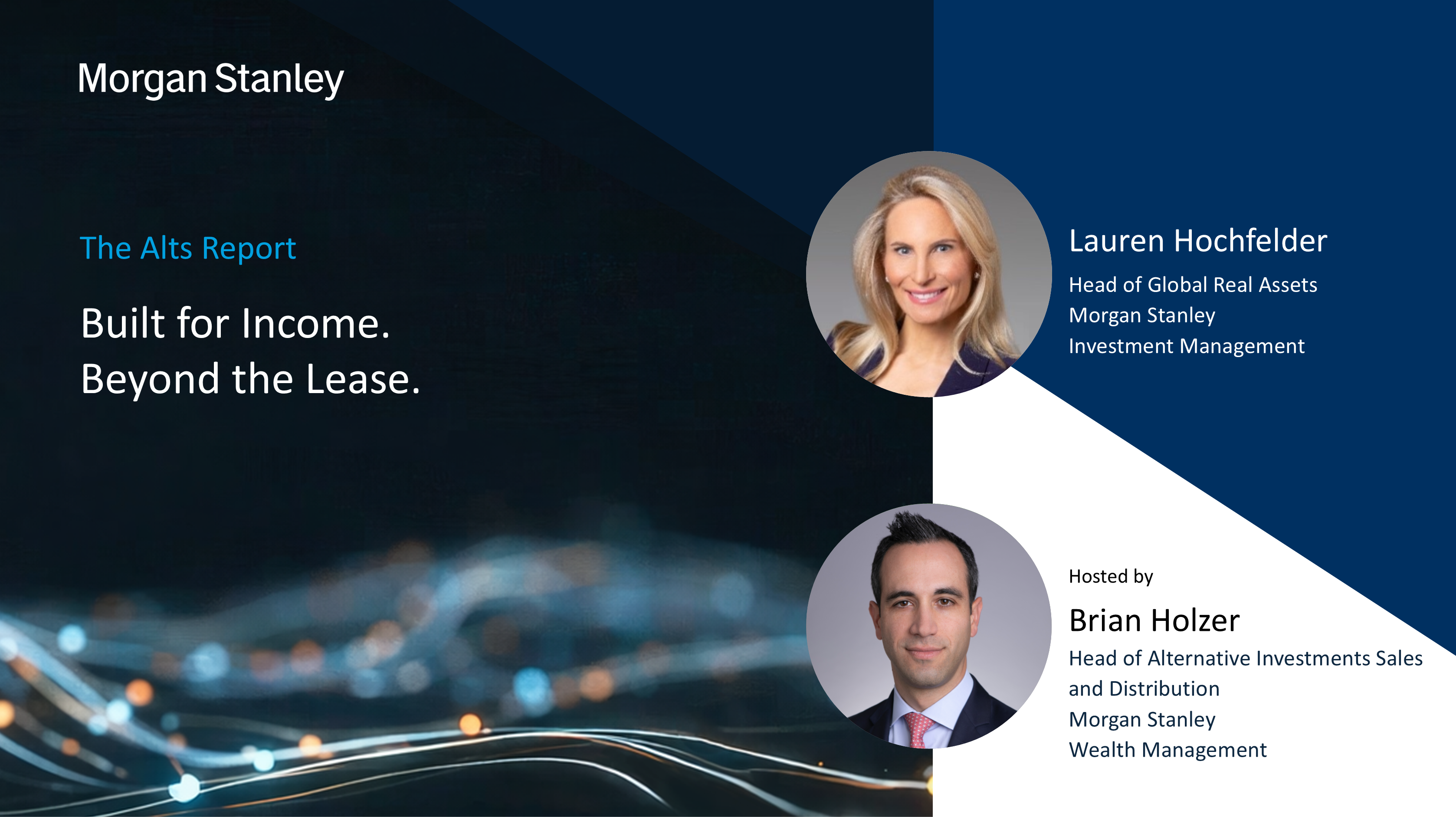
Long-term contractual income is one of the defining characteristics of triple net lease investing – but the underlying real estate matters, too. Brian Holzer, Head of Alternative Investments Sales & Distribution, sits down with Lauren Hochfelder, Head of Global Real Assets at Morgan Stanley Investment Management, to discuss what distinguishes the strategy and how investors may consider it within a broader portfolio.
VIDEO TRANSCRIPT
[COLD OPEN]
LAUREN HOCHFELDER:
If I asked you, Brian, what are some of the things you want in any investment, be it real estate or otherwise?
I suspect you'd say something like, “Give me contractual cash flow, give me inflation hedging, give me downside protection in these volatile times…
But I don't want to give up my upside…”
[CUT TO THE ALTS REPORT OPENING SEQUENCE]
00:35
INTRODUCTION – BRIAN HOLZER
Welcome to The Alts Report, where we explore the value of alternative investments and the trends shaping today's markets. I'm pleased to welcome Lauren Hochfelder, Head of Global Real Assets at Morgan Stanley Investment Management. Today, Lauren and I will discuss triple net lease investing.
Triple net lease investing is a strategy within real estate that brings together credit like underwriting and real estate investing. So, Lauren, thanks for joining us.
LOWER THIRDS:
Brian Holzer
Head of Alternative Investments Sales & Distribution
Morgan Stanley Wealth Management
LAUREN HOCHFELDER
Thank you.
01:00:00
BRIAN HOLZER
To start, can you provide an overview of what triple net lease investing is?
ON-SCREEN QUESTION: What is triple net lease investing?
LAUREN HOCHFELDER
Sure. So net lease is really just a lease structure. Generally, as a sub asset category it refers to assets that are long-term lease. So think 10, 20 plus years to tenants pursuant to this net lease structure. This is a structure in which the tenant pays the rent and all the expenses. So they pay real estate taxes and insurance and operating expenses. That means that as the asset owner, every dollar you collect in rent flows straight through to the bottom line.
LOWER THIRDS:
Lauren Hochfelder
Head of Global Real Assets
Morgan Stanley Investment Management
01:35
BRIAN HOLZER
Maybe to help bring it to life for our viewers, can you provide an example of a triple net lease transaction?
ON-SCREEN QUESTION: What’s an example of a triple net lease transaction?
LAUREN HOCHFELDER
Sure. So again, for starters, I would say net lease is just a lease structure. So it can be many different types of real estate. It can be warehouses leased to names like Amazon or Tesla. It can be medical office buildings leased to NYU Langone or Mount Sinai here in New York.
It can be retail assets. It can be robotics facilities. So, it really can be a pretty wide range of assets.
02:06
A classic example would be, we just acquired a large Class-A warehouse leased to a major household name. Immediately adjacent to LAX airport in Los Angeles. We have a 20-year lease.
02:22
It sits on nearly 20 acres of land in an incredibly infill location right next to this major transit hub airport. And one of the last mile facilities that can serve the incredibly dense demographics, in particular in West LA.
So you have the benefit of the long-term income stream. You have the benefit of this piece of land and asset that we think over the long term should appreciate, beyond the contractual rent staffs.
02:50
BRIAN HOLZER
A few things in there. First, mission critical, hard to replace assets. Two, you mentioned the quality of the underlying tenant, and I think that is why folks associate this with credit like underwriting, and then long-term leases, so the ability to model out cash flows pretty well.
03:10
LAUREN HOCHFELDER
Yes. That's exactly right. If I asked you, Brian, what are some of the things you want in any investment, be it real estate or otherwise? I suspect you'd say something like, give me contractual cash flow, give me inflation hedging, give me downside protection in these volatile times.
But I don't want to give up my upside. And oh, by the way, if you can throw in some tax efficiency that would be great, too. Well, net lease can provide all of that. And enables you to also play, some of the large megatrends that we think are driving structural demand and return growth over time.
03:47
BRIAN HOLZER
So, let's talk about portfolio construction. As you are out speaking with investors, where do you see this fitting in a portfolio?
ON-SCREEN QUESTION: Where does triple net lease investing fit within a portfolio?
LAUREN HOCHFELDER
Yeah, it's a really great question because in a sense, net lease is a sort of a hybrid between real estate and a more credit-oriented asset. So, we see investors putting it into either of those categories.
04:10
I'd say, for those who are thinking of it as part of their real estate allocation, they're saying: I get the real estate benefits, but I have the contractual income that can help insulate me from some of the key risks of real estate.
What are the key risks? My revenue can drop, right?
04:27
My rents can go down. I can lose a tenant and have vacancy. And my expenses can spike. I mean, you don't have to be a professional real estate investor to see what's happening with real estate, taxes, insurance, etc.
04:38
And in a net lease asset for at least the duration of that long-term lease, you're generally mitigated from both of those risks because both are contractual.
When we see investors look at it for their credit bucket, again, they're saying: I have this contractual cashflow. Oh, by the way, it's escalating. But yet, I'm not giving up the underlying benefits of hard asset ownership.
05:04
Net lease, again, if you're choosing the right real estate, that mission critical real estate, that real estate that is operationally essential to their business, that is generally perceived as being a lower default risk than owning that same company's unsecured credit.
05:20
BRIAN HOLZER
So, let's close. We touched a little bit on interest rates. Inflation. Right? We are in an environment with elevated interest rates likely higher for longer. What impact do higher interest rates have on real estate broadly, but also triple net lease investing?
ON-SCREEN QUESTION: What impact do higher interest rates have on real estate and triple net lease investing?
05:35
LAUREN HOCHFELDER
Yeah. We think it makes it a particularly interesting time to invest in triple net lease because it emphasizes the importance of current return. So if you think about the different ways one can make money in real estate coming out of the GFC, a lot of value, a lot of return was driven by interest rates coming down. Right? You saw cap rate compression, you saw cheap borrowing. We think this time around is different because we do expect rates to stay relatively rangebound at today's elevated levels.
06:05
So that means you have to focus on current cash flow. It also means you need to be in those sectors and markets that benefit most from long-term structural drivers of demand, where you can see the greatest income growth potential. And so, in a net lease, obviously you have contractual, rent steps that are generally in line with and sometimes above inflation.
06:32
But you also need to own the assets. Once that lease rolls, you're in the right market that's benefiting from whether it's, you know, physical AI with robotics or aging demographics, with, some of the medical offices that we invest in. So, you really need to be in those places where the income growth can compensate.
06:57
In terms of the drivers of why we think rates stay elevated, one of them is certainly inflation expectations. And I would say that after, you know, 20 plus years of limited, concern around inflation, investors are rightfully really focused on it today.
So we’re seeing a renewed appreciation for the inflation hedging benefits of real estate. And it's really for two reasons.
07:17
One, you have the direct or indirect flow through to income. So, the top line tends to grow with or above inflation. The second part that I think is a little less well understood is the flow through impact to supply. So in inflationary periods, construction costs rise, supply drops and real estate like everything is just supply and demand.
07:41
And so, when we see supply drop off precipitously, as we're seeing in today's inflationary environment, you see the real potential for asset appreciation, because the cost to rebuild that same asset just went way up. So that inflation hedging we think is key.
08:00
[CLOSING]
BRIAN HOLZER
Lauren, that was great. Thank you for joining us and providing an overview of triple net lease investing.
LAUREN HOCHFELDER
Thank you.
BRIAN HOLZER
We appreciate you all joining us for this edition of The Alts Report. To learn more about Alternative Investments and our platform at Morgan Stanley, please visit morganstanley.com/alts or reach out to your Morgan Stanley Financial Advisor or Private wealth advisor. We look forward to seeing you next time.
END OF TRANSCRIPT
Morgan Stanley Smith Barney LLC ("Morgan Stanley Wealth Management") - IMPORTANT DISCLOSURES
Morgan Stanley Wealth Management acts as a placement agent in connection with the offering and sale of the securities of the fund to current and prospective clients of Morgan Stanley Wealth Management or its affiliates. Morgan Stanley Wealth Management will receive cash compensation for its activities as placement agent from the fund’s manager, as described in Morgan Stanley Wealth Management’s point of sale letter, if applicable. In addition, Morgan Stanley Wealth Management, its affiliates or employees, may have additional relationships with the fund’s manager, including as an investor in the fund or other investment vehicles managed by the fund’s manager or as a client of the fund’s manager. The payment of cash compensation to Morgan Stanley Wealth Management, and any additional relationships that Morgan Stanley Wealth Management or its affiliates may have with the fund’s manager or other investment vehicles managed by the fund’s manager, create material conflicts of interest for Morgan Stanley Wealth Management in its role as placement agent.
All expressions of opinion are subject to change without notice and are not intended to be a forecast of future events or results. Further, opinions expressed herein may differ from the opinions expressed by Morgan Stanley Wealth Management and/or other businesses/affiliates of Morgan Stanley Wealth Management.
Alternative investments often are speculative and include a high degree of risk. Investors could lose all or a substantial amount of their investment. Alternative investments are appropriate only for eligible, long-term investors who are willing to forgo liquidity and put capital at risk for an indefinite period of time. They may be highly illiquid and can engage in leverage and other speculative practices that may increase the volatility and risk of loss. Alternative Investments typically have higher fees than traditional investments. Investors should carefully review and consider potential risks before investing.
The sole purpose of this material is to inform, and it in no way is intended to be an offer or solicitation to purchase or sell any security, other investment or service, or to attract any funds or deposits. Investments mentioned may not be appropriate for all clients. Any product discussed herein may be purchased only after a client has carefully reviewed the offering memorandum and executed the subscription documents. Morgan Stanley Wealth Management has not considered the actual or desired investment objectives, goals, guidelines, or factual circumstances of any investor in any fund(s). Before making any investment, each investor should carefully consider the risks associated with the investment, as discussed in the applicable offering memorandum, and make a determination based upon their own particular circumstances, that the investment is consistent with their investment objectives and risk tolerance.
As a diversified global financial services firm, Morgan Stanley Wealth Management engages in a broad spectrum of activities including financial advisory services, investment management activities, sponsoring and managing private investment funds, engaging in broker-dealer transactions and principal securities, commodities and foreign exchange transactions, research publication, and other activities. In the ordinary course of its business, Morgan Stanley Wealth Management therefore engages in activities where Morgan Stanley Wealth Management’s interests may conflict with the interests of its clients, including the private investment funds it manages. Morgan Stanley Wealth Management can give no assurance that conflicts of interest will be resolved in favor of its clients or any such fund.
Real estate investments are subject to special risks, including interest rate and property value fluctuations, as well as risks related to general and economic conditions.
Alternative investments involve complex tax structures, tax inefficient investing, and delays in distributing important tax information. Individual funds have specific risks related to their investment programs that will vary from fund to fund. Clients should consult their own tax and legal advisors as Morgan Stanley Wealth Management does not provide tax or legal advice.
Morgan Stanley Wealth Management is a business of Morgan Stanley Smith Barney LLC.
© 2026 Morgan Stanley Smith Barney LLC. Member SIPC. Alternative investment securities discussed herein are not covered by the protections provided by the Securities Investor Protection Corporation, unless such securities are registered under the Securities Act of 1933, as amended, and are held in a Morgan Stanley Wealth Management Individual Retirement Account.
CRC 5722079 07/26
E6 • June 26, 2026 • 9 mins
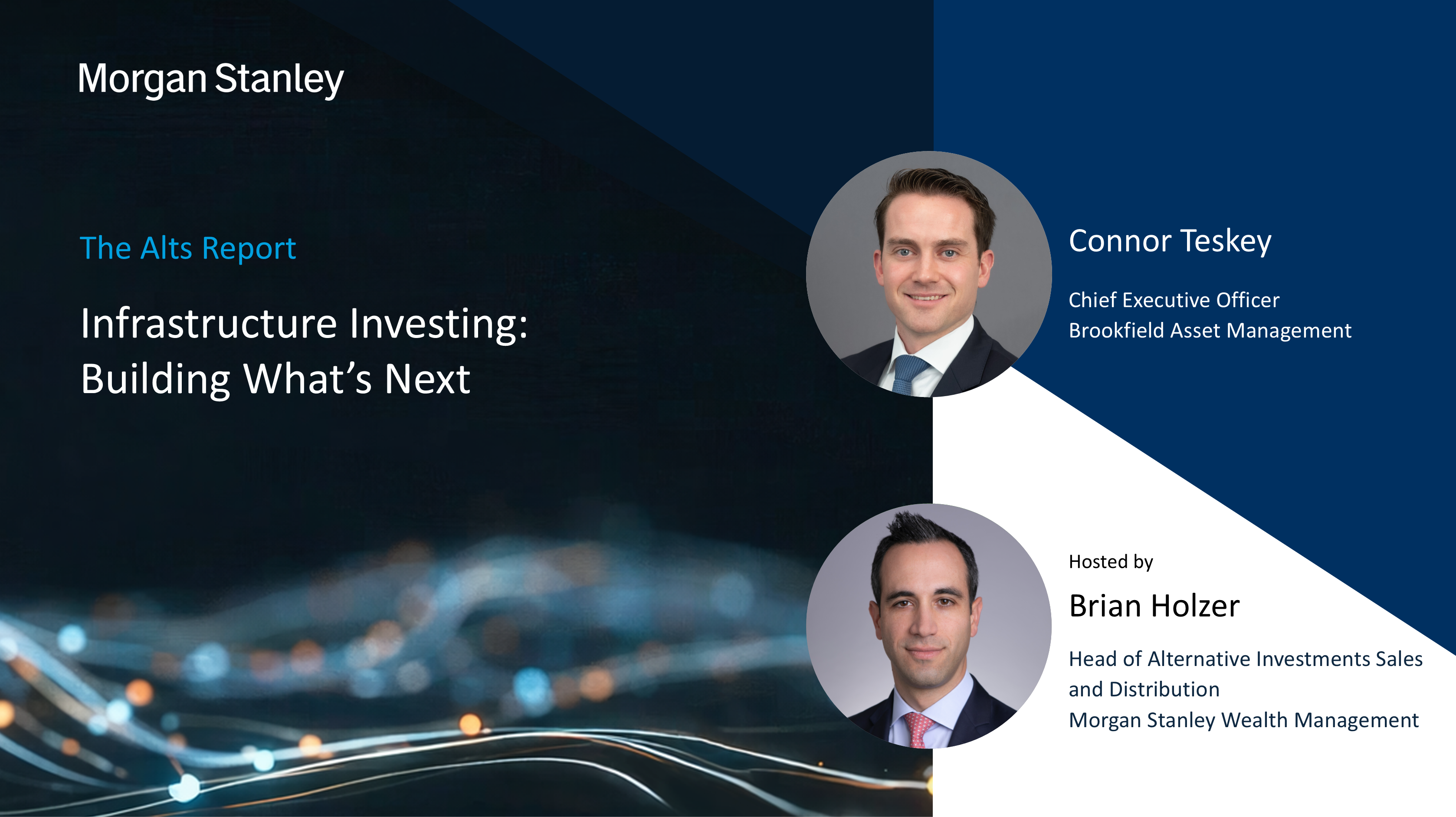
The power grids, data centers and transportation networks behind the modern economy require considerable investment. In this episode of The Alts Report, Brian Holzer, Head of Alternative Investments Sales & Distribution, sits down with Connor Teskey, Chief Executive Officer of Brookfield Asset Management, to discuss what’s driving infrastructure’s expansion and how the opportunity set continues to evolve.
VIDEO TRANSCRIPT
[COLD OPEN]
BRIAN HOLZER: Infrastructure was once viewed as more of a niche asset class. But today we’re seeing broader adoption amongst our clients.
CONNOR TESKEY: Over 70% of the assets that we invest in today were not investable asset classes 12 or 15 years ago.
[CUT TO THE ALTS REPORT OPENING SEQUENCE]
INTRODUCTION – BRIAN HOLZER
00:33
Welcome to The Alts Report, where we explore the value of alternative investments and the trends shaping today's markets.
LOWER THIRDS:
Brian Holzer
Head of Alternative Investments Sales & Distribution
Morgan Stanley Wealth Management
00:38
I'm pleased to welcome Connor Teskey, CEO of Brookfield Asset Management. Today, we're discussing infrastructure, an asset class where we have seen increased adoption amongst our clients. Infrastructure assets help to form the backbone of the economy.
00:52
They are essential systems that support how we live and work every day, from utilities that power our homes to data centers that help fuel the growth of artificial intelligence and transportation networks that move goods and connect people around the world. And these are just a few examples.
01:05
DISCUSSION
So, Connor, thanks for being with us today.
So, as I mentioned in my opening, infrastructure was once viewed as more of a niche asset class. But today we're seeing broader adoption amongst our clients. What do you think has changed?
ON-SCREEN QUESTION: Why is infrastructure seeing broader adoption?
01:17
CONNOR TESKEY
LOWER THIRDS:
Connor Teskey
Chief Executive Officer
Brookfield Asset Management
First of all, thank you for having us. Infrastructure is quickly becoming one of the largest and most excitable investment opportunities. And it's really being driven by two things. One, the opportunity set continues to expand. We've been investing in infrastructure for multiple decades. And one of the lines we like to use is over 70% of the assets that we invest in today were not investable asset classes 12 or 15 years ago. I'll give you an example.
01:48
15 years ago, we invested in toll roads and railroads. Today, we still invest in toll roads and railroads, but we also invest in telecom towers and fiber networks and data centers. 15 years ago, we invested in hydroelectric power dams. We still do that, but we also invest in solar and batteries and nuclear.
02:10
So, not only has the asset class grown, the benefits of investing in infrastructure have proven over the last several years to provide attributes to an investor's portfolio. They can provide stability, they're long duration, they're cash generative. And they can help protect against inflation.
02:29
BRIAN HOLZER
There have been some emerging trends over the past several years that are helping to drive some of this opportunity set, right? So how do you think about what is more cyclical excitement versus kind of real durable demand.
ON-SCREEN QUESTION: What are some of the long-term trends that are driving the opportunity set?
02:43
CONNOR TESKEY
Let's focus on the durable demand. About five years ago we identified three major themes in infrastructure that we thought would inform a lot of our activity over the next, let's say, 2 to 3 years. And those themes were the digitalization of absolutely everything. The world would need more energy than ever before, and the rewiring of global supply chains to focus on resiliency and production of critical goods and services closer to home.
03:12
And those themes were very exciting because, quite frankly, the growth opportunities and the capital needs were so significant that they not only outstripped the capital available from governments, they also outstripped the capital available from public markets. And that created a very large and attractive opportunity set for investors and private capital. Fast forward to today. Those three themes are actually more relevant today than they were five years ago. So we think those themes are going to run through the end of this decade and beyond.
03:45
BRIAN HOLZER
A fair point. When you think about certain trends, like artificial intelligence and others, they've only been accelerating over the past several years. You had touched on sources of funds, right? It used to be either governments, utilities, even public markets. What has happened over the past few years and why is private capital such an important source of funding today?
ON-SCREEN QUESTION: Why is private capital an important source of funding?
04:05
CONNOR TESKEY
So I think it goes to what is driving the growth in the infrastructure asset class. And, perhaps, let's say over the last 20 years, private capital has been increasing as an alternative or a substitute for government money. Historically, governments want to own the critical assets and provide the essential services to their population. Over the last two decades, the demand and desire to provide those services has only gone up. At the same time, government balance sheets have become stretched, and they don't actually have the financial firepower to fund those critical assets and essential services.
04:45
And that's created an opportunity for private capital to step in and invest in these critical infrastructure assets, both the existing ones and building new ones for the future. But there's also this second additional driver of growth in the asset class, which is corporates. The largest corporates around the world, which today are as large and as important as some of the major governments around the world.
05:10
They want their own infrastructure. They want security over their own supply chain. They want control over their own inputs. And that's creating a second demand layer for infrastructure. That, of course, is not going to be funded for governments, by governments, because it's not for the broader population, it's for those corporates themselves. So as the infrastructure asset class has continued to be an incredible source for capital, it's required that the private markets take an increasingly important and larger role.
05:42
BRIAN HOLZER
So let's pivot to asset allocation and portfolio construction. So, institutional investors have been large allocators to infrastructure for decades at this point. I mentioned in my opening we've seen increased adoption from high-net-worth, but still relatively under allocated. How do you think access has changed over the past few years, and how do you view that going forward?
ON-SCREEN QUESTION: How has access to infrastructure evolved?
06:07
CONNOR TESKEY
Access has changed tremendously just in terms of the products and strategies that are now increasingly available for high-net-worth investors. But, as we think about that, institutional investors are incredibly large organizations that are well designed to portfolio manage, handle liquidity, manage downside. When we think about the asset class for the high-net-worth investor, it's one that can provide attractive returns. But increased downside protection, a greater stability of earnings and potential protection against inflation, that is the investment profile, of infrastructure.
06:53
So, it's not only as the asset class becomes increasingly available, through new products and strategies that are available to high net worth. But just the increasing adoption that we've seen in the institutional segment over the last two decades, we're seeing in the high-net-worth segment just on a slightly lagged basis, and we expect both to see, continued allocations to infrastructure going forward and growing allocations.
07:18
BRIAN HOLZER
So final question, and you touched on a little bit, some of the other comments, but where do you see infrastructure fitting into a portfolio, and what role can it potentially play for long term investors?
ON-SCREEN QUESTION: What role can infrastructure potentially play for long-term investors?
07:30
CONNOR TESKEY
Infrastructure can sit right in that hybrid between your traditional public equity and your traditional public debt. It can provide you a return. But with downside protection, recurring cash generation and potential inflation protection, those four points, are really the hallmarks of the asset class. And what we're seeing in institutional portfolios, we very much expect to see replicated in high-net-worth portfolios over time, where as there is an increasing allocation to alternatives, we expect infrastructure to make a disproportionate amount of that alternative allocation given that the characteristics of it very much match what individual investors are looking for.
08:15
BRIAN HOLZER
And I think in today's environment, I think all of those unique return attributions are top of mind for both institutional and high-net-worth investors.
08:23
CONNOR TESKEY
You're absolutely correct. And not only are they increasingly top of mind every time there is a short-term disruption or headwind in the market over the last 5 or 6 years, infrastructure has just proven to reinforce those attributes, whether it was through a pandemic or through rising interest rates.
08:48
CLOSING – BRIAN HOLZER
Connor, this was great. Thank you again for being with us. We appreciate all of you joining us for this edition of The Alts Report. To learn more about Alternative Investments and our platform at Morgan Stanley, please visit morganstanley.com/alts or reach out to your Morgan Stanley Financial Advisor or Private Wealth Advisor. We look forward to seeing you next time.
VIDEO DISCLOSURES
Morgan Stanley Smith Barney LLC ("Morgan Stanley Wealth Management") - IMPORTANT DISCLOSURES
Morgan Stanley Wealth Management acts as a placement agent in connection with the offering and sale of the securities of the fund to current and prospective clients of Morgan Stanley Wealth Management or its affiliates. Morgan Stanley Wealth Management will receive cash compensation for its activities as placement agent from the fund’s manager, as described in Morgan Stanley Wealth Management’s point of sale letter, if applicable. In addition, Morgan Stanley Wealth Management, its affiliates or employees, may have additional relationships with the fund’s manager, including as an investor in the fund or other investment vehicles managed by the fund’s manager or as a client of the fund’s manager. The payment of cash compensation to Morgan Stanley Wealth Management, and any additional relationships that Morgan Stanley Wealth Management or its affiliates may have with the fund’s manager or other investment vehicles managed by the fund’s manager, create material conflicts of interest for Morgan Stanley Wealth Management in its role as placement agent.
All expressions of opinion are subject to change without notice and are not intended to be a forecast of future events or results. Further, opinions expressed herein may differ from the opinions expressed by Morgan Stanley Wealth Management and/or other businesses/affiliates of Morgan Stanley Wealth Management.
Alternative investments often are speculative and include a high degree of risk. Investors could lose all or a substantial amount of their investment. Alternative investments are appropriate only for eligible, long-term investors who are willing to forgo liquidity and put capital at risk for an indefinite period of time. They may be highly illiquid and can engage in leverage and other speculative practices that may increase the volatility and risk of loss. Alternative Investments typically have higher fees than traditional investments. Investors should carefully review and consider potential risks before investing.
The sole purpose of this material is to inform, and it in no way is intended to be an offer or solicitation to purchase or sell any security, other investment or service, or to attract any funds or deposits. Investments mentioned may not be appropriate for all clients. Any product discussed herein may be purchased only after a client has carefully reviewed the offering memorandum and executed the subscription documents. Morgan Stanley Wealth Management has not considered the actual or desired investment objectives, goals, guidelines, or factual circumstances of any investor in any fund(s). Before making any investment, each investor should carefully consider the risks associated with the investment, as discussed in the applicable offering memorandum, and make a determination based upon their own particular circumstances, that the investment is consistent with their investment objectives and risk tolerance.
As a diversified global financial services firm, Morgan Stanley Wealth Management engages in a broad spectrum of activities including financial advisory services, investment management activities, sponsoring and managing private investment funds, engaging in broker-dealer transactions and principal securities, commodities and foreign exchange transactions, research publication, and other activities. In the ordinary course of its business, Morgan Stanley Wealth Management therefore engages in activities where Morgan Stanley Wealth Management’s interests may conflict with the interests of its clients, including the private investment funds it manages. Morgan Stanley Wealth Management can give no assurance that conflicts of interest will be resolved in favor of its clients or any such fund.
Alternative investments involve complex tax structures, tax inefficient investing, and delays in distributing important tax information. Individual funds have specific risks related to their investment programs that will vary from fund to fund. Clients should consult their own tax and legal advisors as Morgan Stanley Wealth Management does not provide tax or legal advice.
Morgan Stanley Wealth Management is a business of Morgan Stanley Smith Barney LLC.
© 2026 Morgan Stanley Smith Barney LLC. Member SIPC. Alternative investment securities discussed herein are not covered by the protections provided by the Securities Investor Protection Corporation, unless such securities are registered under the Securities Act of 1933, as amended, and are held in a Morgan Stanley Wealth Management Individual Retirement Account.
CRC 5589406 06/26
Morgan Stanley Wealth Management offers qualified investors a full suite of alternative investments across various asset classes. Reach out to your Morgan Stanley Financial Advisor or Private Wealth Advisor to learn how alternative investments may strengthen your portfolio and help meet your financial goals.
Disclosures
Morgan Stanley Smith Barney LLC (“Morgan Stanley Wealth Management”) - IMPORTANT DISCLOSURES LLC
Morgan Stanley Wealth Management acts as a placement agent in connection with the offering and sale of the securities of the Fund to current and prospective clients of Morgan Stanley Wealth Management or its affiliates. Morgan Stanley Wealth Management will receive cash compensation for its activities as placement agent from the Fund’s manager, as described in Morgan Stanley Wealth Management’s point of sale letter, if applicable. In addition, Morgan Stanley Wealth Management, its affiliates or employees, may have additional relationships with the Fund’s manager, including as an investor in the Fund or other investment vehicles managed by the Fund’s manager or as a client of the Fund’s manager. The payment of cash compensation to Morgan Stanley Wealth Management, and any additional relationships that Morgan Stanley Wealth Management or its affiliates may have with the Fund’s manager or other investment vehicles managed by the Fund’s manager, create material conflicts of interest for Morgan Stanley Wealth Management in its role as placement agent.
The sole purpose of this material is to inform, and it in no way is intended to be an offer or solicitation to purchase or sell any security, other investment or service, or to attract any funds or deposits. Investments mentioned may not be appropriate for all clients. Any product discussed herein may be purchased only after a client has carefully reviewed the offering memorandum and executed the subscription documents. Morgan Stanley Wealth Management has not considered the actual or desired investment objectives, goals, guidelines, or factual circumstances of any investor in any fund(s). Before making any investment, each investor should carefully consider the risks associated with the investment, as discussed in the applicable offering memorandum, and make a determination based upon their own particular circumstances, that the investment is consistent with their investment objectives and risk tolerance.
Alternative investments often are speculative and include a high degree of risk. Investors could lose all or a substantial amount of their investment. Alternative investments are appropriate only for eligible, long-term investors who are willing to forgo liquidity and put capital at risk for an indefinite period of time. They may be highly illiquid and can engage in leverage and other speculative practices that may increase the volatility and risk of loss. Alternative Investments typically have higher fees than traditional investments. Investors should carefully review and consider potential risks before investing. Certain of these risks may include but are not limited to:
• Loss of all or a substantial portion of the investment due to leveraging, short-selling, or other speculative practices;
• Lack of liquidity in that there may be no secondary market for a fund;
• Volatility of returns
• Restrictions on transferring interests in a fund;
• Potential lack of diversification and resulting higher risk due to concentration of trading authority when a single advisor is utilized;
• Absence of information regarding valuations and pricing;
• Complex tax structures and delays in tax reporting;
• Less regulation and higher fees than mutual funds;
• Risks associated with the operations, personnel, and processes of the manager; and
• Risks associated with cybersecurity.
As a diversified global financial services firm, Morgan Stanley Wealth Management engages in a broad spectrum of activities including financial advisory services, investment management activities, sponsoring and managing private investment funds, engaging in broker-dealer transactions and principal securities, commodities and foreign exchange transactions, research publication, and other activities. In the ordinary course of its business, Morgan Stanley Wealth Management therefore engages in activities where Morgan Stanley Wealth Management’s interests may conflict with the interests of its clients, including the private investment funds it manages. Morgan Stanley Wealth Management can give no assurance that conflicts of interest will be resolved in favor of its clients or any such fund.
As part of the Morgan Stanley Private Markets – Access program, Morgan Stanley will be limited solely to a role as an introducer and will not be serving as a placement agent or adviser. Eligible investors must enroll in the program in order to see any investment opportunities. Investments require independent evaluation, due diligence, review & analysis. Neither Morgan Stanley nor any of its affiliates is making any recommendation to purchase or take any action of any sort and is not providing any advice on investments. Investors are asked to work directly with the issuer/sponsor and with your own independent (non-Morgan Stanley) financial, legal, accounting, tax, and other professional advisors to evaluate the investment opportunity.
Investors are responsible for complying with the terms of any applicable exemption from securities law requirements and any potential Private Company issuer restrictions for any sale of Private Company shares, and you must obtain your own legal counsel to advise you in connection with such requirements and Private Company issuer restrictions. You should consult with your third-party advisors regarding the risks of transacting in Private Company shares, including the risk of transacting in a market with little or no price transparency or liquidity. Morgan Stanley provides no opinion or view on the valuation of any Private Company shares, or the sufficiency, fairness or competitiveness of any price obtained. Private Securities do not trade on any national securities exchange and, as such, any potential liquidity (i.e., the potential for any buying interest that might satisfy your sell interest) in such Private Company shares is very limited.
Investments of this nature include a high degree of risk, likely will be highly illiquid and can engage in leverage and other speculative practices that may increase the volatility and risk of loss. Investors could lose all or a substantial amount of their investment. Investments are appropriate only for eligible investors who are willing to put capital at risk for an indefinite period of time.
Past performance is no guarantee of future results. Actual results may vary. Diversification does not assure a profit or protect against loss in a declining market.
As a diversified global financial services firm, Morgan Stanley engages in a broad spectrum of activities including financial advisory services, investment management activities, sponsoring and managing private investment funds, engaging in broker-dealer transactions and principal securities, commodities and foreign exchange transactions, research publication, and other activities. In the ordinary course of its business, Morgan Stanley therefore engages in activities where Morgan Stanley interests may conflict with the interests of its clients, including the private investment funds it manages. Morgan Stanley can give no assurance that conflicts of interest will be resolved in favor of its clients or any such fund. All expressions of opinion are subject to change without notice and are not intended to be a forecast of future events or results. Further, opinions expressed herein may differ from the opinions expressed by Morgan Stanley Wealth Management and/or other businesses/affiliates of Morgan Stanley Wealth Management.
This is not a "research report" as defined by FINRA Rule 2241 or a "debt research report" as defined by FINRA Rule 2242 and was not prepared by the Research Departments of Morgan Stanley Smith Barney LLC or Morgan Stanley & Co. LLC or its affiliates. Alternative investments involve complex tax structures, tax inefficient investing, and delays in distributing important tax information. Individual funds have specific risks related to their investment programs that will vary from fund to fund. Clients should consult their own tax and legal advisors as Morgan Stanley Wealth Management does not provide tax or legal advice.
Interests in alternative investment products are only made available pursuant to the terms of the applicable offering memorandum, are distributed by Morgan Stanley Wealth Management and certain of its affiliates, and (1) are not FDIC-insured, (2) are not deposits or other obligations of Morgan Stanley Wealth Management or any of its affiliates, (3) are not guaranteed by Morgan Stanley Wealth Management and its affiliates, and (4) involve investment risks, including possible loss of principal. Morgan Stanley Wealth Management is a registered broker-dealer, not a bank.
Morgan Stanley Wealth Management is a business of Morgan Stanley Smith Barney LLC.
Real estate investments are subject to special risks, including interest rate and property value fluctuations, as well as risks related to general and economic conditions.
Environmental, Social and Governance (“ESG”) investments in a portfolio may experience performance that is lower or higher than a portfolio not employing such practices. Portfolios with ESG restrictions and strategies as well as ESG investments may not be able to take advantage of the same opportunities or market trends as portfolios where ESG criteria is not applied. There are inconsistent ESG definitions and criteria within the industry, as well as multiple ESG ratings providers that provide ESG ratings of the same subject companies and/or securities that vary among the providers. Certain issuers of investments may have differing and inconsistent views concerning ESG criteria where the ESG claims made in offering documents or other literature may overstate ESG impact. ESG designations are as of the date of this material, and no assurance is provided that the underlying assets have maintained or will maintain and such designation or any stated ESG compliance. As a result, it is difficult to compare ESG investment products or to evaluate an ESG investment product in comparison to one that does not focus on ESG. Investors should also independently consider whether the ESG investment product meets their own ESG objectives or criteria.
There is no assurance that an ESG investing strategy or techniques employed will be successful. Past performance is not a guarantee or a dependable measure of future results.
© 2026 Morgan Stanley Smith Barney LLC. Member SIPC. Alternative investment securities discussed herein are not covered by the protections provided by the Securities Investor Protection Corporation, unless such securities are registered under the Securities Act of 1933, as amended, and are held in a Morgan Stanley Wealth Management Individual Retirement Account.
CRC# 5752760 (07/2026)