E3 • March 16, 2026 • 8 mins
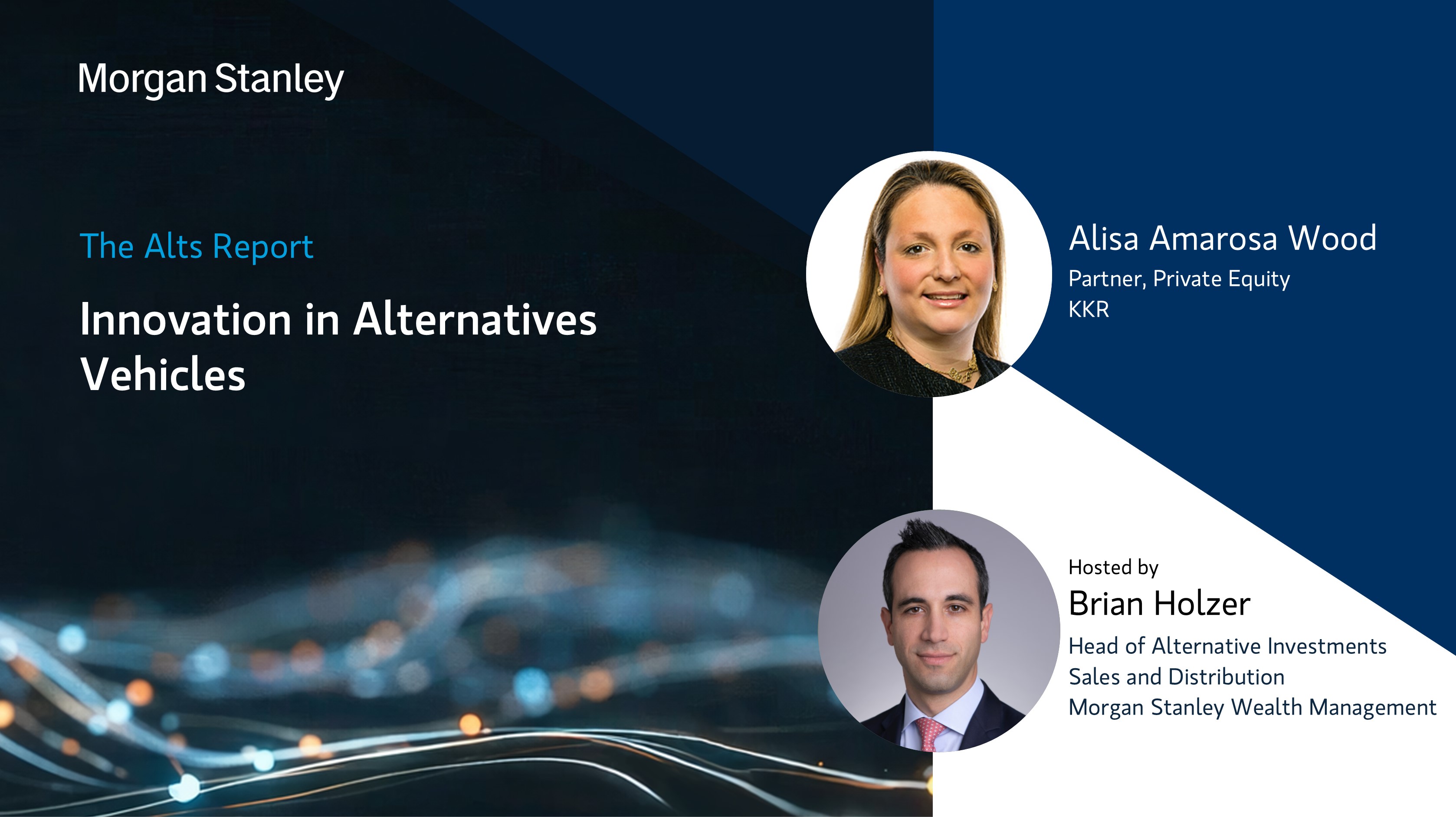
Brian Holzer, Head of Alternative Investments Sales & Distribution, sits down with Alisa Wood, Partner at KKR, to discuss what’s driving the rapid growth in private markets, how evergreen and registered structures are reshaping access, and key considerations for portfolio construction – including why alternatives are often approached with a longer investment horizon.
00;00;00;14 - 00;00;22;20
Brian
Welcome to The Alts Report, where we explore the value of alternative investment and the trends shaping today's markets today. We are onsite at KKR Global Headquarters, and I'm pleased to have Alisa Wood, a partner at KKR, join us. Over the past decade, private markets asset under management has more than tripled, currently in the range of 18 to 20 trillion.
00;00;22;22 - 00;00;44;05
Brian
Now, most of that growth has been fueled by institutional investors. But with recent product innovation and access to alternatives improving, we've already started to see this dynamic shift and greater adoption from individual investors.
00;00;44;06 - 00;00;57;23
Brian
So, Alisa, thanks for being with us today. I appreciate you having to state your office. So maybe to start, I mentioned my opening. We've seen tremendous growth right, in alternative investments over the past decade. What's been driving that expansion and where do you think the industry is heading from here?
00;00;58;00 - 00;01;24;03
Alisa
Sure. And thanks for having me. I think it's actually pretty simple. I think what we've seen is a few different factors, some macro, some asset allocation related, and some just in terms of where capital is appreciating. You know, first and foremost, we've seen the correlation between asset classes fundamentally shift in the last decade. We've also seen a compression and started to see a compression of returns in certain asset classes, depending on different vintage years in different cycles.
00;01;24;03 - 00;01;43;00
Alisa
So early adopters into private equity and private investments realized probably 30 or 40 years ago that if you put that in an asset allocation, it winds up being as a hedge or an uncorrelated or less correlated return stream, than public equities or fixed income or things of that nature. And I think that is playing true more today than ever.
00;01;43;03 - 00;02;06;23
Alisa
I think the second piece of it is, is that companies are staying private longer, right? So they're 40% fewer public companies today. If you look at 20, 25 years ago versus today, companies, you know, back then took probably four years to go public. Today it's probably three times that. So if you want to access, you know that entire remit of different assets in different companies, you can't just invest in the public space.
00;02;07;00 - 00;02;26;06
Alisa
And then the final piece of it is, is we're seeing the public markets really be driven by a lot of AI and technology. Nothing wrong with that. But if you think about what different firms are investing in in the private space, you're actually getting a very different industry. You know, exposure, which and by the way, exposure at a different size as well.
00;02;26;07 - 00;02;34;08
Alisa
Right. When you think about where private investing is typically happening, it really does give that full diversification. So I think that's honestly what we're seeing today.
00;02;34;11 - 00;02;51;13
Brian
So let's talk a little bit about product structure right. So innovation and product structure such as semi liquid vehicles right. They've made alternatives more accessible to a broader audience. What do you think has been the most impactful developments. How have they changed the way investors use alternatives?
00;02;51;14 - 00;03;09;26
Alisa
Sure I think it's really simple actually. You know, in 50 years we've not seen the evolution of closed end funds, right. The way those, you know, pools of capital have been operating, it's literally been the same nothing in financial services and stayed the same in 50 years. Right. So this was ripe for innovation and ripe for evolution.
00;03;09;29 - 00;03;35;23
Alisa
But I don't think it's a revolution. I think it's an evolution. Right. And when you think about it, all that's happened is the inefficiencies and some of the frictional pain points, depending on the size of the client that you are, have come out of, come out of that structure. Right. So a closed end fund, you manage the operational complexity as the end investor. In an open end fund and an evergreen fund, the manager actually owns and operates that operational complexity.
00;03;35;24 - 00;04;05;00
Alisa
That's the fundamental difference. So whether it's J curve mitigation, capital call management, optimizing for you know, a higher velocity of compounding, better diversification, all of that are the benefits of of this, you know, I would say new evolved structure. It's exciting. I think it's actually creating more opportunity for folks who maybe didn't have that, that stomach for the operational complexity to actually lean in and and get that opportunity to get those same type of less correlated returns.
00;04;05;01 - 00;04;20;18
Brian
So as we've seen, the number of funds grow, right? The money flowing into them continues to grow. What should investors be considering in your mind? What will allow certain ones to stand the test of time where maybe others you need to make sure you close attention?
00;04;20;18 - 00;04;36;14
Alisa
So I think it's really simple actually. I think to be a good closed end fund investor, what do you have to be good at? You gotta be good at one thing. You got to invest well. And by the way, I don't want to downplay that. That's really hard to do. Okay, that's a high bar, but that's all you really have to do.
00;04;36;16 - 00;04;59;11
Alisa
As a, as an open end or an evergreen structure that's table stakes. Being a good investor is the basic, you know, thing that gets you in the room, but you then have to be really good at two other things, and you've got to be good at managing operational complexity, liquidity, cash management, hedging, monthly valuations. All of that takes lots of resources that if you're not going to make that investment, you can potentially get really tripped up on.
00;04;59;13 - 00;05;19;00
Alisa
And then the final piece, which I think this is probably the least understood, is do you actually have enough investment flow to feed these vehicles? Right. Like you're taking capital in on a monthly basis? It may be linear. It may not be linear. You've got to manage the ability to have redemptions on in many cases quarterly basis. Like it's complicated.
00;05;19;03 - 00;05;37;22
Alisa
Right. And so can you manage that complexity and can you actually feed it in the right way and make sure you're feeding it with, you know, the things that will generate the return versus, you know, low hanging fruit that may be less attractive. That I think is what good looks like. Now, I think that we're going to see play out in the next however many years.
00;05;37;22 - 00;05;49;27
Alisa
I think there are a lot of evergreens that have been, created over the last few years. I don't think all of them have a right to win. I don't think all of them will be successful. And I think it's really going to come down to how do you rank them on those three metrics?
00;05;50;04 - 00;06;07;24
Brian
So let's close with portfolio construction or incorporating alternatives into portfolios. What are the key considerations for implementation? How should investors think about position sizing? How should they think about liquidity management and really just overall portfolio construction around alternatives?
00;06;07;24 - 00;06;29;06
Alisa
Sure. I know it's a great point. I think at the end of the day, you got to start out with the understanding of what what should good look like if you're investing in privates or private equity. The answer is you should be able to – and this is just basic benchmarking – you should be able to deliver 500 plus basis points in some cases top quartile 500 to 700 basis points above the public markets.
00;06;29;06 - 00;06;48;29
Alisa
Now, the beauty of private equity is in periods of dislocation it's double to triple that. Right. And that's the power of this. Now how can you do that? You do that because this is all about long term capital appreciation. This is not about the quick flip right. And I think that's how you think about the liquidity management piece of it.
00;06;49;05 - 00;07;05;17
Alisa
We like to say that if you're not going to hold an evergreen for at least five years, you shouldn't invest in it right. Now that's different than a closed end, you know, fund investment that might be 10 or 12 years long. And part of it is you can pull forward the maturity of the portfolio because of that structure and compound at a higher rate.
00;07;05;17 - 00;07;16;17
Alisa
That is really exciting and interesting, but you've got to think about it in terms of long term capital appreciation. So when you set your your allocation to what you want it to be, that's the framework that you've got to think about it.
00;07;16;17 - 00;07;24;06
Brian
And I think that I think that's a great point. Right. Even though these evergreen funds offer liquidity, if you need it, you should still think about it with a much longer time horizon.
00;07;24;11 - 00;07;39;17
Alisa
Absolutely. I mean, we say this all the time, this is not a mutual fund, right? And when you think about the liquidity, the liquidity is there in case you need it. Right? The liquidity is there. So you can decide when you want to invest and when you want to redeem. Like that's one of the biggest differences in the structure.
00;07;39;23 - 00;07;56;26
Alisa
And by the way, it does give access to a whole different group of investors who wouldn't typically have been able to access closed end structures. And by the way, that's all good. But you've got to have this long term mindset, right? Because if you don't, I think you're materially going to impair the ability you're going to have to generate those returns.
00;07;56;28 - 00;08;13;06
Brian
Great, Alyssa. Thank you. Appreciate you having us. And thank you to all of you for joining this edition of the Arts Report. To learn more about Alternative Investments and our platform at Morgan Stanley, please visit ms.com/alts or reach out to your Morgan Stanley Financial Advisor or Private Wealth Advisor. We look forward to seeing you next time.
Morgan Stanley Smith Barney LLC ("Morgan Stanley Wealth Management") - IMPORTANT DISCLOSURES
Morgan Stanley Wealth Management acts as a placement agent in connection with the offering and sale of the securities of the fund to current and prospective clients of Morgan Stanley Wealth Management or its affiliates. Morgan Stanley Wealth Management will receive cash compensation for its activities as placement agent from the fund’s manager, as described in Morgan Stanley Wealth Management’s point of sale letter, if applicable. In addition, Morgan Stanley Wealth Management, its affiliates or employees, may have additional relationships with the fund’s manager, including as an investor in the fund or other investment vehicles managed by the fund’s manager or as a client of the fund’s manager. The payment of cash compensation to Morgan Stanley Wealth Management, and any additional relationships that Morgan Stanley Wealth Management or its affiliates may have with the fund’s manager or other investment vehicles managed by the fund’s manager, create material conflicts of interest for Morgan Stanley Wealth Management in its role as placement agent.
All expressions of opinion are subject to change without notice and are not intended to be a forecast of future events or results. Further, opinions expressed herein may differ from the opinions expressed by Morgan Stanley Wealth Management and/or other businesses/affiliates of Morgan Stanley Wealth Management.
Alternative investments often are speculative and include a high degree of risk. Investors could lose all or a substantial amount of their investment. Alternative investments are appropriate only for eligible, long-term investors who are willing to forgo liquidity and put capital at risk for an indefinite period of time. They may be highly illiquid and can engage in leverage and other speculative practices that may increase the volatility and risk of loss. Alternative Investments typically have higher fees than traditional investments. Investors should carefully review and consider potential risks before investing.
The sole purpose of this material is to inform, and it in no way is intended to be an offer or solicitation to purchase or sell any security, other investment or service, or to attract any funds or deposits. Investments mentioned may not be appropriate for all clients. Any product discussed herein may be purchased only after a client has carefully reviewed the offering memorandum and executed the subscription documents. Morgan Stanley Wealth Management has not considered the actual or desired investment objectives, goals, guidelines, or factual circumstances of any investor in any fund(s). Before making any investment, each investor should carefully consider the risks associated with the investment, as discussed in the applicable offering memorandum, and make a determination based upon their own particular circumstances, that the investment is consistent with their investment objectives and risk tolerance.
As a diversified global financial services firm, Morgan Stanley Wealth Management engages in a broad spectrum of activities including financial advisory services, investment management activities, sponsoring and managing private investment funds, engaging in broker-dealer transactions and principal securities, commodities and foreign exchange transactions, research publication, and other activities. In the ordinary course of its business, Morgan Stanley Wealth Management therefore engages in activities where Morgan Stanley Wealth Management’s interests may conflict with the interests of its clients, including the private investment funds it manages. Morgan Stanley Wealth Management can give no assurance that conflicts of interest will be resolved in favor of its clients or any such fund.
Alternative investments involve complex tax structures, tax inefficient investing, and delays in distributing important tax information. Individual funds have specific risks related to their investment programs that will vary from fund to fund. Clients should consult their own tax and legal advisors as Morgan Stanley Wealth Management does not provide tax or legal advice.
Morgan Stanley Wealth Management is a business of Morgan Stanley Smith Barney LLC.
© 2026 Morgan Stanley Smith Barney LLC. Member SIPC. Alternative investment securities discussed herein are not covered by the protections provided by the Securities Investor Protection Corporation, unless such securities are registered under the Securities Act of 1933, as amended, and are held in a Morgan Stanley Wealth Management Individual Retirement Account.
CRC 5257816 03/2026
E2 • February 10, 2026 • 9 mins
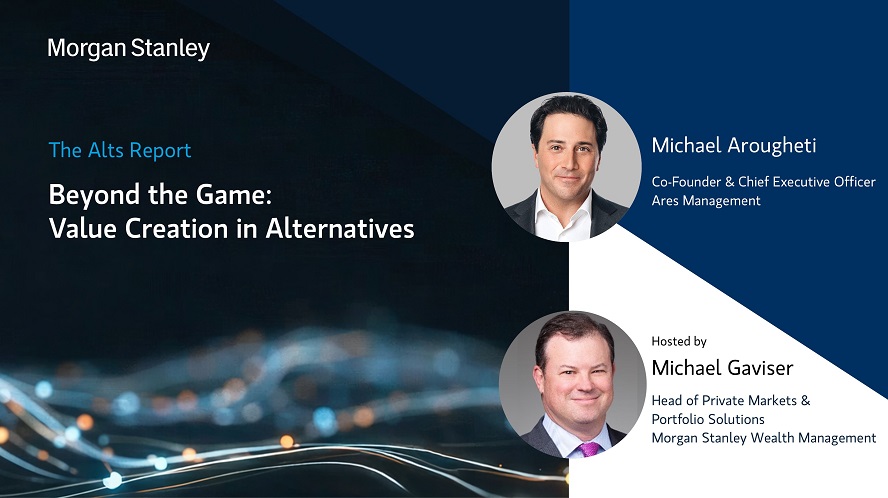
From the field to the portfolio. Michael Gaviser, Head of Morgan Stanley Wealth Management’s Private Markets & Portfolio Solutions, sits down with Michael Arougheti, CEO of Ares Management, to explore how sports investing extends beyond team ownership, alongside opportunities in real estate and infrastructure – and how investors are gaining access.
01;00;17;10 - 01;00;42;25
Speaker 1 Michael Gaviser
Welcome to the Altes Report, where we explore the value of alternative investments and the trends in the marketplace. Happy to be here in Vail, Colorado at the Morgan Stanley Are's due Diligence day, with Mike Arougheti, who's the CEO and founder of Ares. Mike, you've had so many different experiences across the landscape, whether it's private credit, private equity, sports, real estate, really a privilege for all of us to be able to spend some time talking about different market segments.
01;00;42;25 - 01;00;45;23
Speaker 1 Michael Gaviser
And your thoughts on the market in general
01;00;45;25 - 01;00;51;14
Speaker 2 Michael Arougheti
Great to be here, and thanks for the support. It's amazing to see all the advisors here engaging with us on the value of private market investing.
01;00;51;16 - 01;01;13;13
Speaker 1 Michael Gaviser
If we talk about the market, Mike, you know, we've seen studies that suggest that, you know, this is a $30 trillion market for individuals by 2030. We've seen lots of adoption in portfolios in generally across the individual market, over the last several years into alternatives. Can you give us a sense of what you think's driving that market and why we're seeing that shift?
01;01;13;15 - 01;01;58;15
Speaker 2 Michael Arougheti
Probably to think about it through two lenses. One is access and we're talking about access it's really about what is the investable market opportunity that's available to institution and institutional and, wealth clients. And it's interesting because private markets have been taking market share from the public markets pretty consistently for the last 30 years. And I think that's a function of the evolution of the capital available to support growth in the private markets and some of the structural constraints that exist in the public markets in terms of a lack of flexibility in structure or lack of accommodation for smaller companies and issuers and borrowers that have pushed people into the private market.
01;01;58;15 - 01;02;25;01
Speaker 2 Michael Arougheti
But they've had a really positive experience there, and the market has figured out how to keep them private longer. You could see that just in the shrinking number of public companies over time. You can see it in the increasing concentration of market cap in the public companies, and the public markets over time in the traded credit markets, you could see it in the average issuer size and the expansion of those markets to accommodate only the largest.
01;02;25;01 - 01;02;43;14
Speaker 2 Michael Arougheti
So there's been this big secular trend to growth in private. But when I talk about access, the challenge has always been the individual investor has not had the benefit of accessing those asset opportunities. For for years, it was the purview just of the large institutional.
01;02;43;19 - 01;02;56;02
Speaker 1 Michael Gaviser
And do you feel like it's the opportunity for return and performance and diversification? They've always been there. But maybe the structures that would allow individuals to engage haven't actually been set up yet. And that's one of the big changes.
01;02;56;02 - 01;03;30;02
Speaker 2 Michael Arougheti
Yeah So I think it's structure education both for the individual investor and the advisor and technology. And I think those three things have kind of converged at the same time to promote better access. And I think now with the products that we have, whether it's monthly or quarterly liquidity, while we still recommend that folks don't view these as traded, having a path to liquidity to the extent you need it for personal reasons or for portfolio reconstruction, I think was a real value unlock -
01;03;30;02 - 01;03;31;20
Speaker 1 Michael Gaviser
Sure-
Speaker 2 Michael Arougheti
- from a structural standpoint.
01;03;31;20 - 01;03;54;12
Speaker 1 Michael Gaviser
So shifting or drilling down a little bit more, you know, we're in a little bit different world, right rates have normalized. We're not at zero rates anymore. Then obviously real estate sensitive to that. We've also had Covid and we had office vacancies and we've had big building in multifamily. There's a lot of things going on, like how do you look at real estate today from an opportunity perspective, and what are your thoughts?
01;03;54;15 - 01;04;24;20
Speaker 2 Michael Arougheti
I think you have to always think about the real estate market between secular trends and cyclical trends. Cyclically, the entry point for real estate is very well set up. You've had an under build in the major food groups of multifamily and industrial. So we're coming into the current environment with an undersupply. You've seen a drawdown in real estate values generally across the board putting office to the side down 18 to 20%.
01;04;24;20 - 01;04;48;15
Speaker 2 Michael Arougheti
So you've kind of bottomed out. And now we're getting into a constructive rate environment, which over time will get us to a constructive cap rate environment. And you should see transaction activity pick up cyclically. Generally speaking, when we see that bottoming and we've seen it in past cycles, you tend to pick up 400 basis points or so of incremental return on the index.
01;04;48;18 - 01;05;16;07
Speaker 2 Michael Arougheti
So being being thoughtful about your entry point in real estate is a way to drive outperformance. But what's also happening is you're having major secular tailwinds in the real asset market, where global supply chains are reorganizing…
Speaker 1 Michael Gaviser
And as people start building things…
Speaker 2 Michael Arougheti
…reshoring, near shoring, friend shoring, people are building redundancies. And that's creating a lot of demand for industrial real estate.
01;05;16;11 - 01;05;43;27
Speaker 2 Michael Arougheti
You're seeing increased e-commerce penetration that's creating a secular demand for warehouses. You're seeing the proliferation of digital infra and data centers off of the industrial backbone. You have an aging population, that is changing the way that they live. You've got people who are now dealing with affordability in the housing market that are looking at the rental market as a viable alternative.
01;05;43;27 - 01;05;54;00
Speaker 2 Michael Arougheti
So you have also a lot of really interesting secular tailwinds that are promoting demand in the real estate market at a time when the cyclical uptick feels like it's well underway.
01;05;54;00 - 01;06;10;12
Speaker 1 Michael Gaviser
So that all makes a lot of sense. So maybe if we pivot we've talked a lot about, with sports in the past and the opportunities in sports and, and I think the thing that most of us know the most about is buying a team and owning the equity of the team.
01;06;10;14 - 01;06;23;07
Speaker 1 Michael Gaviser
Do you feel like there's more to the sports, kind of ecosystem than simply just owning a franchise? Is there other stuff going on that investors can, you know, gain return from? And how do you think about that landscape?
01;06;23;10 - 01;06;58;20
Speaker 2 Michael Arougheti
We were very intentional about the way that we set up our sports practice, which was to call it sports, media and entertainment. There's a lot that happens around teams and leagues, from an asset and investment opportunity perspective, that could probably take a $3 trillion teams and league market and five X it. So things like sports equipment and sports gear, ticketing platforms in stadium hospitality, around stadium real estate developments, in stadium, out of stadium…
01;06;58;20 - 01;06;59;08
Speaker 1 Michael Gaviser
Everything out side of the game.
01;06;59;09 - 01;07;30;03
Speaker 2 Michael Arougheti
Advertising youth sports as a pipeline to professional sports, college sports is now investable talent agencies so so on and so forth. So yes, the teams in the leagues are kind of at the center of the value creation, because those are the ones that create the sticky customer base. They're the ones that create the brand and the IP, and they're the ones that drive the increasing value in the unscripted content that pulls everybody up with them.
01;07;30;07 - 01;07;40;22
Speaker 2 Michael Arougheti
But if all you do is focus on equity investments in teams, you're missing this entire world of of investment that that opens up to you.
01;07;40;23 - 01;07;48;16
Speaker 1 Michael Gaviser
What is it about this market that there's so much growth behind it, when we don't really have that many different teams than we had 30 or 40 years ago?
01;07;48;23 - 01;08;14;05
Speaker 2 Michael Arougheti
The underpinning of growth is media rights. That is generally least in the major sports leagues. That is ultimately what is going to drive valuation back to media and entertainment. There's been a transformational shift in the media landscape from wired cable to over-the-top and streaming that's changing the way people are consuming content and the way that people are valuing content.
01;08;14;07 - 01;08;40;11
Speaker 2 Michael Arougheti
But if you look at the length of the media, deals are getting signed by global sports leagues and the value the underpinnings are there to support continued valuation increase. Just on what we see today. And I actually look at spending patterns and the consumer is actually shifting spending to experiences versus things. And that's sports and that's concerts and that's live events.
01;08;40;18 - 01;09;02;20
Speaker 2 Michael Arougheti
And so there's something happening there too that's detached from media, that's just behavioral that I think is, you know, fueling some of this. And then look in sports and it's funny because in sports you have people who are anxious about 10 to 15% compound annual growth. There's scarcity value. Right. There's just a limited number. To your point, they don't trade very often.
01;09;02;22 - 01;09;28;08
Speaker 2 Michael Arougheti
They are in some cases stores of value. Right. Detached from the growth in revenue that comes from media, their stores, a value of the same way that you have gold, silver, crypto where people view it as a store of value, that. So there's something that's happening in team valuations over time too, which is just the scarcity and quality of that asset is also, you know, highly differentiated.
01;09;28;12 - 01;09;44;07
Speaker 1 Michael Gaviser
Mike, thanks for joining us for The Alts Report for a great fun.
Speaker 2 Michael Arougheti
Thanks. Great fun.
Speaker 1 Michael Gaviser
Really enjoyed having you. I think we all learned a lot. And if folks want more information they can go to Morganstanley.com/alts. Or they can reach out to their financial advisor and certainly lots of different opportunities for education, as you mentioned.
01;09;44;07 - 01;09;45;01
Speaker 2 Michael Arougheti
For sure. Thanks for the support.
Morgan Stanley Smith Barney LLC ("Morgan Stanley Wealth Management") - IMPORTANT DISCLOSURES
Morgan Stanley Wealth Management acts as a placement agent in connection with the offering and sale of the securities of the Fund to current and prospective clients of Morgan Stanley Wealth Management or its affiliates. Morgan Stanley Wealth Management will receive cash compensation for its activities as placement agent from the Fund’s manager, as described in Morgan Stanley Wealth Management’s point of sale letter, if applicable. In addition, Morgan Stanley Wealth Management, its affiliates or employees, may have additional relationships with the Fund’s manager, including as an investor in the Fund or other investment vehicles managed by the Fund’s manager or as a client of the Fund’s manager. The payment of cash compensation to Morgan Stanley Wealth Management, and any additional relationships that Morgan Stanley Wealth Management or its affiliates may have with the Fund’s manager or other investment vehicles managed by the Fund’s manager, create material conflicts of interest for Morgan Stanley Wealth Management in its role as placement agent.
All expressions of opinion are subject to change without notice and are not intended to be a forecast of future events or results. Further, opinions expressed herein may differ from the opinions expressed by Morgan Stanley Wealth Management and/or other businesses/affiliates of Morgan Stanley Wealth Management.
Alternative investments often are speculative and include a high degree of risk. Investors could lose all or a substantial amount of their investment. Alternative investments are appropriate only for eligible, long-term investors who are willing to forgo liquidity and put capital at risk for an indefinite period of time. They may be highly illiquid and can engage in leverage and other speculative practices that may increase the volatility and risk of loss. Alternative Investments typically have higher fees than traditional investments. Investors should carefully review and consider potential risks before investing.
The sole purpose of this material is to inform, and it in no way is intended to be an offer or solicitation to purchase or sell any security, other investment or service, or to attract any funds or deposits. Investments mentioned may not be appropriate for all clients. Any product discussed herein may be purchased only after a client has carefully reviewed the offering memorandum and executed the subscription documents. Morgan Stanley Wealth Management has not considered the actual or desired investment objectives, goals, guidelines, or factual circumstances of any investor in any fund(s). Before making any investment, each investor should carefully consider the risks associated with the investment, as discussed in the applicable offering memorandum, and make a determination based upon their own particular circumstances, that the investment is consistent with their investment objectives and risk tolerance.
As a diversified global financial services firm, Morgan Stanley Wealth Management engages in a broad spectrum of activities including financial advisory services, investment management activities, sponsoring and managing private investment funds, engaging in broker-dealer transactions and principal securities, commodities and foreign exchange transactions, research publication, and other activities. In the ordinary course of its business, Morgan Stanley Wealth Management therefore engages in activities where Morgan Stanley Wealth Management’s interests may conflict with the interests of its clients, including the private investment funds it manages. Morgan Stanley Wealth Management can give no assurance that conflicts of interest will be resolved in favor of its clients or any such fund.
Alternative investments involve complex tax structures, tax inefficient investing, and delays in distributing important tax information. Individual funds have specific risks related to their investment programs that will vary from fund to fund. Clients should consult their own tax and legal advisors as Morgan Stanley Wealth Management does not provide tax or legal advice.
Morgan Stanley Wealth Management is a business of Morgan Stanley Smith Barney LLC.
© 2026 Morgan Stanley Smith Barney LLC. Member SIPC. Alternative investment securities discussed herein are not covered by the protections provided by the Securities Investor Protection Corporation, unless such securities are registered under the Securities Act of 1933, as amended, and are held in a Morgan Stanley Wealth Management Individual Retirement Account.
CRC 5173532 02/2026
Morgan Stanley Wealth Management offers qualified investors a full suite of alternative investments across various asset classes. Reach out to your Morgan Stanley Financial Advisor or Private Wealth Advisor to learn how alternative investments may strengthen your portfolio and help meet your financial goals.
Disclosures
Morgan Stanley Smith Barney LLC (“Morgan Stanley Wealth Management”) - IMPORTANT DISCLOSURES LLC
Morgan Stanley Wealth Management acts as a placement agent in connection with the offering and sale of the securities of the Fund to current and prospective clients of Morgan Stanley Wealth Management or its affiliates. Morgan Stanley Wealth Management will receive cash compensation for its activities as placement agent from the Fund’s manager, as described in Morgan Stanley Wealth Management’s point of sale letter, if applicable. In addition, Morgan Stanley Wealth Management, its affiliates or employees, may have additional relationships with the Fund’s manager, including as an investor in the Fund or other investment vehicles managed by the Fund’s manager or as a client of the Fund’s manager. The payment of cash compensation to Morgan Stanley Wealth Management, and any additional relationships that Morgan Stanley Wealth Management or its affiliates may have with the Fund’s manager or other investment vehicles managed by the Fund’s manager, create material conflicts of interest for Morgan Stanley Wealth Management in its role as placement agent.
The sole purpose of this material is to inform, and it in no way is intended to be an offer or solicitation to purchase or sell any security, other investment or service, or to attract any funds or deposits. Investments mentioned may not be appropriate for all clients. Any product discussed herein may be purchased only after a client has carefully reviewed the offering memorandum and executed the subscription documents. Morgan Stanley Wealth Management has not considered the actual or desired investment objectives, goals, guidelines, or factual circumstances of any investor in any fund(s). Before making any investment, each investor should carefully consider the risks associated with the investment, as discussed in the applicable offering memorandum, and make a determination based upon their own particular circumstances, that the investment is consistent with their investment objectives and risk tolerance.
Alternative investments often are speculative and include a high degree of risk. Investors could lose all or a substantial amount of their investment. Alternative investments are appropriate only for eligible, long-term investors who are willing to forgo liquidity and put capital at risk for an indefinite period of time. They may be highly illiquid and can engage in leverage and other speculative practices that may increase the volatility and risk of loss. Alternative Investments typically have higher fees than traditional investments. Investors should carefully review and consider potential risks before investing. Certain of these risks may include but are not limited to:
• Loss of all or a substantial portion of the investment due to leveraging, short-selling, or other speculative practices;
• Lack of liquidity in that there may be no secondary market for a fund;
• Volatility of returns
• Restrictions on transferring interests in a fund;
• Potential lack of diversification and resulting higher risk due to concentration of trading authority when a single advisor is utilized;
• Absence of information regarding valuations and pricing;
• Complex tax structures and delays in tax reporting;
• Less regulation and higher fees than mutual funds;
• Risks associated with the operations, personnel, and processes of the manager; and
• Risks associated with cybersecurity.
As a diversified global financial services firm, Morgan Stanley Wealth Management engages in a broad spectrum of activities including financial advisory services, investment management activities, sponsoring and managing private investment funds, engaging in broker-dealer transactions and principal securities, commodities and foreign exchange transactions, research publication, and other activities. In the ordinary course of its business, Morgan Stanley Wealth Management therefore engages in activities where Morgan Stanley Wealth Management’s interests may conflict with the interests of its clients, including the private investment funds it manages. Morgan Stanley Wealth Management can give no assurance that conflicts of interest will be resolved in favor of its clients or any such fund.
As part of the Morgan Stanley Private Markets – Access program, Morgan Stanley will be limited solely to a role as an introducer and will not be serving as a placement agent or adviser. Eligible investors must enroll in the program in order to see any investment opportunities. Investments require independent evaluation, due diligence, review & analysis. Neither Morgan Stanley nor any of its affiliates is making any recommendation to purchase or take any action of any sort and is not providing any advice on investments. Investors are asked to work directly with the issuer/sponsor and with your own independent (non-Morgan Stanley) financial, legal, accounting, tax, and other professional advisors to evaluate the investment opportunity.
Investors are responsible for complying with the terms of any applicable exemption from securities law requirements and any potential Private Company issuer restrictions for any sale of Private Company shares, and you must obtain your own legal counsel to advise you in connection with such requirements and Private Company issuer restrictions. You should consult with your third-party advisors regarding the risks of transacting in Private Company shares, including the risk of transacting in a market with little or no price transparency or liquidity. Morgan Stanley provides no opinion or view on the valuation of any Private Company shares, or the sufficiency, fairness or competitiveness of any price obtained. Private Securities do not trade on any national securities exchange and, as such, any potential liquidity (i.e., the potential for any buying interest that might satisfy your sell interest) in such Private Company shares is very limited.
Investments of this nature include a high degree of risk, likely will be highly illiquid and can engage in leverage and other speculative practices that may increase the volatility and risk of loss. Investors could lose all or a substantial amount of their investment. Investments are appropriate only for eligible investors who are willing to put capital at risk for an indefinite period of time.
Past performance is no guarantee of future results. Actual results may vary. Diversification does not assure a profit or protect against loss in a declining market.
As a diversified global financial services firm, Morgan Stanley engages in a broad spectrum of activities including financial advisory services, investment management activities, sponsoring and managing private investment funds, engaging in broker-dealer transactions and principal securities, commodities and foreign exchange transactions, research publication, and other activities. In the ordinary course of its business, Morgan Stanley therefore engages in activities where Morgan Stanley interests may conflict with the interests of its clients, including the private investment funds it manages. Morgan Stanley can give no assurance that conflicts of interest will be resolved in favor of its clients or any such fund. All expressions of opinion are subject to change without notice and are not intended to be a forecast of future events or results. Further, opinions expressed herein may differ from the opinions expressed by Morgan Stanley Wealth Management and/or other businesses/affiliates of Morgan Stanley Wealth Management.
This is not a "research report" as defined by FINRA Rule 2241 or a "debt research report" as defined by FINRA Rule 2242 and was not prepared by the Research Departments of Morgan Stanley Smith Barney LLC or Morgan Stanley & Co. LLC or its affiliates. Alternative investments involve complex tax structures, tax inefficient investing, and delays in distributing important tax information. Individual funds have specific risks related to their investment programs that will vary from fund to fund. Clients should consult their own tax and legal advisors as Morgan Stanley Wealth Management does not provide tax or legal advice.
Interests in alternative investment products are only made available pursuant to the terms of the applicable offering memorandum, are distributed by Morgan Stanley Wealth Management and certain of its affiliates, and (1) are not FDIC-insured, (2) are not deposits or other obligations of Morgan Stanley Wealth Management or any of its affiliates, (3) are not guaranteed by Morgan Stanley Wealth Management and its affiliates, and (4) involve investment risks, including possible loss of principal. Morgan Stanley Wealth Management is a registered broker-dealer, not a bank.
Morgan Stanley Wealth Management is a business of Morgan Stanley Smith Barney LLC.
Environmental, Social and Governance (“ESG”) investments in a portfolio may experience performance that is lower or higher than a portfolio not employing such practices. Portfolios with ESG restrictions and strategies as well as ESG investments may not be able to take advantage of the same opportunities or market trends as portfolios where ESG criteria is not applied. There are inconsistent ESG definitions and criteria within the industry, as well as multiple ESG ratings providers that provide ESG ratings of the same subject companies and/or securities that vary among the providers. Certain issuers of investments may have differing and inconsistent views concerning ESG criteria where the ESG claims made in offering documents or other literature may overstate ESG impact. ESG designations are as of the date of this material, and no assurance is provided that the underlying assets have maintained or will maintain and such designation or any stated ESG compliance. As a result, it is difficult to compare ESG investment products or to evaluate an ESG investment product in comparison to one that does not focus on ESG. Investors should also independently consider whether the ESG investment product meets their own ESG objectives or criteria.
There is no assurance that an ESG investing strategy or techniques employed will be successful. Past performance is not a guarantee or a dependable measure of future results.
© 2026 Morgan Stanley Smith Barney LLC. Member SIPC. Alternative investment securities discussed herein are not covered by the protections provided by the Securities Investor Protection Corporation, unless such securities are registered under the Securities Act of 1933, as amended, and are held in a Morgan Stanley Wealth Management Individual Retirement Account.
CRC#5246667 (03/2026)