E6 • June 26, 2026 • 9 mins
The power grids, data centers and transportation networks behind the modern economy require considerable investment. In this episode of The Alts Report, Brian Holzer, Head of Alternative Investments Sales & Distribution, sits down with Connor Teskey, Chief Executive Officer of Brookfield Asset Management, to discuss what’s driving infrastructure’s expansion and how the opportunity set continues to evolve.
VIDEO TRANSCRIPT
[COLD OPEN]
BRIAN HOLZER: Infrastructure was once viewed as more of a niche asset class. But today we’re seeing broader adoption amongst our clients.
CONNOR TESKEY: Over 70% of the assets that we invest in today were not investable asset classes 12 or 15 years ago.
[CUT TO THE ALTS REPORT OPENING SEQUENCE]
INTRODUCTION – BRIAN HOLZER
00:33
Welcome to The Alts Report, where we explore the value of alternative investments and the trends shaping today's markets.
LOWER THIRDS:
Brian Holzer
Head of Alternative Investments Sales & Distribution
Morgan Stanley Wealth Management
00:38
I'm pleased to welcome Connor Teskey, CEO of Brookfield Asset Management. Today, we're discussing infrastructure, an asset class where we have seen increased adoption amongst our clients. Infrastructure assets help to form the backbone of the economy.
00:52
They are essential systems that support how we live and work every day, from utilities that power our homes to data centers that help fuel the growth of artificial intelligence and transportation networks that move goods and connect people around the world. And these are just a few examples.
01:05
DISCUSSION
So, Connor, thanks for being with us today.
So, as I mentioned in my opening, infrastructure was once viewed as more of a niche asset class. But today we're seeing broader adoption amongst our clients. What do you think has changed?
ON-SCREEN QUESTION: Why is infrastructure seeing broader adoption?
01:17
CONNOR TESKEY
LOWER THIRDS:
Connor Teskey
Chief Executive Officer
Brookfield Asset Management
First of all, thank you for having us. Infrastructure is quickly becoming one of the largest and most excitable investment opportunities. And it's really being driven by two things. One, the opportunity set continues to expand. We've been investing in infrastructure for multiple decades. And one of the lines we like to use is over 70% of the assets that we invest in today were not investable asset classes 12 or 15 years ago. I'll give you an example.
01:48
15 years ago, we invested in toll roads and railroads. Today, we still invest in toll roads and railroads, but we also invest in telecom towers and fiber networks and data centers. 15 years ago, we invested in hydroelectric power dams. We still do that, but we also invest in solar and batteries and nuclear.
02:10
So, not only has the asset class grown, the benefits of investing in infrastructure have proven over the last several years to provide attributes to an investor's portfolio. They can provide stability, they're long duration, they're cash generative. And they can help protect against inflation.
02:29
BRIAN HOLZER
There have been some emerging trends over the past several years that are helping to drive some of this opportunity set, right? So how do you think about what is more cyclical excitement versus kind of real durable demand.
ON-SCREEN QUESTION: What are some of the long-term trends that are driving the opportunity set?
02:43
CONNOR TESKEY
Let's focus on the durable demand. About five years ago we identified three major themes in infrastructure that we thought would inform a lot of our activity over the next, let's say, 2 to 3 years. And those themes were the digitalization of absolutely everything. The world would need more energy than ever before, and the rewiring of global supply chains to focus on resiliency and production of critical goods and services closer to home.
03:12
And those themes were very exciting because, quite frankly, the growth opportunities and the capital needs were so significant that they not only outstripped the capital available from governments, they also outstripped the capital available from public markets. And that created a very large and attractive opportunity set for investors and private capital. Fast forward to today. Those three themes are actually more relevant today than they were five years ago. So we think those themes are going to run through the end of this decade and beyond.
03:45
BRIAN HOLZER
A fair point. When you think about certain trends, like artificial intelligence and others, they've only been accelerating over the past several years. You had touched on sources of funds, right? It used to be either governments, utilities, even public markets. What has happened over the past few years and why is private capital such an important source of funding today?
ON-SCREEN QUESTION: Why is private capital an important source of funding?
04:05
CONNOR TESKEY
So I think it goes to what is driving the growth in the infrastructure asset class. And, perhaps, let's say over the last 20 years, private capital has been increasing as an alternative or a substitute for government money. Historically, governments want to own the critical assets and provide the essential services to their population. Over the last two decades, the demand and desire to provide those services has only gone up. At the same time, government balance sheets have become stretched, and they don't actually have the financial firepower to fund those critical assets and essential services.
04:45
And that's created an opportunity for private capital to step in and invest in these critical infrastructure assets, both the existing ones and building new ones for the future. But there's also this second additional driver of growth in the asset class, which is corporates. The largest corporates around the world, which today are as large and as important as some of the major governments around the world.
05:10
They want their own infrastructure. They want security over their own supply chain. They want control over their own inputs. And that's creating a second demand layer for infrastructure. That, of course, is not going to be funded for governments, by governments, because it's not for the broader population, it's for those corporates themselves. So as the infrastructure asset class has continued to be an incredible source for capital, it's required that the private markets take an increasingly important and larger role.
05:42
BRIAN HOLZER
So let's pivot to asset allocation and portfolio construction. So, institutional investors have been large allocators to infrastructure for decades at this point. I mentioned in my opening we've seen increased adoption from high-net-worth, but still relatively under allocated. How do you think access has changed over the past few years, and how do you view that going forward?
ON-SCREEN QUESTION: How has access to infrastructure evolved?
06:07
CONNOR TESKEY
Access has changed tremendously just in terms of the products and strategies that are now increasingly available for high-net-worth investors. But, as we think about that, institutional investors are incredibly large organizations that are well designed to portfolio manage, handle liquidity, manage downside. When we think about the asset class for the high-net-worth investor, it's one that can provide attractive returns. But increased downside protection, a greater stability of earnings and potential protection against inflation, that is the investment profile, of infrastructure.
06:53
So, it's not only as the asset class becomes increasingly available, through new products and strategies that are available to high net worth. But just the increasing adoption that we've seen in the institutional segment over the last two decades, we're seeing in the high-net-worth segment just on a slightly lagged basis, and we expect both to see, continued allocations to infrastructure going forward and growing allocations.
07:18
BRIAN HOLZER
So final question, and you touched on a little bit, some of the other comments, but where do you see infrastructure fitting into a portfolio, and what role can it potentially play for long term investors?
ON-SCREEN QUESTION: What role can infrastructure potentially play for long-term investors?
07:30
CONNOR TESKEY
Infrastructure can sit right in that hybrid between your traditional public equity and your traditional public debt. It can provide you a return. But with downside protection, recurring cash generation and potential inflation protection, those four points, are really the hallmarks of the asset class. And what we're seeing in institutional portfolios, we very much expect to see replicated in high-net-worth portfolios over time, where as there is an increasing allocation to alternatives, we expect infrastructure to make a disproportionate amount of that alternative allocation given that the characteristics of it very much match what individual investors are looking for.
08:15
BRIAN HOLZER
And I think in today's environment, I think all of those unique return attributions are top of mind for both institutional and high-net-worth investors.
08:23
CONNOR TESKEY
You're absolutely correct. And not only are they increasingly top of mind every time there is a short-term disruption or headwind in the market over the last 5 or 6 years, infrastructure has just proven to reinforce those attributes, whether it was through a pandemic or through rising interest rates.
08:48
CLOSING – BRIAN HOLZER
Connor, this was great. Thank you again for being with us. We appreciate all of you joining us for this edition of The Alts Report. To learn more about Alternative Investments and our platform at Morgan Stanley, please visit morganstanley.com/alts or reach out to your Morgan Stanley Financial Advisor or Private Wealth Advisor. We look forward to seeing you next time.
VIDEO DISCLOSURES
Morgan Stanley Smith Barney LLC ("Morgan Stanley Wealth Management") - IMPORTANT DISCLOSURES
Morgan Stanley Wealth Management acts as a placement agent in connection with the offering and sale of the securities of the fund to current and prospective clients of Morgan Stanley Wealth Management or its affiliates. Morgan Stanley Wealth Management will receive cash compensation for its activities as placement agent from the fund’s manager, as described in Morgan Stanley Wealth Management’s point of sale letter, if applicable. In addition, Morgan Stanley Wealth Management, its affiliates or employees, may have additional relationships with the fund’s manager, including as an investor in the fund or other investment vehicles managed by the fund’s manager or as a client of the fund’s manager. The payment of cash compensation to Morgan Stanley Wealth Management, and any additional relationships that Morgan Stanley Wealth Management or its affiliates may have with the fund’s manager or other investment vehicles managed by the fund’s manager, create material conflicts of interest for Morgan Stanley Wealth Management in its role as placement agent.
All expressions of opinion are subject to change without notice and are not intended to be a forecast of future events or results. Further, opinions expressed herein may differ from the opinions expressed by Morgan Stanley Wealth Management and/or other businesses/affiliates of Morgan Stanley Wealth Management.
Alternative investments often are speculative and include a high degree of risk. Investors could lose all or a substantial amount of their investment. Alternative investments are appropriate only for eligible, long-term investors who are willing to forgo liquidity and put capital at risk for an indefinite period of time. They may be highly illiquid and can engage in leverage and other speculative practices that may increase the volatility and risk of loss. Alternative Investments typically have higher fees than traditional investments. Investors should carefully review and consider potential risks before investing.
The sole purpose of this material is to inform, and it in no way is intended to be an offer or solicitation to purchase or sell any security, other investment or service, or to attract any funds or deposits. Investments mentioned may not be appropriate for all clients. Any product discussed herein may be purchased only after a client has carefully reviewed the offering memorandum and executed the subscription documents. Morgan Stanley Wealth Management has not considered the actual or desired investment objectives, goals, guidelines, or factual circumstances of any investor in any fund(s). Before making any investment, each investor should carefully consider the risks associated with the investment, as discussed in the applicable offering memorandum, and make a determination based upon their own particular circumstances, that the investment is consistent with their investment objectives and risk tolerance.
As a diversified global financial services firm, Morgan Stanley Wealth Management engages in a broad spectrum of activities including financial advisory services, investment management activities, sponsoring and managing private investment funds, engaging in broker-dealer transactions and principal securities, commodities and foreign exchange transactions, research publication, and other activities. In the ordinary course of its business, Morgan Stanley Wealth Management therefore engages in activities where Morgan Stanley Wealth Management’s interests may conflict with the interests of its clients, including the private investment funds it manages. Morgan Stanley Wealth Management can give no assurance that conflicts of interest will be resolved in favor of its clients or any such fund.
Alternative investments involve complex tax structures, tax inefficient investing, and delays in distributing important tax information. Individual funds have specific risks related to their investment programs that will vary from fund to fund. Clients should consult their own tax and legal advisors as Morgan Stanley Wealth Management does not provide tax or legal advice.
Morgan Stanley Wealth Management is a business of Morgan Stanley Smith Barney LLC.
© 2026 Morgan Stanley Smith Barney LLC. Member SIPC. Alternative investment securities discussed herein are not covered by the protections provided by the Securities Investor Protection Corporation, unless such securities are registered under the Securities Act of 1933, as amended, and are held in a Morgan Stanley Wealth Management Individual Retirement Account.
CRC 5589406 06/26
E5 • May 26, 2026 • 5 mins
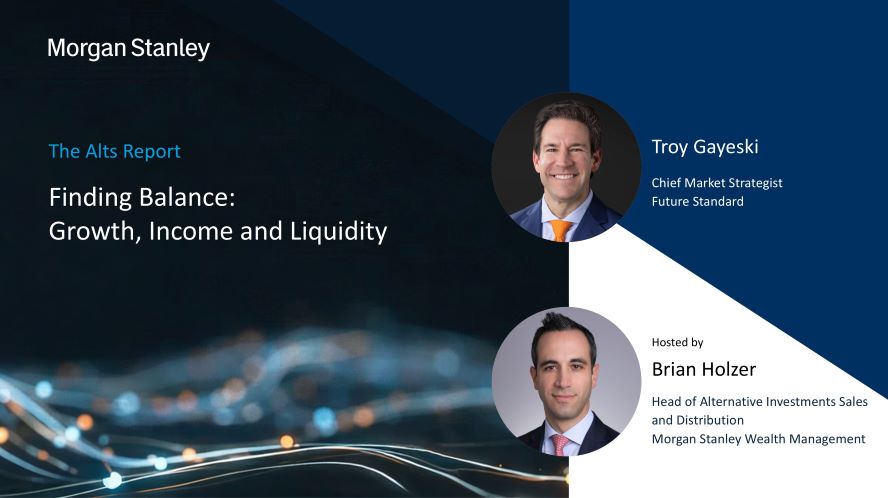
Investors are balancing growth opportunities, income needs and liquidity considerations. In this episode of The Alts Report, Brian Holzer, Head of Alternative Investments Sales & Distribution, sits down with Troy Gayeski, Chief Market Strategist for Future Standard, to discuss alternative investments and the role they may play within diversified portfolios.
VIDEO TRANSCRIPT
[COLD OPEN]
TROY GAYESKI
There isn't an earnings problem in equities. We have great companies, particularly in the US. But valuations are extremely stretched. And so, whenever you start at such high valuations the question is how do you complement your large and mega cap tech in particular…
[CUT TO THE ALTS REPORT OPENING SEQUENCE]
[INTRO 0:30]
BRIAN HOLZER
Welcome to The Alts Report where we explore the value of Alternative Investments and the trends shaping today's markets. Today, I'm pleased to welcome Troy Gayeski, Chief Market Strategist for Future Standard to The Alts Report. Our topic today is implementing alternative investments in portfolios. Alternatives are diverse by design. Each asset class has its own characteristics and considerations. That is why it can be important to evaluate and select strategies that align with your long-term financial goals.
So, Troy, thanks for being with us today. Let's get started. Can you outline a few of the key challenges advisors and clients are facing in today's current market environment?
[1:10]
TROY GAYESKI
Yeah, we'd say there's three and I'll start with the newest one. It’s how do you help clients put these massive cash piles to work that have built up dramatically since the pandemic, where you're meaningfully increasing income and/or total return. You know, some strategies are total return, some are income…
BRIAN HOLZER
Sure.
[1:25]
TROY GAYESKI
…without taking uncomfortable levels of risk. So that would be challenge one.
You know, challenge two is there isn't an earnings problem in equities. We have great companies, particularly in the US. But valuations are extremely stretched. And so, whenever you start at such high valuations the question is how do you complement your large and mega cap tech in particular.
TROY GAYESKI
But also US equity exposure hopefully taking less risk and not leaving too much money on the table. And then the third, you know, it's really been with us since 17 or 18 is how do you complement or replace fixed income to have more income with less volatility? And I'd say the challenge is as acute today as it was in 2020 and 21 before the Fed hiked. So cash replacement or complement, equity complement or replacement, and fixed income complement or replacement.
[2:15]
BRIAN HOLZER
So as, as somebody that spends a lot of time with advisors and clients, right, as you are talking to them about implementing alternatives, what are some of the common pushbacks or apprehension that advisors or clients have?
TROY GAYESKI
In the middle market, capital activity has been much more profound and pronounced exiting via strategic acquisitions or exiting via larger sponsor acquisitions.
[2:38]
In commercial real estate, it's no surprise we just went through a bear market. So you can understand why clients and advisors aren't in a rush to allocate there, but as we've bottomed, we've started to see a meaningful pickup in positive net inflows again, which is logical given that all of these asset classes have to go through a bottoming process. And, we're really optimistic about the forward returns in the forward flow there.
[3:00]
BRIAN HOLZER
So, last question. So for advisors and clients that are watching this that have not invested in alternatives before, how do you think about implementation? Where should they consider starting by asset class, by structure?
TROY GAYESKI
Yeah. Great question. So for those that have not been big users of alternatives historically, you know, typically one of the first ways to get clients invested is that cash or fixed income replacement substitute. Everyone likes income. Everyone likes to see the income go up meaningfully. And no one wants to take material downside risk. So that that would be one.
[3:30]
Another way is, if you're starting in alternatives, you more than likely at this stage of the game want to utilize an evergreen vehicle because yes, you are sacrificing some degree of liquidity. You have monthly subscriptions, typically quarterly redemptions with tendering limitations, but you're not locking up your money for seven, 10 or 12 years.
[3:50]
BRIAN HOLZER
Yeah, and I think we're even seeing that across our platform, right? Folks starting with evergreen funds building the core. And then for clients that can accept a degree of illiquidity, right? Satelliting drawdown funds around that. So I think that, that makes a lot of sense. So Troy, that was great.
[4:05]
[CLOSING]
Thanks for joining us. We appreciate you all joining us for this edition of The Alts Report. To learn more about Alternative Investments and our platform at Morgan Stanley, please visit ms.com/alts or reach out to your Morgan Stanley Financial Advisor or Private Wealth Advisor. We look forward to seeing you next time.
==
VIDEO DISCLOSURES
Morgan Stanley Smith Barney LLC ("Morgan Stanley Wealth Management") - IMPORTANT DISCLOSURES
Morgan Stanley Wealth Management acts as a placement agent in connection with the offering and sale of the securities of the fund to current and prospective clients of Morgan Stanley Wealth Management or its affiliates. Morgan Stanley Wealth Management will receive cash compensation for its activities as placement agent from the fund’s manager, as described in Morgan Stanley Wealth Management’s point of sale letter, if applicable. In addition, Morgan Stanley Wealth Management, its affiliates or employees, may have additional relationships with the fund’s manager, including as an investor in the fund or other investment vehicles managed by the fund’s manager or as a client of the fund’s manager. The payment of cash compensation to Morgan Stanley Wealth Management, and any additional relationships that Morgan Stanley Wealth Management or its affiliates may have with the fund’s manager or other investment vehicles managed by the fund’s manager, create material conflicts of interest for Morgan Stanley Wealth Management in its role as placement agent.
All expressions of opinion are subject to change without notice and are not intended to be a forecast of future events or results. Further, opinions expressed herein may differ from the opinions expressed by Morgan Stanley Wealth Management and/or other businesses/affiliates of Morgan Stanley Wealth Management.
Alternative investments often are speculative and include a high degree of risk. Investors could lose all or a substantial amount of their investment. Alternative investments are appropriate only for eligible, long-term investors who are willing to forgo liquidity and put capital at risk for an indefinite period of time. They may be highly illiquid and can engage in leverage and other speculative practices that may increase the volatility and risk of loss. Alternative Investments typically have higher fees than traditional investments. Investors should carefully review and consider potential risks before investing.
The sole purpose of this material is to inform, and it in no way is intended to be an offer or solicitation to purchase or sell any security, other investment or service, or to attract any funds or deposits. Investments mentioned may not be appropriate for all clients. Any product discussed herein may be purchased only after a client has carefully reviewed the offering memorandum and executed the subscription documents. Morgan Stanley Wealth Management has not considered the actual or desired investment objectives, goals, guidelines, or factual circumstances of any investor in any fund(s). Before making any investment, each investor should carefully consider the risks associated with the investment, as discussed in the applicable offering memorandum, and make a determination based upon their own particular circumstances, that the investment is consistent with their investment objectives and risk tolerance.
As a diversified global financial services firm, Morgan Stanley Wealth Management engages in a broad spectrum of activities including financial advisory services, investment management activities, sponsoring and managing private investment funds, engaging in broker-dealer transactions and principal securities, commodities and foreign exchange transactions, research publication, and other activities. In the ordinary course of its business, Morgan Stanley Wealth Management therefore engages in activities where Morgan Stanley Wealth Management’s interests may conflict with the interests of its clients, including the private investment funds it manages. Morgan Stanley Wealth Management can give no assurance that conflicts of interest will be resolved in favor of its clients or any such fund.
Alternative investments involve complex tax structures, tax inefficient investing, and delays in distributing important tax information. Individual funds have specific risks related to their investment programs that will vary from fund to fund. Clients should consult their own tax and legal advisors as Morgan Stanley Wealth Management does not provide tax or legal advice.
Morgan Stanley Wealth Management is a business of Morgan Stanley Smith Barney LLC.
© 2026 Morgan Stanley Smith Barney LLC. Member SIPC. Alternative investment securities discussed herein are not covered by the protections provided by the Securities Investor Protection Corporation, unless such securities are registered under the Securities Act of 1933, as amended, and are held in a Morgan Stanley Wealth Management Individual Retirement Account.
CRC 5505781 05/26
Morgan Stanley Wealth Management offers qualified investors a full suite of alternative investments across various asset classes. Reach out to your Morgan Stanley Financial Advisor or Private Wealth Advisor to learn how alternative investments may strengthen your portfolio and help meet your financial goals.
Disclosures
Morgan Stanley Smith Barney LLC (“Morgan Stanley Wealth Management”) - IMPORTANT DISCLOSURES LLC
Morgan Stanley Wealth Management acts as a placement agent in connection with the offering and sale of the securities of the Fund to current and prospective clients of Morgan Stanley Wealth Management or its affiliates. Morgan Stanley Wealth Management will receive cash compensation for its activities as placement agent from the Fund’s manager, as described in Morgan Stanley Wealth Management’s point of sale letter, if applicable. In addition, Morgan Stanley Wealth Management, its affiliates or employees, may have additional relationships with the Fund’s manager, including as an investor in the Fund or other investment vehicles managed by the Fund’s manager or as a client of the Fund’s manager. The payment of cash compensation to Morgan Stanley Wealth Management, and any additional relationships that Morgan Stanley Wealth Management or its affiliates may have with the Fund’s manager or other investment vehicles managed by the Fund’s manager, create material conflicts of interest for Morgan Stanley Wealth Management in its role as placement agent.
The sole purpose of this material is to inform, and it in no way is intended to be an offer or solicitation to purchase or sell any security, other investment or service, or to attract any funds or deposits. Investments mentioned may not be appropriate for all clients. Any product discussed herein may be purchased only after a client has carefully reviewed the offering memorandum and executed the subscription documents. Morgan Stanley Wealth Management has not considered the actual or desired investment objectives, goals, guidelines, or factual circumstances of any investor in any fund(s). Before making any investment, each investor should carefully consider the risks associated with the investment, as discussed in the applicable offering memorandum, and make a determination based upon their own particular circumstances, that the investment is consistent with their investment objectives and risk tolerance.
Alternative investments often are speculative and include a high degree of risk. Investors could lose all or a substantial amount of their investment. Alternative investments are appropriate only for eligible, long-term investors who are willing to forgo liquidity and put capital at risk for an indefinite period of time. They may be highly illiquid and can engage in leverage and other speculative practices that may increase the volatility and risk of loss. Alternative Investments typically have higher fees than traditional investments. Investors should carefully review and consider potential risks before investing. Certain of these risks may include but are not limited to:
• Loss of all or a substantial portion of the investment due to leveraging, short-selling, or other speculative practices;
• Lack of liquidity in that there may be no secondary market for a fund;
• Volatility of returns
• Restrictions on transferring interests in a fund;
• Potential lack of diversification and resulting higher risk due to concentration of trading authority when a single advisor is utilized;
• Absence of information regarding valuations and pricing;
• Complex tax structures and delays in tax reporting;
• Less regulation and higher fees than mutual funds;
• Risks associated with the operations, personnel, and processes of the manager; and
• Risks associated with cybersecurity.
As a diversified global financial services firm, Morgan Stanley Wealth Management engages in a broad spectrum of activities including financial advisory services, investment management activities, sponsoring and managing private investment funds, engaging in broker-dealer transactions and principal securities, commodities and foreign exchange transactions, research publication, and other activities. In the ordinary course of its business, Morgan Stanley Wealth Management therefore engages in activities where Morgan Stanley Wealth Management’s interests may conflict with the interests of its clients, including the private investment funds it manages. Morgan Stanley Wealth Management can give no assurance that conflicts of interest will be resolved in favor of its clients or any such fund.
As part of the Morgan Stanley Private Markets – Access program, Morgan Stanley will be limited solely to a role as an introducer and will not be serving as a placement agent or adviser. Eligible investors must enroll in the program in order to see any investment opportunities. Investments require independent evaluation, due diligence, review & analysis. Neither Morgan Stanley nor any of its affiliates is making any recommendation to purchase or take any action of any sort and is not providing any advice on investments. Investors are asked to work directly with the issuer/sponsor and with your own independent (non-Morgan Stanley) financial, legal, accounting, tax, and other professional advisors to evaluate the investment opportunity.
Investors are responsible for complying with the terms of any applicable exemption from securities law requirements and any potential Private Company issuer restrictions for any sale of Private Company shares, and you must obtain your own legal counsel to advise you in connection with such requirements and Private Company issuer restrictions. You should consult with your third-party advisors regarding the risks of transacting in Private Company shares, including the risk of transacting in a market with little or no price transparency or liquidity. Morgan Stanley provides no opinion or view on the valuation of any Private Company shares, or the sufficiency, fairness or competitiveness of any price obtained. Private Securities do not trade on any national securities exchange and, as such, any potential liquidity (i.e., the potential for any buying interest that might satisfy your sell interest) in such Private Company shares is very limited.
Investments of this nature include a high degree of risk, likely will be highly illiquid and can engage in leverage and other speculative practices that may increase the volatility and risk of loss. Investors could lose all or a substantial amount of their investment. Investments are appropriate only for eligible investors who are willing to put capital at risk for an indefinite period of time.
Past performance is no guarantee of future results. Actual results may vary. Diversification does not assure a profit or protect against loss in a declining market.
As a diversified global financial services firm, Morgan Stanley engages in a broad spectrum of activities including financial advisory services, investment management activities, sponsoring and managing private investment funds, engaging in broker-dealer transactions and principal securities, commodities and foreign exchange transactions, research publication, and other activities. In the ordinary course of its business, Morgan Stanley therefore engages in activities where Morgan Stanley interests may conflict with the interests of its clients, including the private investment funds it manages. Morgan Stanley can give no assurance that conflicts of interest will be resolved in favor of its clients or any such fund. All expressions of opinion are subject to change without notice and are not intended to be a forecast of future events or results. Further, opinions expressed herein may differ from the opinions expressed by Morgan Stanley Wealth Management and/or other businesses/affiliates of Morgan Stanley Wealth Management.
This is not a "research report" as defined by FINRA Rule 2241 or a "debt research report" as defined by FINRA Rule 2242 and was not prepared by the Research Departments of Morgan Stanley Smith Barney LLC or Morgan Stanley & Co. LLC or its affiliates. Alternative investments involve complex tax structures, tax inefficient investing, and delays in distributing important tax information. Individual funds have specific risks related to their investment programs that will vary from fund to fund. Clients should consult their own tax and legal advisors as Morgan Stanley Wealth Management does not provide tax or legal advice.
Interests in alternative investment products are only made available pursuant to the terms of the applicable offering memorandum, are distributed by Morgan Stanley Wealth Management and certain of its affiliates, and (1) are not FDIC-insured, (2) are not deposits or other obligations of Morgan Stanley Wealth Management or any of its affiliates, (3) are not guaranteed by Morgan Stanley Wealth Management and its affiliates, and (4) involve investment risks, including possible loss of principal. Morgan Stanley Wealth Management is a registered broker-dealer, not a bank.
Morgan Stanley Wealth Management is a business of Morgan Stanley Smith Barney LLC.
Environmental, Social and Governance (“ESG”) investments in a portfolio may experience performance that is lower or higher than a portfolio not employing such practices. Portfolios with ESG restrictions and strategies as well as ESG investments may not be able to take advantage of the same opportunities or market trends as portfolios where ESG criteria is not applied. There are inconsistent ESG definitions and criteria within the industry, as well as multiple ESG ratings providers that provide ESG ratings of the same subject companies and/or securities that vary among the providers. Certain issuers of investments may have differing and inconsistent views concerning ESG criteria where the ESG claims made in offering documents or other literature may overstate ESG impact. ESG designations are as of the date of this material, and no assurance is provided that the underlying assets have maintained or will maintain and such designation or any stated ESG compliance. As a result, it is difficult to compare ESG investment products or to evaluate an ESG investment product in comparison to one that does not focus on ESG. Investors should also independently consider whether the ESG investment product meets their own ESG objectives or criteria.
There is no assurance that an ESG investing strategy or techniques employed will be successful. Past performance is not a guarantee or a dependable measure of future results.
© 2026 Morgan Stanley Smith Barney LLC. Member SIPC. Alternative investment securities discussed herein are not covered by the protections provided by the Securities Investor Protection Corporation, unless such securities are registered under the Securities Act of 1933, as amended, and are held in a Morgan Stanley Wealth Management Individual Retirement Account.
CRC# 5631425 (06/2026)