


 Top
Top


US real estate investment trusts (REITs) are operating in an environment where physical climate risk is no longer peripheral, but a financially material driver of long-term performance. Defined by highly idiosyncratic exposure across regions, intensifying physical risks—including hurricanes, floods, wildfires, and other extreme weather events—are reshaping property-level economics, capital allocation decisions, and access to financing. These pressures are now feeding directly into valuation frameworks and credit assessments, as lenders and rating agencies increasingly incorporate climate exposure into underwriting.1
As a result, physical climate risk is emerging as a defining force in the competitive landscape for US REITs, influencing asset values, cost structures, and long-term strategic positioning.
Physical risk as an Operational and Financial reality
In the US, physical climate risk has become a central sustainability concern with direct operational and financial implications. Extreme weather events, such as hurricanes and flooding, are prompting shifts in geographic exposure for key players in the Real Estate industry, as some reduce presence in higher-risk areas.
In the short term, these events create sudden shocks to capital and operating expenditures through repair costs and reduced operational capacity. Over the medium to long term, they require sustained investment to strengthen asset resilience and protect tenant safety. At the same time, increasing frequency and severity of events are driving greater scrutiny from investors and other stakeholders across the investment lifecycle.
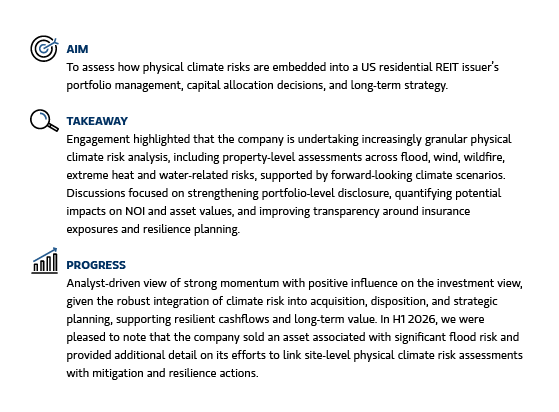
While extreme weather events currently remain relatively isolated, they are increasingly recognized as having the potential to affect the financial performance and long-term risk profile of REITs. Physical climate events can increase operating and capital expenditure through repair costs, business interruption and resilience spending, while also contributing to asset impairments and declines in property values in higher-risk locations.2 These pressures may weigh on net operating income ("NOI"), liquidity and future refinancing conditions. For instance, our engagement with one US residential REIT issuer highlighted how physical climate risk is incorporated into buy, sell and hold decisions through a risk assessment framework that includes storm exposure. Management also noted that several assets assessed as higher risk from a physical climate perspective had been sold, helping to reduce exposure to climate-related physical risks as part of portfolio repositioning. This illustrates how physical climate risk is increasingly informing asset-level decision-making and portfolio construction. Although physical climate risk has not yet been a primary driver of credit rating actions for REITs, rating agencies are increasingly incorporating climate vulnerability and resilience into their credit analysis, reinforcing the growing financial relevance of these risks.
Insurance pressure and Refinancing Risk
Insurance markets are amplifying the financial impact of physical climate risk as rising premiums and insurer withdrawals from high-risk markets are increasingly turning this idiosyncratic risk into systemic challenges. It is projected that certain high-risk areas in the US will see insurance costs more than double by 2030, and there has already been an average increase of 31% in costs year-over-year.3 Furthermore, with insurance providers exiting new business, such as Farmers and Allstate in California4, commercial real estate owners may face higher premiums, increased deductibles and more restrictive coverage terms. As a result, these owners are at a juncture, and are increasingly assessing how insurance affordability and availability may evolve. This is reinforcing the importance of integrating physical climate risk assessments into resilience planning and capital allocation across real estate portfolios.
Higher deductibles are leading more commercial real estate owners to adopt self-insurance strategies, retaining a greater share of risk. While this may help manage insurance costs, it can increase volatility in financial performance and expose issuers to unplanned post-disaster capital expenditure and liquidity pressures. As a result, properties in higher-risk locations may be subject to what is known as a ‘brown discount’– a reduction in valuation reflecting elevated sustainability-related risks – or in more severe cases, stranded-asset risk, reducing collateral values and intensifying refinancing risk. For instance, we view that these issues are increasingly significant for multi-family real-estate owners along the Florida and U.S. Gulf Coasts, as concerns grow over how insurance costs are calculated and what impact this will have on property values in the secondary market.
Driving Stronger Climate Risk Management in REITs Through Engagement
In light of these risks, the MSIM Fixed Income team conducted a targeted series of engagements with selected REITs, identified through credit analyst recommendations and physical climate risk screening, prioritising issuers for which these risks were considered financially material. Discussions highlighted increasing adoption of asset-level risk assessments and forward-looking scenario analysis, alongside more systematic integration of climate considerations into capex planning, resilience investments, and operational decision-making. Across engagements, we observed growing sophistication in how REITs manage climate-related risks at the asset level, with increasing integration of these considerations into capital allocation and resilience planning. However, approaches to quantifying portfolio-level financial impacts and quality of disclosure continue to evolve. In our engagements, we emphasized the importance of strengthening portfolio-level disclosure, enhancing financial risk quantification, and improving alignment between physical climate risk assessments and broader risk management practices, including insurance planning. These factors are increasingly relevant to maintaining resilient cashflows and long-term portfolio value.
In summary, physical climate risk is now a central factor shaping the US REIT landscape. It is influencing asset values, operating costs, insurance availability, and financing conditions.
The opportunity lies in differentiation. REITs that effectively assess, price, and mitigate physical risk—and invest in resilience—are better positioned to protect cash flows, maintain asset values, and access capital. In doing so, they can turn a growing structural challenge into a source of long-term competitive advantage.

Featured Insights