


 Top
Top


Private credit’s growth reflects an evolution in credit intermediation, rather than a rise in systemic risk. While borrower fundamentals matter, bank and insurer exposures appear manageable.
Private Credit and Preferreds: What the Headlines Get Wrong
Private credit has grown rapidly over the past decade, filling a gap left by increasingly regulated banks. Recently, investor scrutiny of this asset class has intensified as concerns about AI-driven disruption compete with headlines around “gated” redemption requests. While we share some concerns about segments of the borrower base, we do not view private credit risks as systemic in nature. For traditional financial institutions—the primary issuers of preferreds—we believe exposures, though rising, remain manageable relative to overall balance sheets.
Rise of Private Credit Lending
Private credit—non-bank lending to private companies—has existed for decades, but its modern expansion was catalyzed by post–Global Financial Crisis regulation. Regulatory guidance limiting bank loan underwriting at higher leverage levels (at or above 6x debt to EBITDA), along with annual stress tests, increased the capital costs of riskier lending. As a result, banks pulled back from certain segments, particularly middle-market companies and private equity–backed, leveraged borrowers.
Private capital stepped in to fill that gap. Today, private credit exceeds $1 trillion in assets[1] and is an increasingly important component of the broader financial ecosystem. It includes private investment funds, business development companies (BDCs), and institutional investors, such as pension funds and insurance companies. Whether through direct lending or structured products, a key feature of these vehicles is that the underlying credit risk is borne by investors.
Private Credit Direct Lending Growth: Assets Under Management
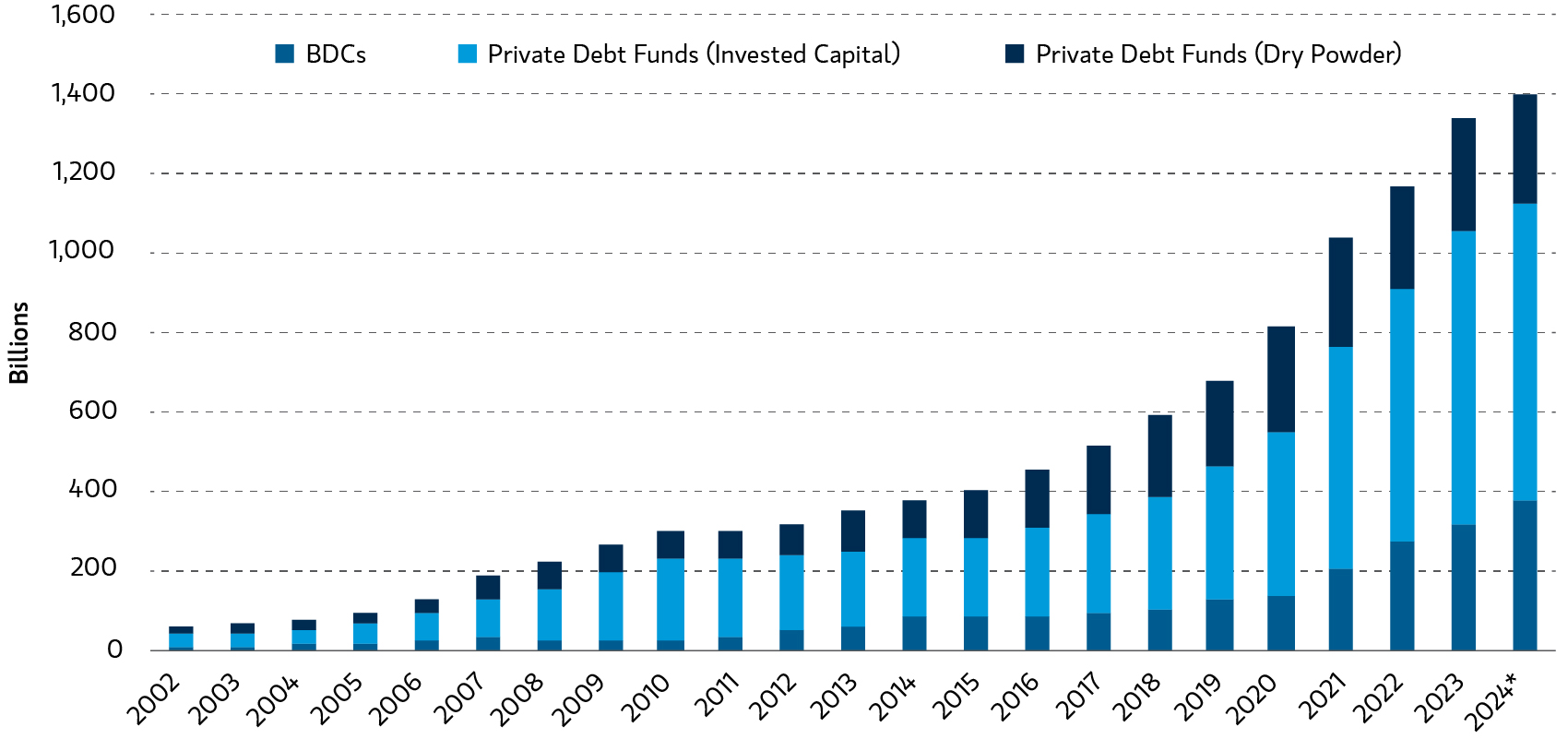
* As of June 30, 2024
Source: Federal Reserve Board, “Bank Lending to Private Credit: Size, Characteristics, and Financial Stability Implications, Accessible Data.”
Private Credit Direct Lending Growth: Assets Under Management
Structural Differences from Banking
Unlike banks, which are funded by short-term liabilities and can face liquidity pressures, private credit vehicles are typically backed by long-term, committed capital. This better aligns funding with the illiquid nature of the assets, enabling lending to borrowers that may not fit within traditional bank constraints.
Recent attention on fund-level “gates” has raised concerns about liquidity. However, these features are not flaws; they are integral to the structure. By limiting redemptions, they help prevent forced asset sales, which in turn helps long-term investors.
For preferred investors, the rise of private credit reflects less of an increase in aggregate financial leverage and more of a shift in where that leverage resides. Lending has migrated from public markets and bank balance sheets into private channels—reducing direct exposure for deposit-funded institutions while transferring risk to investors.
Bank and Insurance Exposure: Putting It in Context
Despite these distinctions, private credit is not entirely isolated from the traditional financial system or the investment-grade (IG) corporate market. Banks and insurance companies maintain both direct and indirect exposure, an area of increased investor focus.
Within IG credit, BDCs account for approximately $60 billion of unsecured debt—less than 1% of the U.S. IG corporate bond market.2 While the sector carries an average rating of BBB, spreads have widened over the past year to levels more typical of BB-rated issuers. The preferred securities market has little direct exposure to private credit, though insurance hybrids underperformed in March, particularly among institutions more closely linked to alternative asset managers.
For banks, the focus has centered on lending to non-depository financial institutions (NDFIs)—a category that includes private equity funds, private credit funds, and other financial intermediaries. Now roughly 12% of total bank lending, this category has nearly doubled over the past decade.3 Exposure, however, is not uniform. Intermediaries include mortgage lenders, broker-dealers, asset-backed securities issuers, and finance companies. According to the FDIC, loans to business credit intermediaries—where lending to private credit funds and BDCs would reside—account for just under 25% of total NDFI exposure.
Bank Lending by Credit Segment
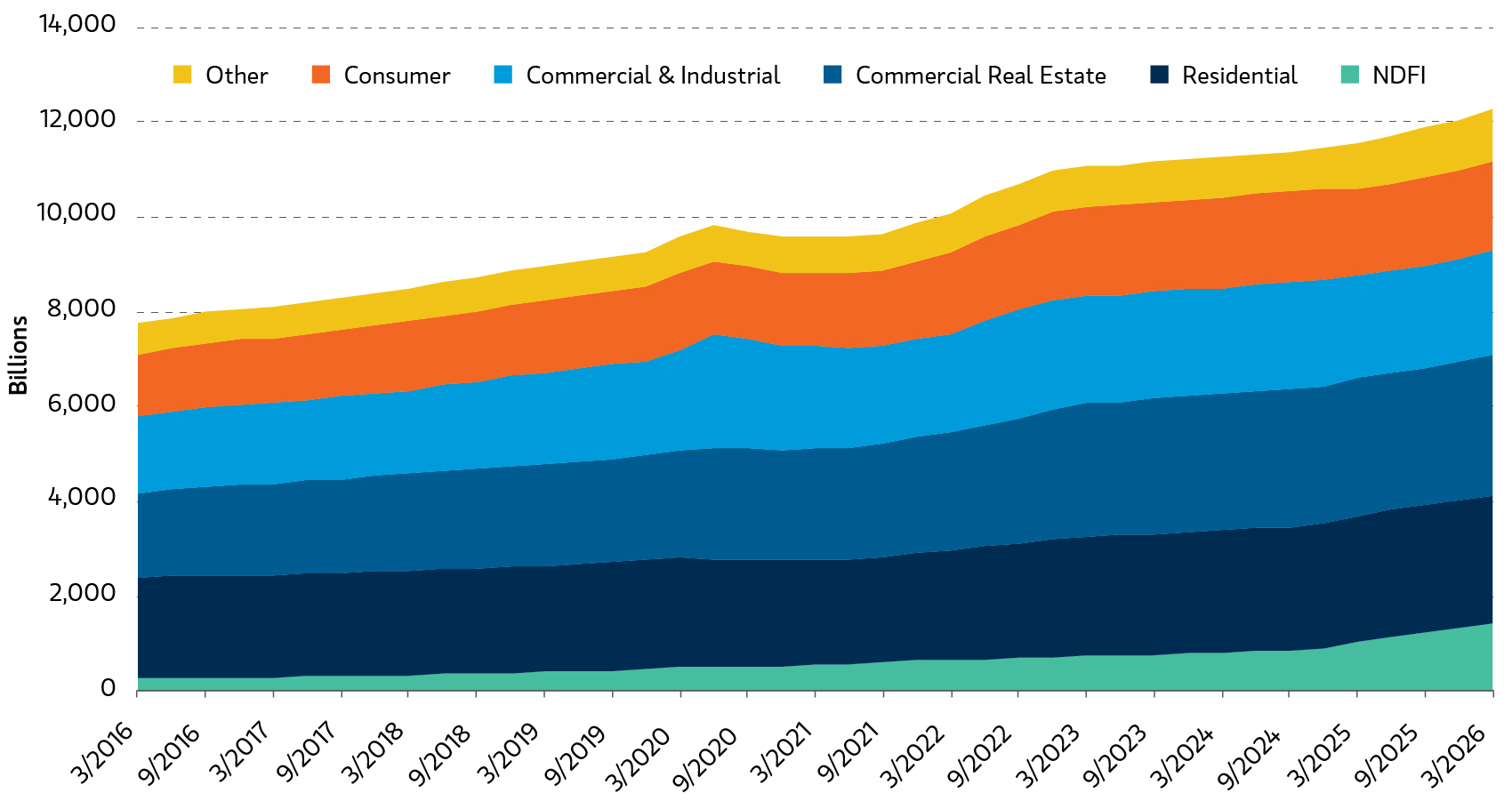
Source: Bloomberg, Federal Reserve, ”Assets and Liabilities of Commercial Banks in the United States” - H.8.
Bank Lending by Credit Segment
Bank Lending Growth to NDFIs Outpaces Other Segments
(As of 3/31/2026)
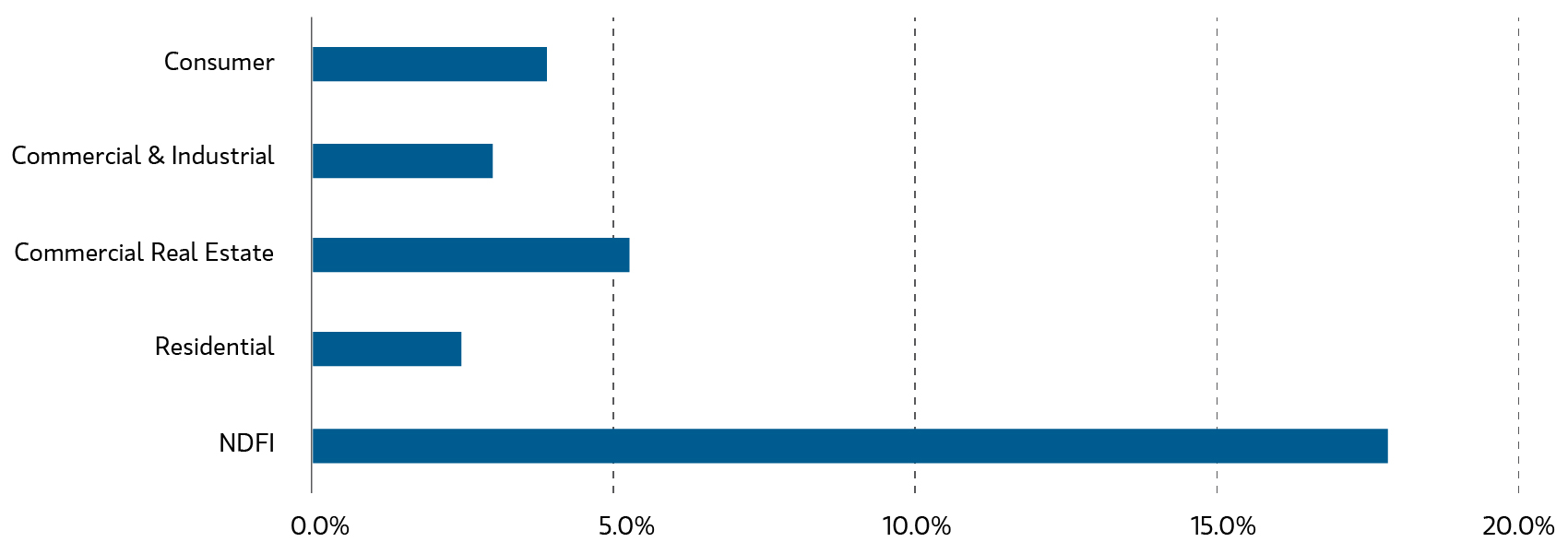
Source: Bloomberg, Federal Reserve, ”Assets and Liabilities of Commercial Banks in the United States - H.8”
Bank Lending Growth to NDFIs Outpaces Other Segments
(As of 3/31/2026)
Structural Features Further Mitigate Risk
Bank loans to business credit intermediaries are often structured as revolving credit facilities secured by diversified loan pools. These facilities typically benefit from conservative advance rates, performance covenants, short durations, and strong collateral protections. Historically, losses have been minimal, aside from a handful of isolated fraud cases.
Exposures also vary significantly by institution, and banks have been increasing disclosure in recent years. Regulatory filings have incorporated NDFI exposure since 2010, and annual stress tests include scenarios with meaningful loss assumptions—often in the high single digits—for this category.
Insurance companies are another key area of focus for preferred investors, given their growing role as long-term investors in private credit. Recent spread widening in life insurance hybrid securities reflects increased investor sensitivity, particularly for firms with close ties to alternative asset managers. One metric receiving attention is the ratio of privately rated assets—often used as a proxy for private credit exposure—to statutory surplus. Across life insurers, this ratio averages roughly 1.5x, though dispersion across companies is significant.
Insurers access private credit through multiple channels. Some participate directly in lending, while others invest in BDC debt or equity. More commonly, exposure comes through secured vehicles, including structured products linked to private credit or “feeder funds”—tranched investments used to fund GP commitments. In many cases, this exposure differs meaningfully from direct middle-market lending.
While risks vary across insurance credits, we believe some concerns are overstated. For preferred investors, the key is identifying issuers with strong business operations, capital bases, and investment portfolios that may provide resilience through a credit cycle.
Conclusion
The growth of private credit reflects an evolution in credit intermediation, not an unchecked expansion of risk. This is not to suggest risks are absent from the preferred securities market—borrower fundamentals remain critical and dispersion across lenders may increase.
However, viewed in aggregate, we believe exposures within banks and insurance companies remain manageable. In our view, private credit is best understood not as a source of systemic fragility, but as a reallocation of risk to those most willing—and able—to bear it.
1 Federal Reserve Board, May 23, 2025, “Bank Lending to Private Credit: Size, Characteristics, and Financial Stability Implications, Accessible Data.”
2 Based on holdings in Bloomberg U.S. Corporate Investment Grade Index (LUACTRUU), as of March 31, 2026.
3 Bloomberg, Federal Reserve, ”Assets and Liabilities of Commercial Banks in the United States” - H.8.
Featured Insights





Risk Considerations
Diversification does not eliminate the risk of loss.
All investments involve risk including the possible loss of principal. There is no assurance that a portfolio will achieve its investment objective. Portfolios are subject to market risk, which is the possibility that the market values of securities owned by the portfolio will decline and that the value of portfolio shares may therefore be less than what you paid for them. Market values can change daily due to economic and other events (e.g. natural disasters, health crises, terrorism, conflicts and social unrest) that affect markets, countries, companies or governments. It is difficult to predict the timing, duration, and potential adverse effects (e.g. portfolio liquidity) of events.
Alternative investments are speculative, involve a high degree of risk, are highly illiquid, typically have higher fees than other investments, and may engage in the use of leverage, short sales, and derivatives, which may increase the risk of investment loss. These investments are designed for investors who understand and are willing to accept these risks. Performance may be volatile, and an investor could lose all or a substantial portion of its investment. Preferred securities are subject to interest rate risk and generally decreases in value if interest rates rise and increase in value if interest rates fall. Fixed-income securities are subject to the ability of an issuer to make timely principal and interest payments (credit risk), changes in interest rates (interest-rate risk), the creditworthiness of the issuer and general market liquidity (market risk). In a rising interest-rate environment, bond prices may fall and may result in periods of volatility and increased portfolio redemptions. In a declining interest-rate environment, the portfolio may generate less income. Longer-term securities may be more sensitive to interest rate changes. Investments in foreign markets entail special risks such as currency, political, economic, and market risks. The risks of investing in emerging market countries are greater than risks associated with investments in foreign developed countries. Public bank loans are subject to liquidity risk and the credit risks of lower-rated securities. High-yield securities (junk bonds) are lower-rated securities that may have a higher degree of credit and liquidity risk. Sovereign debt securities are subject to default risk.
Important Disclosures
There is no guarantee that any investment strategy will work under all market conditions, and each investor should evaluate their ability to invest for the long-term, especially during periods of downturn in the market.
A separately managed account may not be appropriate for all investors. Separate accounts managed according to the Strategy include a number of securities and will not necessarily track the performance of any index. Please consider the investment objectives, risks and fees of the Strategy carefully before investing. A minimum asset level is required.
For important information about the investment managers, please refer to Form ADV Part 2.
The views and opinions and/or analysis expressed are those of the author or the investment team as of the date of preparation of this material and are subject to change at any time without notice due to market or economic conditions and may not necessarily come to pass. Furthermore, the views will not be updated or otherwise revised to reflect information that subsequently becomes available or circumstances existing, or changes occurring, after the date of publication. The views expressed do not reflect the opinions of all investment personnel at Morgan Stanley Investment Management (MSIM) and its subsidiaries and affiliates (collectively “the Firm”), and may not be reflected in all the strategies and products that the Firm offers.
Forecasts and/or estimates provided herein are subject to change and may not actually come to pass. Information regarding expected market returns and market outlooks is based on the research, analysis and opinions of the authors or the investment team. These conclusions are speculative in nature, may not come to pass and are not intended to predict the future performance of any specific strategy or product the Firm offers. Future results may differ significantly depending on factors such as changes in securities or financial markets or general economic conditions.
This material has been prepared on the basis of publicly available information, internally developed data and other third-party sources believed to be reliable. However, no assurances are provided regarding the reliability of such information and the Firm has not sought to independently verify information taken from public and third-party sources.
This material is a general communication, which is not impartial and all information provided has been prepared solely for informational and educational purposes and does not constitute an offer or a recommendation to buy or sell any particular security or to adopt any specific investment strategy. The information herein has not been based on a consideration of any individual investor circumstances and is not investment advice, nor should it be construed in any way as tax, accounting, legal or regulatory advice. To that end, investors should seek independent legal and financial advice, including advice as to tax consequences, before making any investment decision.
The indexes are unmanaged and do not include any expenses, fees or sales charges. It is not possible to invest directly in an index.
This material is not a product of Morgan Stanley’s Research Department and should not be regarded as a research material or a recommendation.
The Firm has not authorised financial intermediaries to use and to distribute this material, unless such use and distribution is made in accordance with applicable law and regulation. Additionally, financial intermediaries are required to satisfy themselves that the information in this material is appropriate for any person to whom they provide this material in view of that person’s circumstances and purpose. The Firm shall not be liable for, and accepts no liability for, the use or misuse of this material by any such financial intermediary.
This material may be translated into other languages. Where such a translation is made this English version remains definitive. If there are any discrepancies between the English version and any version of this material in another language, the English version shall prevail.
The whole or any part of this material may not be directly or indirectly reproduced, copied, modified, used to create a derivative work, performed, displayed, published, posted, licensed, framed, distributed or transmitted or any of its contents disclosed to third parties without the Firm’s express written consent. This material may not be linked to unless such hyperlink is for personal and non-commercial use. All information contained herein is proprietary and is protected under copyright and other applicable law.
DISTRIBUTION
This material is only intended for and will only be distributed to persons resident in jurisdictions where such distribution or availability would not be contrary to local laws or regulations.
MSIM, the asset management division of Morgan Stanley (NYSE: MS), and its affiliates have arrangements in place to market each other’s products and services. Each MSIM affiliate is regulated as appropriate in the jurisdiction it operates. MSIM’s affiliates are: Calvert Research and Management, Eaton Vance Management, Parametric Portfolio Associates LLC, Parametric SAS, and Atlanta Capital Management LLC.
This material has been issued by any one or more of the following entities:
EMEA
This material is for Professional Clients/Accredited Investors only.
In the EU, MSIM materials are issued by MSIM Fund Management (Ireland) Limited (“FMIL”). FMIL is regulated by the Central Bank of Ireland and is incorporated in Ireland as a private company limited by shares with company registration number 616661 and has its registered address at 24-26 City Quay, Dublin 2, DO2 NY19, Ireland.
Outside the EU, MSIM materials are issued by Morgan Stanley Investment Management Limited (MSIM Ltd) is authorised and regulated by the Financial Conduct Authority. Registered in England. Registered No. 1981121. Registered Office: 25 Cabot Square, Canary Wharf, London E14 4QA.
In Switzerland, MSIM materials are issued by Morgan Stanley & Co. International plc, London (Zurich Branch) Authorised and regulated by the Eidgenössische Finanzmarktaufsicht ("FINMA"). Registered Office: Beethovenstrasse 33, 8002 Zurich, Switzerland.
Italy: MSIM FMIL (Milan Branch), (Sede Secondaria di Milano) Palazzo Serbelloni Corso Venezia, 16 20121 Milano, Italy. The Netherlands: MSIM FMIL (Amsterdam Branch), Rembrandt Tower, 11th Floor Amstelplein 1 1096HA, Netherlands. France: MSIM FMIL (Paris Branch), 61 rue de Monceau 75008 Paris, France. Spain: MSIM FMIL (Madrid Branch), Calle Serrano 55, 28006, Madrid, Spain. Germany: MSIM FMIL Frankfurt Branch, Große Gallusstraße 18, 60312 Frankfurt am Main, Germany (Gattung: Zweigniederlassung (FDI) gem. § 53b KWG). Denmark: MSIM FMIL (Copenhagen Branch), Gorrissen Federspiel, Axel Towers, Axeltorv2, 1609 Copenhagen V, Denmark.
MIDDLE EAST
Dubai International Financial Centre: This information does not constitute or form part of any offer to issue or sell, or any solicitation of any offer to subscribe for or purchase, any securities or investment products in the UAE (including the Dubai International Financial Centre and the Abu Dhabi Global Market) and accordingly should not be construed as such. Furthermore, this information is being made available on the basis that the recipient acknowledges and understands that the entities and securities to which it may relate have not been approved, licensed by or registered with the UAE Central Bank, the Dubai Financial Services Authority, the UAE Securities and Commodities Authority, the Financial Services Regulatory Authority or any other relevant licensing authority or government agency in the UAE. The content of this report has not been approved by or filed with the UAE Central Bank, the Dubai Financial Services Authority, the UAE Securities and Commodities Authority or the Financial Services Regulatory Authority.
Abu Dhabi Global Market ("ADGM"): This material is sent strictly within the context of, and constitutes, an Exempt Communication. This material relates to private credit, which is not subject to any form of regulation or approval by the Financial Services Regulatory Authority of the Abu Dhabi Global Market (the “FSRA”).
Saudi Arabia
This financial promotion was issued and approved for use in Saudi Arabia by Morgan Stanley Saudi Arabia, Al Rashid Tower, Kings Sand Street, Riyadh, Saudi Arabia, authorized and regulated by the Capital Market Authority license number 06044-37.
U.S.
NOT FDIC INSURED | OFFER NO BANK GUARANTEE | MAY LOSE VALUE | NOT INSURED BY ANY FEDERAL GOVERNMENT AGENCY | NOT A DEPOSIT
Latin America (Brazil, Chile Colombia, Mexico, Peru, and Uruguay)
This material is for use with an institutional investor or a qualified investor only. All information contained herein is confidential and is for the exclusive use and review of the intended addressee, and may not be passed on to any third party. This material is provided for informational purposes only and does not constitute a public offering, solicitation or recommendation to buy or sell for any product, service, security and/or strategy. A decision to invest should only be made after reading the strategy documentation and conducting in-depth and independent due diligence.
ASIA PACIFIC
Hong Kong: This document has been issued by Morgan Stanley Asia Limited, CE No. AAD291, for use in Hong Kong and shall only be made available to “professional investors” as defined under the Securities and Futures Ordinance of Hong Kong (Cap 571). The contents of this document have not been reviewed nor approved by any regulatory authority including the Securities and Futures Commission in Hong Kong. Accordingly, save where an exemption is available under the relevant law, this document shall not be issued, circulated, distributed, directed at, or made available to, the public in Hong Kong. Singapore: This material is disseminated in Singapore by Morgan Stanley Investment Management Company, Registration No. 199002743C. This material should not be considered to be the subject of an invitation for subscription or purchase, whether directly or indirectly, to the public or any member of the public in Singapore other than (i) to an institutional investor under section 304 of the Securities and Futures Act, Chapter 289 of Singapore (“SFA”), (ii) to a “relevant person” (which includes an accredited investor) pursuant to section 305 of the SFA, and such distribution is in accordance with the conditions specified in section 305 of the SFA; or (iii) otherwise pursuant to, and in accordance with the conditions of, any other applicable provision of the SFA. This material has not been reviewed by the Monetary Authority of Singapore. Australia: This material is provided by Morgan Stanley Investment Management (Australia) Pty Ltd ABN 22122040037, AFSL No. 314182 and its affiliates and does not constitute an offer of interests. Morgan Stanley Investment Management (Australia) Pty Limited arranges for MSIM affiliates to provide financial services to Australian wholesale clients. This material will not be lodged with the Australian Securities and Investments Commission.
Japan
For professional investors, this material is circulated or distributed solely for informational purposes. For non-professional investors, this material is provided in connection with Morgan Stanley Investment Management (Japan) Co., Ltd. (“MSIMJ”)’s business with respect to discretionary investment management agreements (“IMA”) and investment advisory agreements (“IAA”). This does not constitute a recommendation or solicitation of transactions nor offers any particular financial instruments. Under an IMA, with respect to the management of client assets, the client prescribes basic management policies in advance and commissions MSIMJ to make all investment decisions based on an analysis of the value, etc. of the securities, and MSIMJ accepts such commission. The client shall delegate to MSIMJ the authorities necessary to make such investment decisions. MSIMJ exercises these delegated authorities accordingly, and the client shall not make individual instructions. All investment profits and losses belong to the clients; principal is not guaranteed. Please consider the investment objectives and nature of risks before investing. As an investment advisory fee for an IAA or an IMA, the amount of assets subject to the contract multiplied by a certain rate (the upper limit is 2.20% per annum (including tax)) shall be incurred in proportion to the contract period. For some strategies, a contingency fee may be incurred in addition to the fee mentioned above. Indirect charges also may be incurred, such as brokerage commissions for underlying securities. Since these charges and expenses vary by contract and other factors, MSIMJ cannot present the rates, upper limits, etc. in advance. All clients should read thoroughly the Documents Provided Prior to the Conclusion of a Contract carefully before executing an agreement. This material is distributed in Japan by MSIMJ, Registered No. 410 (Director of Kanto Local Finance Bureau (Financial Instruments Firms)), Membership: the Japan Securities Dealers Association, the Investment Management Association of Japan and the Type II Financial Instruments Firms Association.


