


 Top
Top


Key Takeaways
- Incorporating alternative investment strategies may improve the performance and diversification of traditional 60/40 portfolios.
- Private markets can provide access to parts of the economy that public markets may not be able to provide.
- With the “democratization” of alternatives and rise of client-friendly vehicles, many individual investors now have access to these strategies, which are no longer the exclusive domain of large institutions and wealthy individuals.
- Financial Advisors should know the value proposition of alternatives so they can help clients recognize how such allocations may strengthen their portfolios.
Why Now? Expanding the Investor’s Toolkit with Alternatives
For many years, the investment community embraced the 60/40 portfolio as an industry standard. The model was simple to communicate: Equities, comprising 60% of the portfolio, would drive growth, while fixed income, making up the remaining 40%, would offer stability and income. This allocation offered some degree of diversification due to the historically low correlation between stocks and bonds. But the model faltered in 2022, when higher interest rates weakened both asset classes at once, and stocks and bonds declined simultaneously for the first time in decades. With traditional asset classes increasingly moving in tandem—and reliable sources of income harder to find—advisors are recognizing that they need new tools beyond the traditional 60/40 portfolio.
Improving the Efficiency Frontier: Adding Alternatives to a 60/40 Portfolio May Reduce Volatility and Potentially Increase Returns
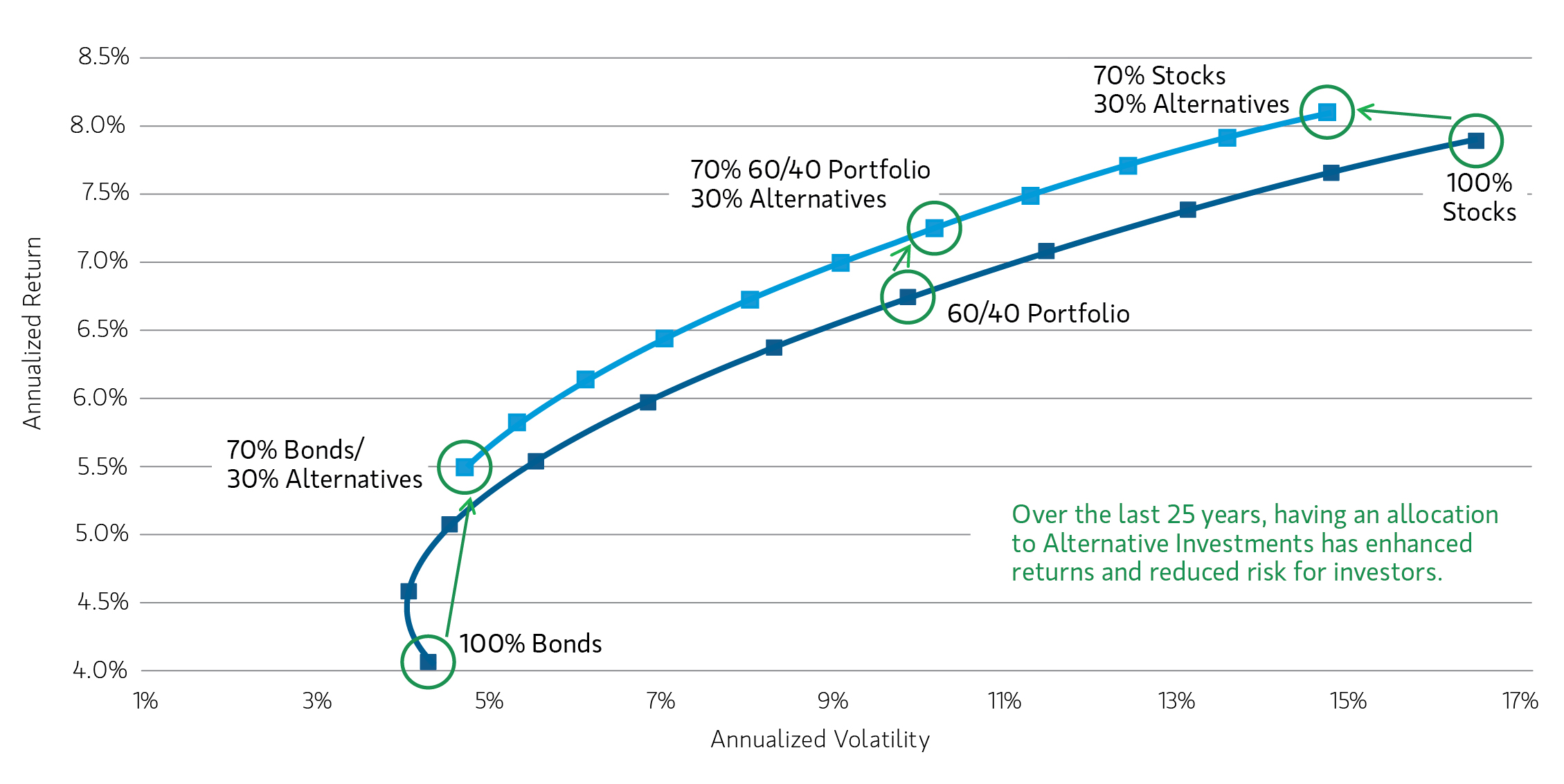
Improving the Efficiency Frontier: Adding Alternatives to a 60/40 Portfolio May Reduce Volatility and Potentially Increase Returns
Compounding the challenge, today’s public markets are increasingly top-heavy, dominated by a handful of trillion-dollar companies. This concentration means that a portfolio’s performance can hinge on the fortunes of just a few names. Studies have shown that allocating to alternative investments can potentially improve the risk/reward profile of balanced portfolios—in part by reducing concentration risk and providing exposure to different sources of returns. Until recently, however, only institutions and ultra-high net worth individuals who met Qualified Purchaser (QP) eligibility requirements1 were able to participate in these strategies.
Fortunately, asset managers have focused on “democratizing” alternatives. There has been meaningful growth in offerings made at lower minimum investments, with greater transparency and more timely tax reporting. As these strategies become more widely available, financial advisors now have an expanded set of tools to help their clients achieve their unique investment objectives. Indeed, the current $2.2 trillion allocated to alternatives by U.S. financial advisors is expected to rise to $4.2 trillion within five years.2
What the Democratization of Alternative Investments Means for Financial Advisors
Three primary factors have driven wider access to alternatives.
- Market Environment: Today’s market calls for a more comprehensive and sophisticated toolkit to fully address the investable opportunity set.
- Product Innovation: Advances in product design have introduced more investor-friendly structures that open alternatives to a broader range of investors.
- Access to Institutional Managers: Institutional and ultra-high net worth investors have significantly increased their alternatives allocations over the past twenty years, yet usage among individual investors remains far lower. To close this gap, alternatives managers have created vehicles with lower minimums aimed at sophisticated individual investors who can tolerate non-daily liquidity.
Together, these factors have led to a proliferation of alternative investment vehicles that provide access to private markets that are tailored for sophisticated individual investors—with lower minimums and, often, 1099 tax reporting. Access to these strategies may be an important portfolio diversifier, offering returns that are uncorrelated to traditional markets, lower volatility and, often, an illiquidity premium.
Investors can access these strategies using registered funds, which offer many of the protections associated with SEC registration while still allowing exposure to private markets. These funds—including tender offer funds and interval funds—are continuously offered as closed-end funds. Registered with the SEC under the 1940 Act, they are typically available to Accredited Investors, defined as individuals with income greater than $200,000 (or $300,000 together with a spouse) in each of the last two years. Other vehicles for accessing private markets include Business Development Companies (BDCs) and non-traded REITs (NTRs), both of which are also available to Accredited Investors. BDCs, whether public or private, offer access to private credit, while NTRs can provide entry to private real estate.
Overview of the Alternative Investment Landscape
The term “alternative investments” is broad and, in our view, not especially descriptive. It encompasses all strategies that cannot be accessed through traditional equity and fixed income solutions. Yet these strategies have the potential to address many of the challenges investors face today—including the need for enhanced income, inflation protection, diversification and stability amid volatile markets.
At the highest level, alternative investments can be grouped into five categories: hedge funds, private credit, private equity, real estate and infrastructure.
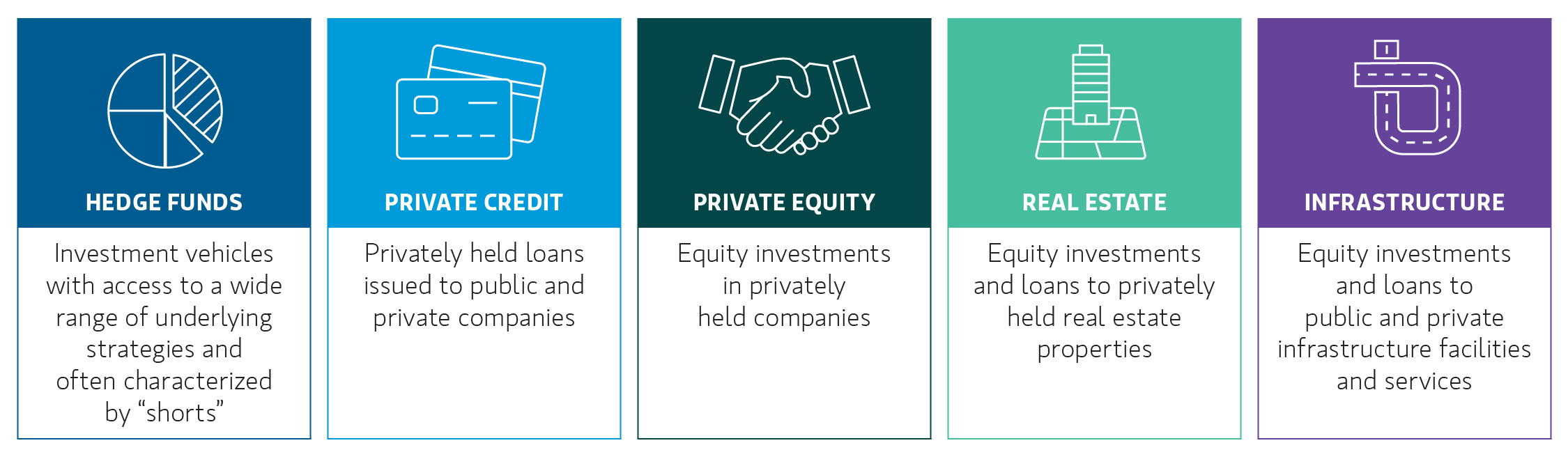
HEDGE FUNDS employ a wide range of strategies, each with its own risk and return characteristics. As a result, they can play different roles within a portfolio: isolating alpha, enhancing returns, mitigating or hedging risk and providing diversification. Generally, hedge funds fall into five categories: Equity Hedge, Event-Driven, Relative Value, Macro and Multi-Strategy, each serving investors manage risk in a distinct way.
Equity Hedge and Event-Driven strategies keep investors exposed to the stock market’s growth potential while using hedging techniques to soften volatility and reduce overall portfolio risk. Relative Value strategies take a different approach, simultaneously buying and selling related securities to profit from small price discrepancies; by capitalizing on these inefficiencies, they aim to deliver steady returns with muted volatility. Macro strategies are more defensive and have historically proven their worth during periods of market turmoil. By making calls on broad economic trends through futures, options and spot markets, they can offer valuable diversification when markets come under stress. Finally, Multi-Strategy hedge funds allocate capital opportunistically across these approaches, seeking returns that move independently of traditional markets while further reducing portfolio risk.
PRIVATE CREDIT is a form of lending capital outside the traditional banking system, in which lenders work directly with borrowers to negotiate and originate privately held loans. These loans are typically held to maturity and not traded on public markets. Because they are not traded, investors are compensated with an illiquidity premium—the additional return earned for committing capital over an extended period and giving managers time to unlock value.
The private credit market has grown exponentially since the global financial crisis, with AUM rising more than eightfold, from $311 billion in 2009 to more than $2.6 trillion today.3
Broadly speaking, these strategies fall into three categories: direct lending, specialty lending and distressed lending. Direct lending provides credit primarily to middle-market, non-investment grade companies seeking loans from non-bank lenders, with a focus on income generation. Specialty lending encompasses a wide range of products typically backed by loans or assets such as real estate, and it targets the highest possible total return. Distressed lending involves acquiring stakes in stressed companies at significant discounts, aiming to generate profit once the company turns around—also with a focus on maximizing total return.
Historically, private credit has shown a low correlation with more traditional fixed income, since the debt is not traded and therefore not subject to public market volatility. It is also often floating-rate, meaning that income rises or falls along with interest rates.
PRIVATE EQUITY strategies are primarily differentiated by where they focus in a company’s lifecycle— early, middle or late. These strategies have traditionally offered investors a considerable illiquidity premium, with their risk/return profiles tied to the likelihood of achieving growth or operational improvements. Importantly, private equity also offers the potential for alpha—returns above what public markets deliver—because managers can take an active role in improving the companies they own, rather than simply riding the movements of the broader market.
Private equity falls into three main categories: buyout, growth capital and venture capital. Buyout is the largest segment as measured by AUM; these investors gain majority ownership and control of mature companies using a mix of equity and debt. Growth capital strategies take minority or non-controlling stakes in companies with growth potential; investors usually adopt a more passive approach, retaining the existing management team, and take on lower levels of leverage than in traditional buyout transactions. Finally, venture capital strategies invest in start-ups and early-stage companies believed to have significant growth potential, providing additional financing in the form of “rounds” as the company grows.
REAL ASSETS, INCLUDING REAL ESTATE AND INFRASTRUCTURE, are tangible, physical assets whose value stems from their physical use. Private real estate strategies consist of equity investments in—and loans to—privately held properties. They are classified as Core, Core-Plus, Value Add and Opportunistic, according to the level of risk associated with characteristics such as the location, the quality of property and the percentage leased. The main property types are residential, commercial and industrial. Historically, these strategies have served as a source of income, often generating yields that meaningfully surpass those of traditional fixed income.
Private infrastructure strategies consist of equity investments in—and loans to—privately held infrastructure facilities and services. They generally fall into two broad categories: economic (e.g., toll roads, airports, water treatment facilities and power) and social (e.g., schools, hospitals and correctional facilities). As with real estate, these strategies can be classified as Core, Core-Plus, Value Add and Opportunistic.
Conclusion
The democratization of alternative investments represents a significant milestone. These new products, which open access to out-of-reach asset classes, present a compelling opportunity for both financial advisors and individual investors. Such strategies can enhance portfolio diversification and offer the potential for higher returns with reduced volatility. As investors navigate an increasingly complex and often volatile landscape, alternatives may be powerful tools for clients and advisors alike—provided that potential risks and benefits are fully understood.
Featured Insights