
Scroll Up Top
Overview
Overview

The Emerging Markets Corporate Debt Strategy is a value-oriented fixed income strategy that seeks to maximize total return from income and price appreciation by primarily investing across the credit spectrum in the debt securities of emerging market corporate issuers. Investments are mostly denominated in U.S. currency, but can include non-U.S. and/or local currencies. To help achieve its objective, the team follows a disciplined investment process that follows an active management approach that combines top-down country allocation with bottom-up credit analysis to identify undervalued Emerging Markets Corporate Debt securities.
 

Differentiators
1
Investment Universe

Source ideas from the broadest possible opportunity set— $2.6tr EM corporate debt stock from 70+ countries and 1,600+ issuers.

2
Focus on Idea Generation

Focus research on businesses that have a unique competitive advantage that are located in stable to improving macro jurisdictions. Our investment process emphasizes building conviction in business quality, understanding the industry structure and identifying trends via extensive primary research.

3
Flexible, Opportunistic Approach

We dedicate our resources to situations where a security mispricing seems more likely in an effort to capitalize on inefficiencies in the asset class

4
Thoughtful Portfolio Construction

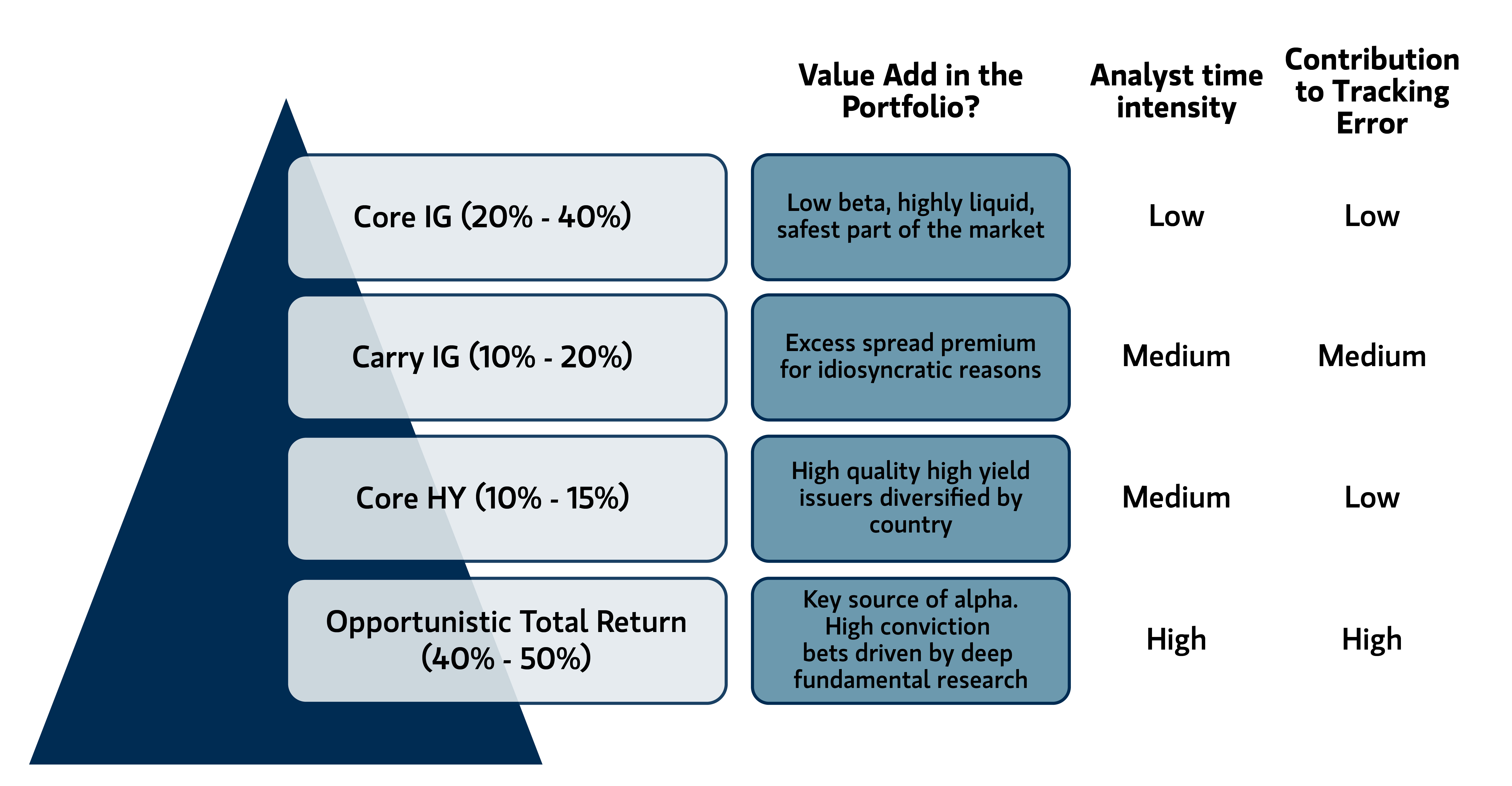
Our bottoms-up best ideas that are owned by analysts are combined with a bespoke list of core investment grade and high yield credits to deliver a benchmark aware portfolio with superior risk-adjusted returns.

Investment Approach

The team generally looks to take advantage of investment opportunities across corporate, quasi-sovereign and to a lesser extent sovereign debt securities from Emerging Markets countries experiencing positive fundamental change. EM Corporate Debt seeks to provide investors the opportunity to capitalize on this progress as local companies become leaders in their domestic markets and relevant in the global credit arena. 

The team aims to capture the upside potential of Emerging Market Corporate Debt securities through:

  • Value orientation with an emphasis on loan-to-value and asset coverage
  • Focus on deep, fundamental research to identify long term earnings power of a company
  • Go beyond the benchmark to search for unique ideas
  • Country expertise matters for emerging markets investing
  • Own high conviction ideas and size them accordingly
  • Take a long-term perspective and emphasize individual decision-making
  • Secondary markets are often a better place (vs. primary issuances) to find mispriced securities –particularly given the diverse buyer base of emerging markets corporates
  • ESG integration leads to better investment decisions


Investment Process

1
Opportunity identification

The team begins with a broad investable universe of more than 1,500 issuers across over 70 countries, including investment grade, high-yield, and off-benchmark unrated credits. The team uses proprietary screening tools and qualitative criteria to identify companies with attractive investment potential based on industry structure, macro trends, business quality, competitive moats, and relative credit spread opportunities.

2
Preliminary credit review

Once an opportunity is identified, the team conducts an initial credit review to establish the high-level investment thesis. This includes a first-hand assessment of the issuer’s capital structure, summary financials, and key credit metrics, as well as engagement with the sovereign team to evaluate country-level risks that may affect the company’s operating environment or credit profile.

3
Fundamental credit analysis and industry outlook

For ideas that pass the initial review, the team undertakes a deeper assessment of the issuer’s business model, competitive positioning, and industry backdrop. This includes stress-testing the durability of the company’s competitive advantages, evaluating long-term strengths and threats, and conducting diligence with competitors, suppliers, customers, and other relevant market participants to validate the investment thesis.

4
Valuation and investment recommendation

The team builds out a detailed financial model and enterprise value analysis to assess valuation, downside protection, and return potential across scenarios. Legal documentation is also reviewed as part of the diligence process. The output of this work is a formal investment recommendation that weighs the issuer’s fundamentals, valuation, risks, and expected return profile.

5
Portfolio sizing and implementation

Position sizing is determined based on the risk-reward of the opportunity relative to other ideas in the portfolio. The team typically builds positions over time and takes an opportunistic approach to implementation, using market dislocations, technical selling pressure, or other windows of attractive liquidity to increase exposure where conviction and valuation support a larger position.

Portfolio Managers

Effective March 8, 2024, Budi Suharto no longer serves as Portfolio Manager to the Fund. 

Effective July 19, 2022, Akbar Causer was added as Portfolio Manager to the Strategy and Sahil Tandon is no longer serving as Portfolio Manager to the Strategy.

Effective September 30, 2022, Warren Mar no longer serves as Portfolio Manager to the Strategy. 


RISK CONSIDERATIONS  

Diversification does not protect you against a loss in a particular market; however it allows you to spread that risk across various asset classes.

There is no assurance that a portfolio will achieve its investment objective. Portfolios are subject to market risk, which is the possibility that the market values of securities owned by the portfolio will decline. Market values can change daily due to economic and other events (e.g. natural disasters, health crises, terrorism, conflicts and social unrest) that affect markets, countries, companies or governments. It is difficult to predict the timing, duration, and potential adverse effects (e.g. portfolio liquidity) of events. Accordingly, you can lose money investing in this strategy. Please be aware that this strategy may be subject to certain additional risks. Fixed-income securities are subject to the ability of an issuer to make timely principal and interest payments (credit risk), changes in interest rates (interest-rate risk), the creditworthiness of the issuer and general market liquidity (market risk). In a rising interest-rate environment, bond prices may fall and may result in periods of volatility and increased portfolio redemptions. In a declining interest-rate environment, the portfolio may generate less income. Longer-term securities may be more sensitive to interest rate changes. Investments in foreign marketsentail special risks such as currency, political, economic, and market risks. The risks of investing in emerging market countries are greater than the risks generally associated with investments in foreign developed countries. Derivative instruments can be illiquid, may disproportionately increase losses and may have a potentially large negative impact on the portfolio’s performance. When investing in value securities, the market may not have the same value assessment as the manager, and, therefore, the performance of the securities may decline.


This communication is only intended for and will be only distributed to persons resident in jurisdictions where such distribution or availability would not be contrary to local laws or regulations.

There is no guarantee that any investment strategy will work under all market conditions, and each investor should evaluate their ability to invest for the long-term, especially during periods of downturn in the market. Past performance is no guarantee of future results.

A separately managed account may not be appropriate for all investors. Separate accounts managed according to the Strategy include a number of securities and will not necessarily track the performance of any index. Please consider the investment objectives, risks and fees of the Strategy carefully before investing. A minimum asset level is required. For important information about the investment manager, please refer to Form ADV Part 2.

Any views and opinions provided are those of the portfolio management team and are subject to change at any time due to market or economic conditions and may not necessarily come to pass. Furthermore, the views will not be updated or otherwise revised to reflect information that subsequently becomes available or circumstances existing, or changes occurring. The views expressed do not reflect the opinions of all portfolio managers at Morgan Stanley Investment Management (MSIM) or the views of the firm as a whole, and may not be reflected in all the strategies and products that the Firm offers.

This material is a general communication, which is not impartial and all information provided has been prepared solely for informational and educational purposes and does not constitute an offer or a recommendation to buy or sell any particular security or to adopt any specific investment strategy. The information herein has not been based on a consideration of any individual investor circumstances and is not investment advice, nor should it be construed in any way as tax, accounting, legal or regulatory advice. To that end, investors should seek independent legal and financial advice, including advice as to tax consequences, before making any investment decision.

OTHER CONSIDERATIONS

The indexes are unmanaged and do not include any expenses, fees or sales charges. It is not possible to invest directly in an index. Any index referred to herein is the intellectual property (including registered trademarks) of the applicable licensor. Any product based on an index is in no way sponsored, endorsed, sold or promoted by the applicable licensor and it shall not have any liability with respect thereto.

The JP Morgan CEMBI Broad Diversified Index is a global, liquid corporate emerging-markets benchmark that tracks U.S.-denominated corporate bonds issued by emerging-markets entities. 

The information presented represents how the portfolio management team generally implements its investment process under normal market conditions.

Morgan Stanley Investment Management is the asset management division of Morgan Stanley.