

 Top
Top

Introduction
The current macroenvironment is proving to be resilient, yet volatile and divergent. Interest rate policy has shifted from dovish to hawkish as central bankers combat elevated inflation fueled by energy price spikes. Real estate continues to screen attractively against other alternatives given re-pricing of ~25%, durability of income flows in sectors aligned to structural trends and a meaningfully lower supply environment, exacerbated by even higher construction costs. While MSREI remains constructive on the overall environment, the ability to build a diversified portfolio, dynamically shift capital between regions and/or asset classes and “stock pick” assets with specifications and locational attributes that fit new occupier demand preferences, remains critical.
Macroeconomic Environment
Contending with higher tariffs last year and ongoing Middle East conflict this year, global economies have remained surprisingly resilient. Pockets of outsized nominal growth exist in the U.S. (+6%), Japan (+4%) and Korea (+4%) which is driving strong real estate fundamentals, particularly in the absence of new supply1. While the U.S. economy is benefitting from the adoption of AI across all sectors of the economy and a pick-up in manufacturing, Japan and Korea are benefiting from exporting the chips and tech components that feed the U.S. adoption of AI. While Europe’s growth has moderated below trend due to the impact of higher inflation on real consumer incomes and spending, government stimulus and private markets investment in defense and infrastructure should support a recovery in fundamentals once inflation subsides.
Display 1: U.S. Growth Structurally Higher
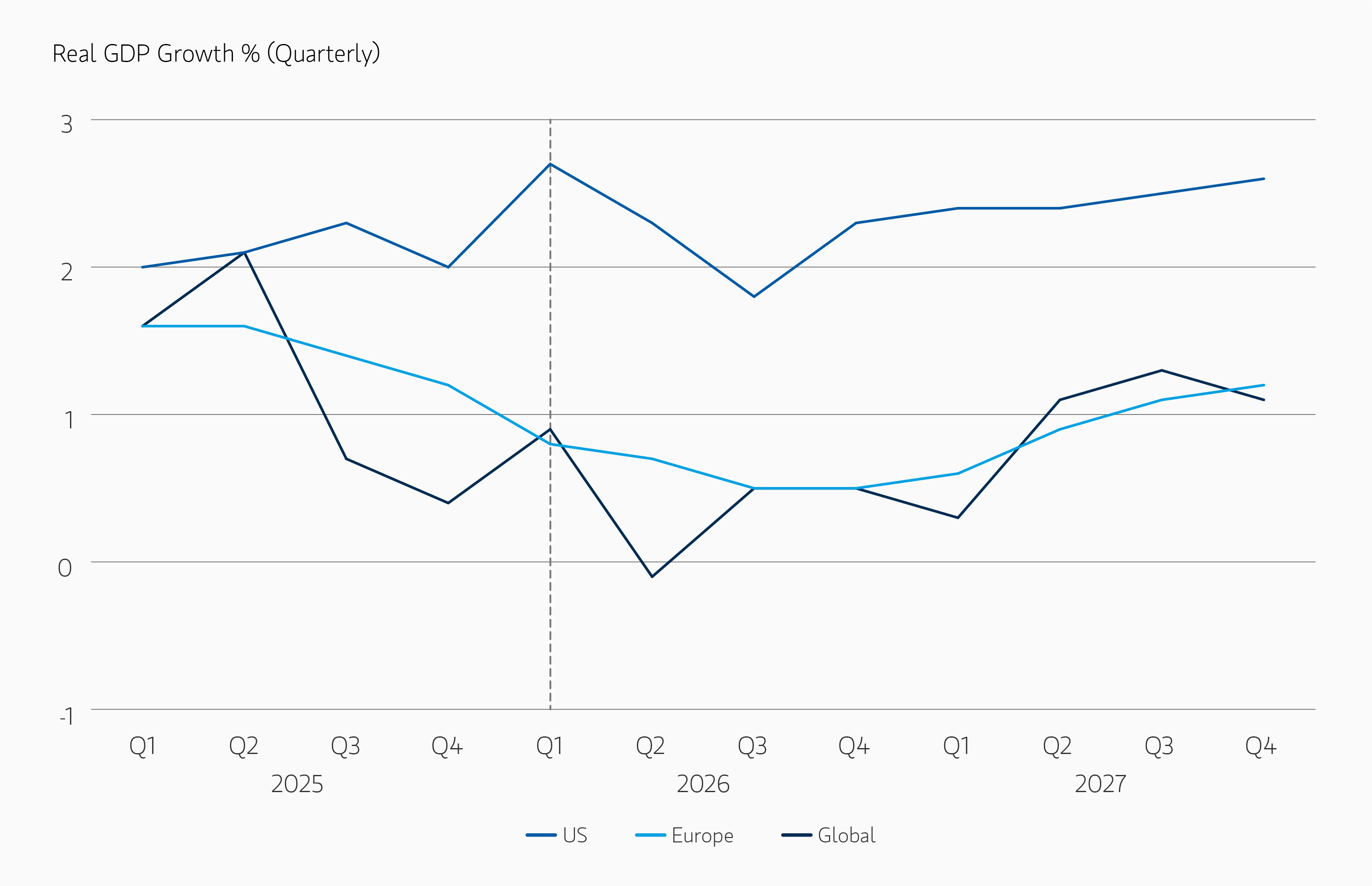
Display 1: U.S. Growth Structurally Higher
Display 2: Interest Rates Higher in the Near Term
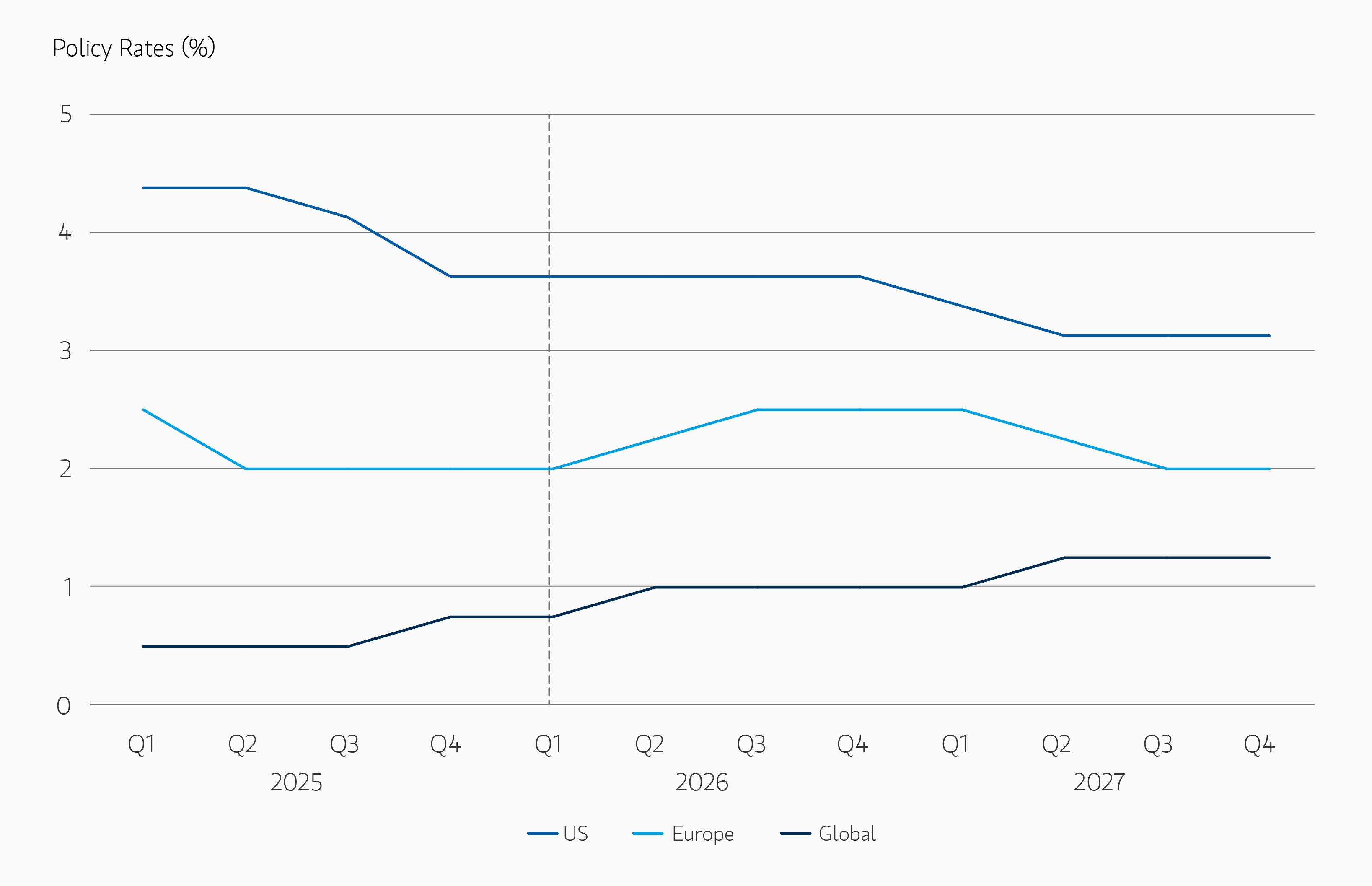
Display 2: Interest Rates Higher in the Near Term
While the uptick in inflation has been the major driver of an upward shift in interest rate curves around the world, the strength of the underlying economies and higher priced AI inputs has also contributed to a more hawkish central bank position. Australia and Japan were first out of the gates with interest rate rises (75bp and 50bps respectively), followed by Europe (+25bps). The Fed has recently shifted its focus from employment to inflation, resulting in the removal of its easing bias and a hold through the medium term, with upside risk of higher rates if inflation remains sticky.
This structurally higher nominal growth, inflation and interest rate environment is likely to stay. The ability to acquire assets at an attractive basis below replacement cost, in sectors and locations where growth can exceed what the underlying economy can deliver, becomes critically important to deliver outperformance.
Commercial Real Estate Market
Despite events in the Middle East and the subsequent shift in interest rate policy, real estate capital flows have remained resilient as investors gravitate towards its relative value, inflation hedging attributes, and alignment with long term structural trends. Transaction activity is up 23% in the US, 25% in Asia and down 7% in Europe (YOY) through the first half of 20262. With prices down 20-25% and yields at their highest level in ten years, real estate is viewed as “cheap” relative to other asset classes which continue to push record highs in values or tights in spreads.
Display 3: U.S. Private Real Estate vs Other Asset Classes Relative Valuation
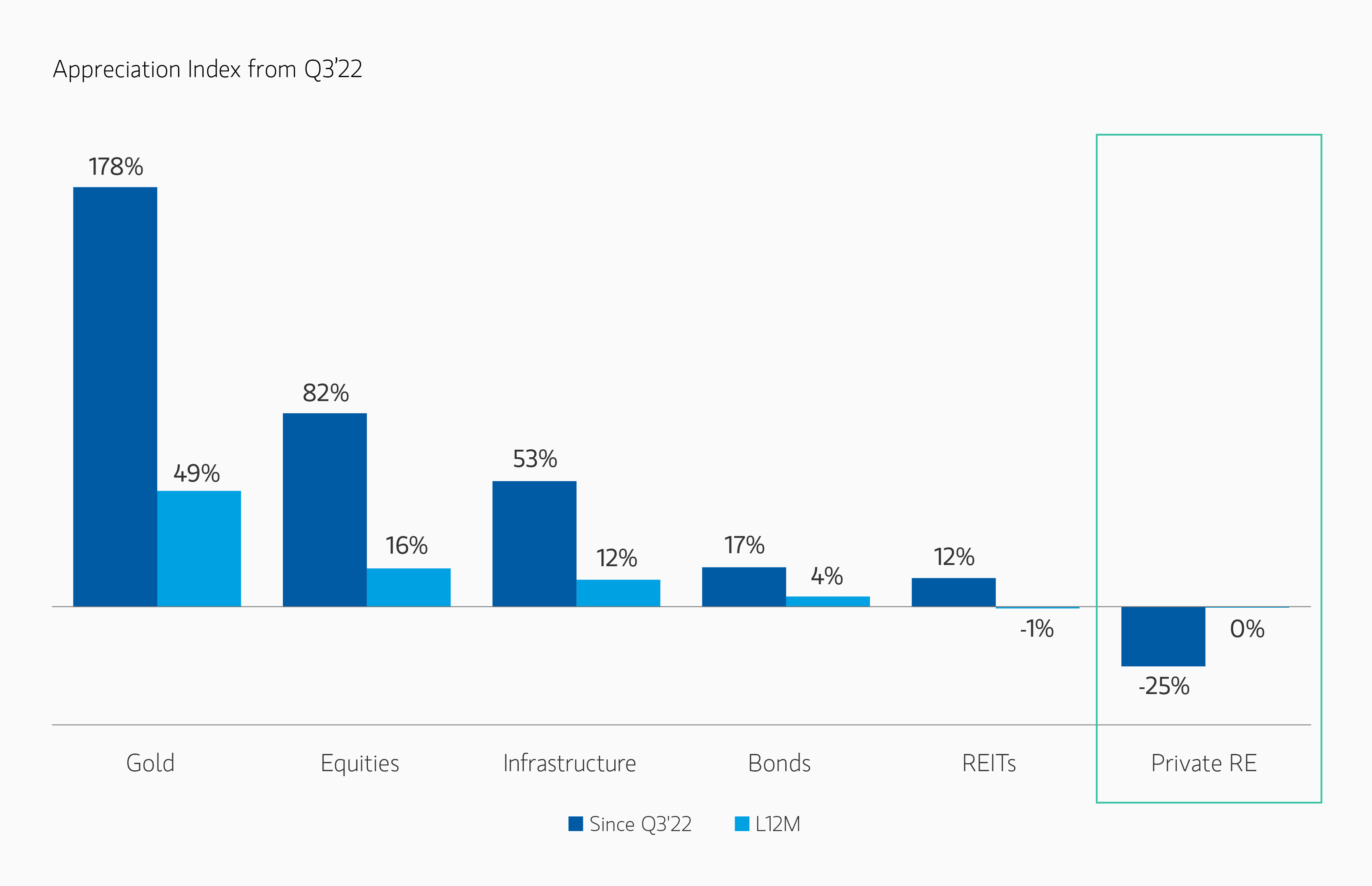
Display 3: U.S. Private Real Estate vs Other Asset Classes Relative Valuation
Display 4: Reduced Supply Supports Fundamentals
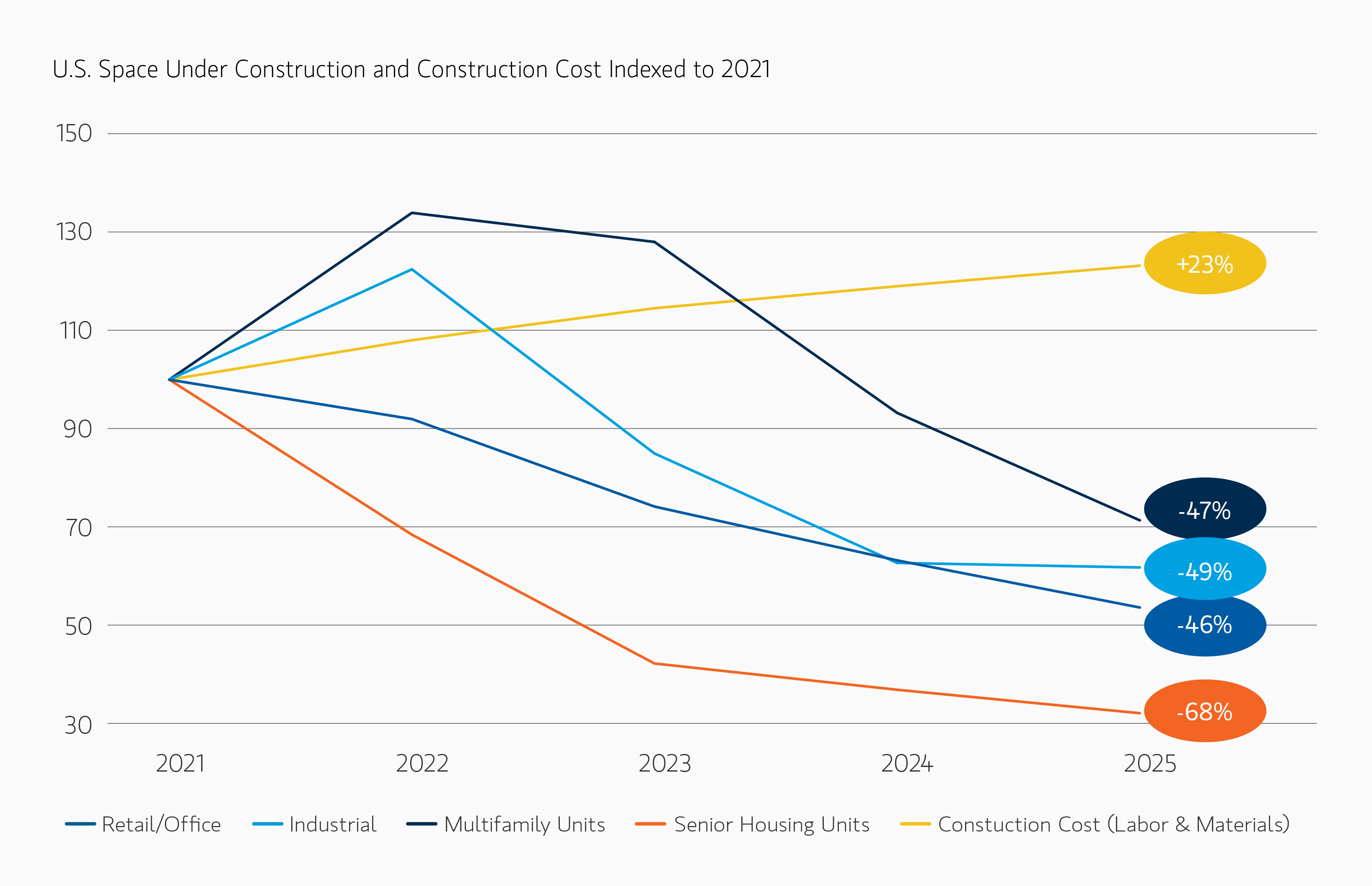
Display 4: Reduced Supply Supports Fundamentals
Additionally, given inflation forecasts are higher, real estate’s proven ability to outperform during inflationary periods has become a much sought after attribute. Since the 1970s, real estate has generated total returns above inflation in five of the seven high inflation periods3. This outperformance is largely due to strong income growth derived from lower supply. Today’s environment mirrors several of these moderate demand-pull/cost-push environments, where elevated construction and financing costs should continue to slow new development, tighten future supply and ultimately support rent growth and value appreciation in existing assets.
Lastly, clear pockets of outperformance in fundamentals and pricing are emerging for assets/locations/ sectors levered to growing parts of the economy or long-term structural trends, including AI, defense, aging and de-globalization. By way of example, senior housing in the U.S. (aligned with aging demographics) continues to deliver rent growth of 7-10% and cap rate compression of 100-150bps over the past 12 months. Office assets in Japan (supported by the reflating economy) have delivered rent growth of 14% (YOY through 1Q26) while cap rates have held steady (despite higher interest rates)4. Lastly in Europe, there are opportunities to acquire assets aligned to these themes at a discounted entry basis due to capital markets dislocation. This bifurcation in performance requires a very granular approach to selecting assets, sub sectors and locations tied to durable long-term trends.
Real Estate Investing Strategies
As discussed above, the ability to acquire tangible real estate aligned with long-term structural trends is a critical driver of outperformance, particularly in an environment where cyclical volatility, geopolitical risks and political fragmentation are becoming more frequent. Morgan Stanley Research highlights four key themes that have recently generated outsized returns: AI and technology diffusion (+108% LTM equity returns), deglobalization (+104%), societal shifts (+7%), and the future of energy (+56%). Despite this strong performance at the equity level, valuations for real estate linked to these same themes have largely remained flat—creating a notable disconnect—aside from data centers, which have appreciated approximately 22%5. This divergence presents a compelling opportunity to deploy capital into real assets with the potential for both income growth and capital appreciation as these structural tailwinds increasingly translate into physical space demand.
Display 5: MS Research Structural Themes, Equity Returns and Real Estate Strategies
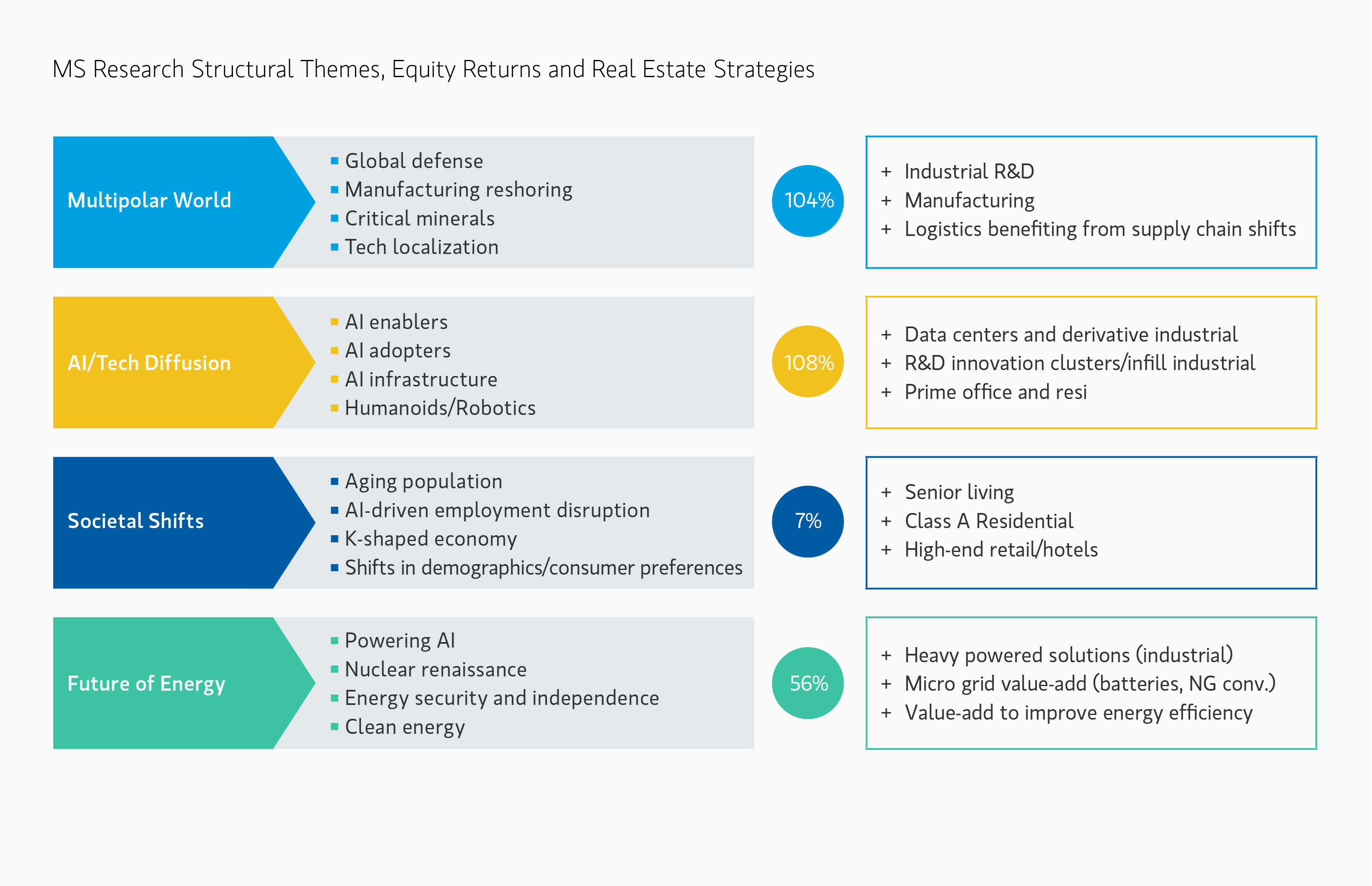
Display 5: MS Research Structural Themes, Equity Returns and Real Estate Strategies
Multipolar World
While tariffs, deglobalization, and reshoring trends continue to underpin demand for industrial space, an increasing focus on defense spending, particularly in the U.S. and Germany, is providing an additional and accelerating tailwind. In the U.S., manufacturing and industrial production activity has strengthened, with manufacturing users now accounting for approximately 25% of total industrial leasing demand, reflecting a structural shift toward onshoring and supply chain resilience6. In Europe, the case for increased defense spending is even more pronounced, with the Middle East conflict reinforcing the urgency for R&D in advanced weaponry and technologies. This is translating into tangible real estate demand, particularly within established innovation clusters such as Paris and Munich, where defense-related industrial and R&D space is expected to grow meaningfully—potentially comprising 15–20% of total industrial stock within the next decade.
AI/Tech Diffusion
AI spending in the U.S. and globally continues to grow at an exponential pace, with nearly $3 trillion in AI-related infrastructure investment expected to flow through the global economy by 2028—over 80% of which is still ahead. This surge is already having a measurable macroeconomic impact, with AI projected to drive approximately 25% of U.S. GDP growth this year7. This dynamic creates a compelling opportunity to invest in real estate and markets that disproportionately benefit from AI enablement and physical deployment. Strategically, this favors overweight exposure to regions experiencing AI-driven GDP acceleration—particularly the U.S., Korea, and Japan—and to sectors that benefit both directly and indirectly, including industrial (such as advanced manufacturing, distribution and small-bay facilities in data center clusters, office R&D, and multifamily in markets facing less AI disruption risk). AI related demand is also reshaping geographic and asset-level dynamics, concentrating activity in major global hubs such as the San Francisco Bay Area, Northern Virginia, Los Angeles, Boston, Tokyo, Seoul, Munich, Paris, and London, often clustering further within micro-locations (e.g., Fremont in SFBA, El Segundo in Los Angeles).
Display 6: Manufacturing is Expanding Driving Leasing
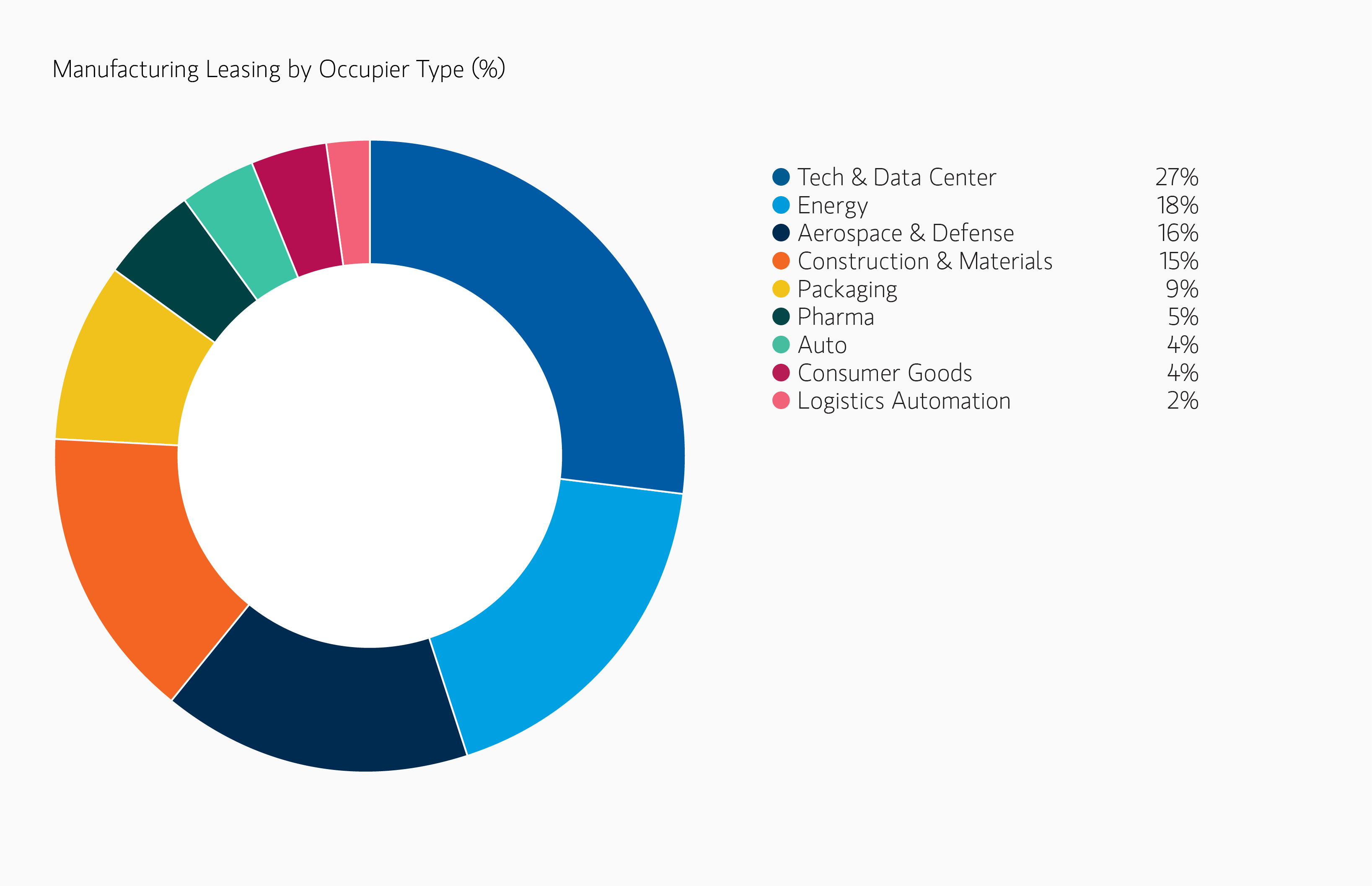
Display 6: Manufacturing is Expanding Driving Leasing
Display 7: U.S. Population Growth (75+) Should Drive Senior Housing Demand
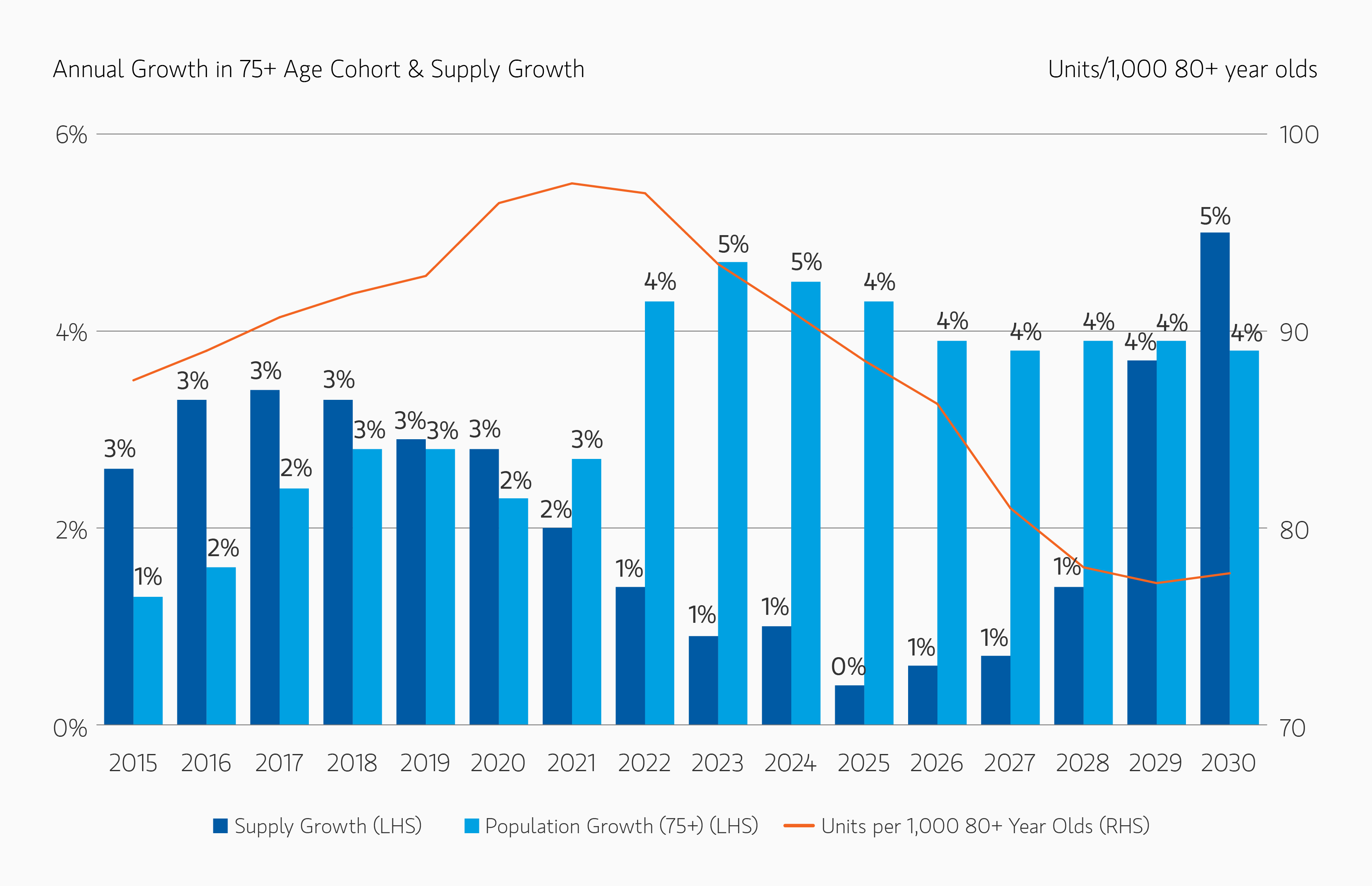
Display 7: U.S. Population Growth (75+) Should Drive Senior Housing Demand
Societal Shifts
Aging demographics, shifting migration patterns, urbanization and the continued emergence of the K-shaped economy are key forces shaping residential investment strategies. In the U.S., the 80+ age cohort is expected to grow at 5% per annum through the end of the decade and continue outpacing new supply growth in senior housing. These dynamics are driving expectations for high single digit rent growth in the sector over the coming years. At the same time, evolving migration trends, including a rebalancing between gateway markets (impacted by reduced immigration) and Sunbelt regions (where domestic migration is moderating), combined with localized pockets of under- and oversupply, reinforce the need for a diversified and market-specific investment approach. Internationally, Japan continues to benefit from strong population inflows into the central wards of Tokyo, driven by urbanization and wage growth, resulting in outsized rent increases for the first time in many years. In Europe, where housing undersupply remains particularly acute (for example, only ~1,000 multifamily units commenced construction in London in 2025, down from an already low annual average of 5,000, for a population of 9 million)8, the opportunity to acquire assets below replacement cost with embedded rental upside remains compelling, despite regulatory headwinds. More broadly, the K-shaped economy is favoring residential assets that cater to higher-income households, while also supporting hospitality demand in key European and Japanese markets that benefit from multiple demand drivers, including both tourism and business travel.
Future of Energy
The availability, cost and security of energy remain top of mind. Higher costs, initially driven by the rapid build out of data centers, have been further compounded by energy price spikes stemming from the Middle East conflict and closure of the Strait of Hormuz. At the same time, demand is accelerating sharply, fueled not only by data centers, but also by the physical adoption of AI (e.g., robotics), defense spending and broader industrial and manufacturing activity. In this environment, investment strategies focused on assets with surplus or secured power capacity are likely to continue commanding rent and valuation premiums. Similarly, markets characterized by abundant, reliable, and lower-cost power are positioned to capture a disproportionate share of incremental demand.
Conclusion
Overall, the investment landscape for real estate is increasingly defined by a combination of resilient macro fundamentals, structural supply constraints, and powerful secular tailwinds. While volatility in interest rates, geopolitics, and inflation is likely to persist, the ongoing repricing cycle has created a more compelling entry point, particularly for assets acquired below replacement cost and aligned with durable sources of demand. In this environment, outperformance will be driven by dynamic capital allocation, regional and sector diversification, and highly selective, asset-level underwriting.


IMPORTANT DISCLAIMERS
The document has been prepared solely for information purposes and does not constitute an offer or a recommendation to buy or sell any particular security or to adopt any specific investment strategy. The material contained herein has not been based on a consideration of any individual client circumstances and is not investment advice, nor should it be construed in any way as tax, accounting, legal or regulatory advice. To that end, investors should seek independent legal and financial advice, including advice as to tax consequences, before making any investment decision. The information contained herein refers to research but does not constitute an equity research report and is not from Morgan Stanley Equity Research.
Unless otherwise indicated, the views expressed are those of the research and strategy team of Morgan Stanley Real Assets and may differ from those of Morgan Stanley Equity Research and other Morgan Stanley affiliates (including others within Morgan Stanley Real Assets). These views may also differ from investment strategies implemented by Morgan Stanley Real Assets now or in the future. The information (including facts, opinions, estimates or projections) contained herein is based on financial, economic, market and other conditions prevailing as of the date hereof. As such, it remains subject to change at any time. By providing such information, Morgan Stanley Real Assets assumes no obligation to provide any update or supplement to such information following the date hereof. Although reasonable care has been taken to ensure that the information (including facts, opinions, estimates or projections) contained herein is accurate, complete and fair, no warranty, express or implied, is made as to the accuracy, completeness or fairness of such information. Certain economic and market information contained herein may have been obtained from third parties’ sources. While Morgan Stanley Real Assets believes that such sources are reliable, neither Morgan Stanley Real Assets nor any other Morgan Stanley affiliate has independently verified such information or assumes any responsibility or liability for the accuracy, completeness or fairness of such information or any omission of information.
There is no guarantee that any investment strategy will work under all market conditions, and each investor should evaluate their ability to invest for the long-term, especially during periods of downturn in the market. There are important differences in how the strategy is carried out in each of the investment vehicles. Your financial professional will be happy to discuss with you the vehicle most appropriate for you given your investment objectives, risk tolerance and investment time horizon.
The information contained herein is highly confidential. By accepting this document, you agree that this document (including any data, analysis, conclusions, or other information contained herein and all oral information, if any, provided by Morgan Stanley Real Assets in connection herewith) may not be photocopied, reproduced or otherwise shared or distributed to any other persons, in whole or in part, without the prior consent of Morgan Stanley Real Assets. Notwithstanding the foregoing, this document and information may be provided to (a) your legal, tax, financial and other advisors who agree to maintain this document in confidence and (b) a government official to the extent necessary to comply with a judicial or governmental order.
Except as otherwise indicated herein, the views and opinions expressed herein are those of Morgan Stanley Real Assets, are based on matters as they exist as of the date of preparation and not as of any future date and will not be updated or otherwise revised to reflect information that subsequently becomes available or circumstances existing, or changes occurring, after the date hereof.
Historical information is not indicative of future results, and the historical information in this Presentation should not be viewed as an indicator of any future performance that may be achieved as a result of implementing an investment strategy substantially identical or similar to that described in this Presentation.
Certain information contained in this Presentation constitutes “forward looking statements,” which can be identified by the use of forward-looking terminology such as “may,” “will,” “should,” “expect,” “anticipate,” “target,” “estimate,” “intend,” “continue,” or “believe,” or the negatives thereof or other variations thereon or comparable terminology. Due to various risks and uncertainties, actual events or results or the actual performance may differ materially from those reflected or contemplated in such forward looking statements. Prospective investors should pay close attention to the assumptions underlying the analyses and forecasts contained in this Presentation. The analyses and forecasts contained in this Presentation are based on assumptions believed to be reasonable in light of the information presently available. Such assumptions (and the resulting analyses and forecasts) may require modification as additional information becomes available and as economic and market developments warrant. Any such modification could be either favorable or adverse. Nothing contained in this Presentation may be relied upon as a guarantee, promise, assurance or a representation as to the future.
Any index referred to herein is the intellectual property (including registered trademarks) of the applicable licensor. Any product based on an index is in no way sponsored, endorsed, sold or promoted by the applicable licensor and it shall not have any liability with respect thereto.
Real estate investments are subject to special risks, including interest rate and property value fluctuations, as well as risks related to general and economic conditions.
Morgan Stanley, its affiliates and Morgan Stanley Financial Advisors do not provide tax, accounting or legal advice. Individuals should consult their tax advisor for matters involving taxation and tax planning and their attorney for matters involving legal matters.
Morgan Stanley is not responsible for the information contained on any third party website or your use or inability to use such site, nor do we guarantee its accuracy or completeness. The terms, conditions, and privacy policy on any third party website may be different from those applicable to your use of any Morgan Stanley website. The opinions expressed by the author of an article written by a third party are solely his/her own and do not necessarily reflect those of Morgan Stanley. The information and data provided by any third-party website of publication is as of the date of the material when it was written and is subject to change without notice.
DISTRIBUTION
This communication is only intended for and will only be distributed to persons resident in jurisdictions where such distribution or availability would not be contrary to local laws or regulations.
EMEA: This communication was issued and approved in the United Kingdom by Morgan Stanley Investment Management Limited, 25 Cabot Square, Canary Wharf, London E14 4QA, authorized and regulated by the Financial Conduct Authority, for distribution to Professional Clients only and must not be relied upon or acted upon by Retail Clients (each as defined in the UK Financial Conduct Authority’s rules).
Financial intermediaries are required to satisfy themselves that the information in this document is suitable for any person to whom they provide this document in view of that person’s circumstances and purpose. Morgan Stanley Investment Management shall not be liable for, and accepts no liability for, the use or misuse of this document by any such financial intermediary. If such a person considers an investment, she/he should always ensure that she/he has satisfied herself/himself that she/he has been properly advised by that financial intermediary about the suitability of an investment.
This material is for Professional Clients/Accredited Investors only.
In the EU, MSIM and Eaton Vance materials are issued by MSIM Fund Management (Ireland) Limited (“FMIL”). FMIL is regulated by the Central Bank of Ireland and is incorporated in Ireland as a private company limited by shares with company registration number 616661 and has its registered address at 24-26 City Quay, Dublin 2, DO2 NY19, Ireland.
Outside the EU, MSIM materials are issued by Morgan Stanley Investment Management Limited (MSIM Ltd) is authorised and regulated by the Financial Conduct Authority. Registered in England. Registered No. 1981121. Registered Office: 25 Cabot Square, Canary Wharf, London E14 4QA.
In Switzerland, MSIM materials are issued by Morgan Stanley & Co. International plc, London (Zurich Branch) Authorised and regulated by the Eidgenössische Finanzmarktaufsicht (“FINMA”). Registered Office: Beethovenstrasse 33, 8002 Zurich, Switzerland.
Outside the US and EU, Eaton Vance materials are issued by Eaton Vance Management (International) Limited (“EVMI”) 125 Old Broad Street, London, EC2N 1AR, UK, which is authorised and regulated in the United Kingdom by the Financial Conduct Authority. Italy: MSIM FMIL (Milan Branch), (Sede Secondaria di Milano) Palazzo Serbelloni Corso Venezia, 16 20121 Milano, Italy. The Netherlands: MSIM FMIL (Amsterdam Branch), Rembrandt Tower, 11th Floor Amstelplein 11096HA, Netherlands. France: MSIM FMIL (Paris Branch), 61 rue de Monceau 75008 Paris, France. Spain: MSIM FMIL (Madrid Branch), Calle Serrano 55, 28006, Madrid, Spain.
MIDDLE EAST
Dubai: MSIM Ltd (Representative Office, Unit Precinct 3-7th Floor-Unit 701 and 702, Level 7, Gate Precinct Building 3, Dubai International Financial Centre, Dubai, 506501, United Arab Emirates. Telephone: +97 (0)14 709 7158). In addition, real estate investments are subject to a variety of risks, including those related to, among other things, the economic climate, both nationally and locally, the financial condition of tenants and environmental regulations. Saudi Arabia. This document is not and does not purport to be any of the following: (a) a marketing communication, (b) a securities advertisement, (c) a financial promotion. Material contained herein has not been based on a consideration of any individual client circumstances and is not investment advice, nor should it be construed in any way as tax, accounting, legal or regulatory advice. To that end, recipients or viewers of this document should seek independent legal and financial advice, including advice as to tax consequences, before making any investment decision. This document may not be distributed in the Kingdom of Saudi Arabia except to such persons as are permitted under the Rules of Offering Securities and Continuing Obligations and the Securities Business Regulations issued by the Capital Market Authority. The disclosure of this presentation is restricted to sophisticated investors.
The Capital Market Authority does not make any representation as to the accuracy or completeness of this document, and expressly disclaims any liability whatsoever for any loss arising from, or incurred in reliance upon, any part of this document. Prospective purchasers should conduct their own due diligence on the accuracy of the information in this presentation. If you do not understand the contents of this document, you should consult an authorized financial adviser.
Hong Kong: This material is disseminated by Morgan Stanley Asia Limited for use in Hong Kong and shall only be made available to “professional investors” as defined under the Securities and Futures Ordinance of Hong Kong (Cap 571). The contents of this material have not been reviewed nor approved by any regulatory authority including the Securities and Futures Commission in Hong Kong. Accordingly, save where an exemption is available under the relevant law, this material shall not be issued, circulated, distributed, directed at, or made available to, the public in Hong Kong. Singapore: This material is disseminated by Morgan Stanley Investment Management Company and should not be considered to be the subject of an invitation for subscription or purchase, whether directly or indirectly, to the public or any member of the public in Singapore other than (i) to an institutional investor under section 304 of the Securities and Futures Act, Chapter 289 of Singapore (“SFA”); (ii) to a “relevant person” (which includes an accredited investor) pursuant to section 305 of the SFA, and such distribution is in accordance with the conditions specified in section 305 of the SFA; or (iii) otherwise pursuant to, and in accordance with the conditions of, any other applicable provision of the SFA. This publication has not been reviewed by the Monetary Authority of Singapore. Australia: This material is disseminated in Australia by Morgan Stanley Investment Management (Australia) Pty Limited ACN: 122040037, AFSL No. 314182, which accept responsibility for its contents. This publication, and any access to it, is intended only for “wholesale clients” within the meaning of the Australian Corporations Act. Calvert Research and Management, ARBN 635 157 434 is regulated by the U.S. Securities and Exchange Commission under U.S. laws which differ from Australian laws. Calvert Research and Management is exempt from the requirement to hold an Australian financial services licence in accordance with class order 03/1100 in respect of the provision of financial services to wholesale clients in Australia.


