

 Anfang


China’s autonomous vehicle (AV) sector represents a long-term structural growth opportunity, supported by:
1) A large total addressable market with a favorable adoption curve
2) Structural cost advantages that support unit economics (UE)
3) Technical leadership reinforced by a data flywheel
Supported by a favorable policy backdrop, Chinese players in the AV market are rapidly closing the gap with global leaders, and we believe valuation dispersion continues to create compelling bottom-up investment opportunities.
Consumer transportation is a large market, with AV adoption still in early stages
Global expenditure on passenger mobility is measured in the trillions annually, while the commercial robotaxi market remains in its infancy, with 2025 revenue estimates around $0.5 billion.1 Over the long term, we expect AV adoption to increase substantially, driven by:
- Improved convenience—as the technology scales, higher vehicle density should reduce wait times, while AVs also provide consumers with private space.
- Lower per-mile costs—AVs reshape mobility economics by removing labor costs, which are the largest component of ride-hailing fares.
- Improved safety versus human-driven vehicles—Safety metrics continue to improve, with leading autonomous vehicle operators reporting miles-per-airbag deployment approximately 10 times higher than human-driven vehicles, and, in some cases, no active safety incidents.
Structural cost advantages support improving UE
Chinese AV companies are demonstrating materially lower bill-of-material costs, often 60% to 80% below leading international peers.2 These cost advantages are supported by purpose-built vehicle programs with auto original equipment manufacturers (OEMs) and lower sensor and compute costs, including the use of auto-grade chips. With a lower vehicle cost base, scaling fleet density should lift utilization and support profitable fleet operations. Several leading Chinese AV operators have already achieved positive unit economics in select cities. This progress comes despite China’s ride-hailing market operating at fare levels that are a fraction of those in many developed markets, with average fares estimated at roughly $0.30 per mile,3 suggesting attractive economics as these companies expand into higher average-revenue-per-user (ARPU)regions.
Data flywheel as a competitive advantage
The investment case is reinforced by competitive moats built on integrated hardware and software ecosystems, as well as large databases of real-world level 4 (L4) driving data. Chinese AV players utilize a hybrid approach that combines rules-based algorithms with an end-to-end AI model. Greater deployment strengthens a data flywheel: more fleet miles generate more L4 data for reinforcement learning, improving models and helping solve edge cases. China’s dense, complex urban environments further enhance data quality, while international expansion adds broader coverage of diverse road conditions (including both left-hand and right-hand drive).
International expansion and asset-light business model
Chinese AV players are proactively pursuing international permits, supported by partnerships with automakers, ride-hailing mobility platforms, and local governments that enable an asset-light model. In some cases, they have already secured financing partners to fund AV capex, underscoring the relative maturity of their approach. Over time, we believe this model should support efficient scaling domestically and internationally without significant capital intensity.
Valuation dislocation creates opportunity
Valuations across the sector remain highly uneven despite improving fundamentals. Leading Chinese players are trading at an 80% to 90% and greater discount relative to global peers, even as they demonstrate comparable technological progress, faster commercialization, and clearer paths to profitability, alongside expanding international footprints.
Multiple monetization pathways
Beyond passenger mobility, Chinese AV companies could also license their autonomous driving software to auto OEMs for deployment in passenger vehicles sold to consumers. Additional upside could come from adjacent opportunities, such as robotrucks and robobuses, with one key player noting that 80% of their tech stack is shared between their robotaxi and robotruck platforms. In addition to providing incremental revenue streams, this also supports the broader AV ecosystem expansion and facilitates regulatory support.
Display 1: Robotaxi Utilization and Market Value
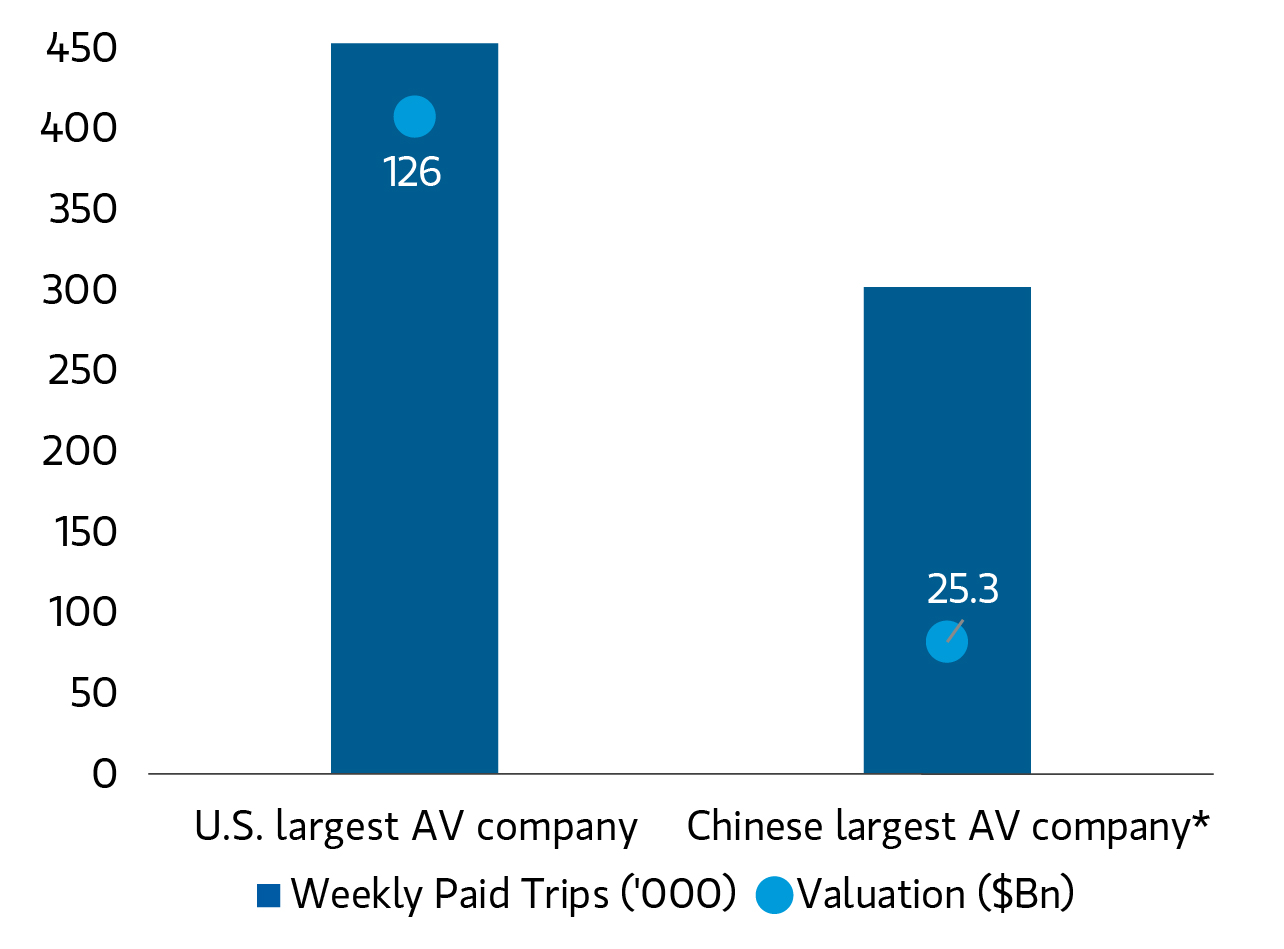
*Source: Driverless digest as of December 2024.
Display 1: Robotaxi Utilization and Market Value
Overall, we view China’s autonomous driving sector as a compelling long-term investment theme
This view is supported by cost leadership, data advantages, strong technical talent, and policy alignment to develop the ecosystem. We have invested in China’s autonomous driving sector, reflecting our conviction in the long-term opportunity to capture significant value globally over time.
Vorgestellte Einblicke