Key takeaways:
Direct Lending is a type of Private Credit strategy that makes direct, illiquid loans to middle market companies outside of the traditional banking system. Direct Lending usually refers to first lien loans as well as unitranche loans that combine different debt classes or liens into a single loan.
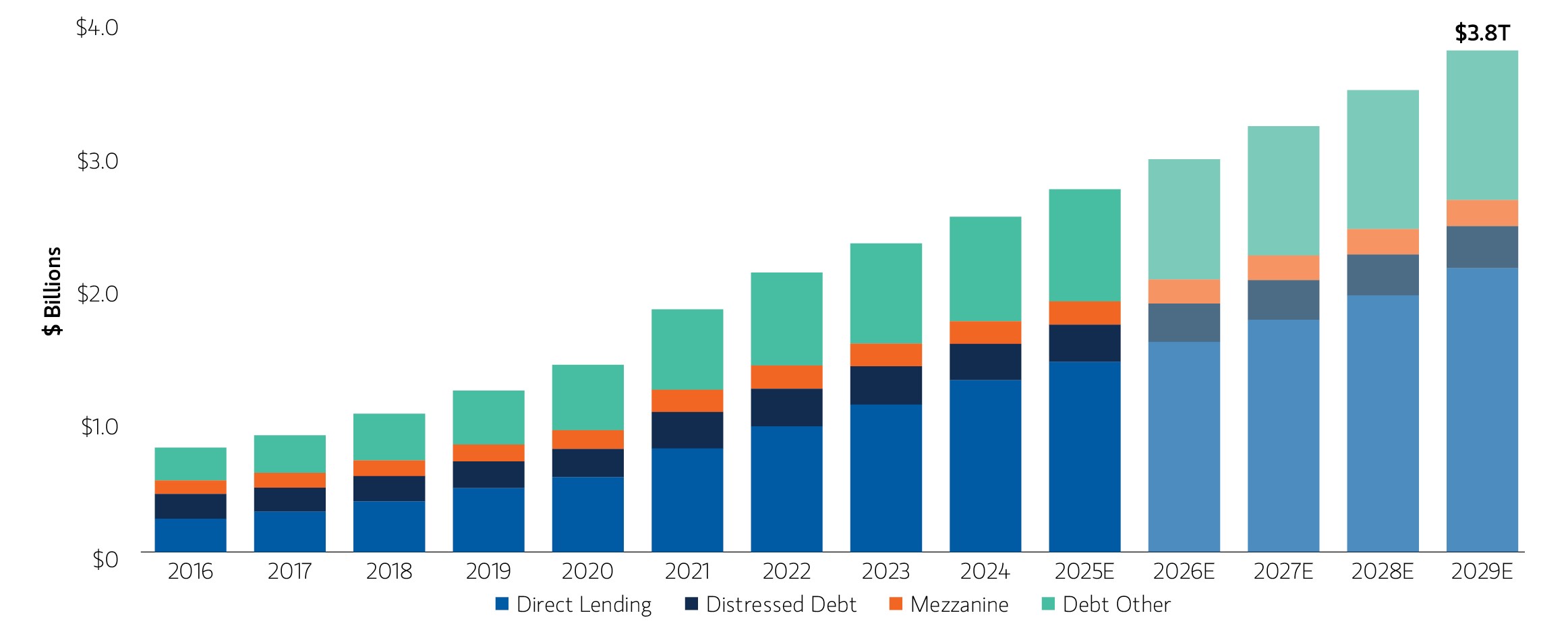
Source: PitchBook, LESG, Morgan Stanley Investment Management. Gross invested assets including leverage applied. Excludes uncalled capital in drawdown funds. Forecasts generated on April 19, 2025. Historical data as of September 30, 2025.
DISPLAY 1
Source: PitchBook, LESG, Morgan Stanley Investment Management. Gross invested assets including leverage applied. Excludes uncalled capital in drawdown funds. Forecasts generated on April 19, 2025. Historical data as of September 30, 2025.
The middle market represents a significant cross-section of the US economy, accounting for more than one-third of private sector GDP, $15 trillion in revenue and 50 million workers employed.4 Despite this, banks have largely withdrawn from the middle market as they have grown larger via consolidation and more constrained with their lending due to the flood of regulations post the Great Financial Crisis.
Other growth drivers for the industry include the $1.8 trillion of dry powder that the Private Equity industry has amassed while awaiting a better dealmaking environment.5 In addition, nearly $1 trillion in middle market loans are scheduled to come due by 2030, which can drive significant refinancing activity for direct lenders.6
Investor demand for Direct Lending funds remains strong, underpinned by a higher-for-longer interest rate environment. Direct Lending funds have generated superior performance relative to both high-yield bonds and syndicated loans during seven periods of rising rates since 2009.7 This has not been lost on investors. Surveyed investors have cited Private Debt most frequently as the private asset class they intend to allocate more to.
Learn more about the rise of direct lending from its small, early origins to its present role as a mainstay of the private credit industry.
1 Source: PitchBook, LSEG, Morgan Stanley Investment Management. Gross invested assets inclusive of leverage applied. Excludes uncalled capital in drawdown funds. As of September 30, 2025.
2 Source: FDIC, as of March 31, 2025. Data from 1984 to 2025, measured by number of FDIC insured banks.
3 Source: PitchBook LCD, Cliffwater, Moody's, S&P Global, Morgan Stanley Investment Management. Leveraged loan and high yield loss rates are calculated from annualized data between 2017 and 2025 and use the following formula: LTM default rate * (1 minus – average recovery rate). Default rates for leveraged loans are based on PitchBook LCD data and include distressed exchanges. Recovery rates for leveraged loans are based on S&P Credit Pro data. Default and recovery rates for high yield bonds are based on Moody’s data and include distressed exchanges. Credit losses for senior direct lending are based on annualized data between 2017 and 2025 from the Cliffwater Direct Lending Index – Senior (CDLI-S) using reported net losses (realized) adjusted for estimated imbedded gains. The broader Cliffwater Direct Lending Index (CDLI), which is representative of both senior and non-senior loans originated for middle market borrowers, would produce an estimated annualized loss of 1.47%. Note: 2025 data is annualized as of September 30, 2025.
4 Source: National Center for the Middle Market, Mid-Year 2025 Report and the 2024 Indicators Report. US Bureau of Economic Analysis and US Census Dynamics Statistics.
5 Source: PitchBook, as of September 30, 2025.
6 Source: LSEG, PitchBook LCD, Morgan Stanley Investment Management. As of September 30, 2025. US only.
7 Source: Morningstar, PitchBook. Private Asset performance reflects fund returns net of fees, and desmoothed to remove artificial effects of late reporting of fluctuations in underlying fair values. As of September 30, 2025.
Integrated private credit platform across Direct Lending and Opportunistic Credit strategies. Our experienced team provides flexible, patient, long-term capital to leading owner-operated and private equity-backed businesses.
DEFINITIONS:
Cliffwater Direct Lending Index (CDLI) seeks to measure the unlevered, gross of fee performance of U.S. middle-market corporate loans, as represented by the asset- weighted performance of the underlying assets of Business Development Companies (BDCs), including both exchange-traded and unlisted BDCs, subject to certain eligibility requirements.
Earnings Before Interest, Taxes, Depreciation and Amortization (EBITDA) is essentially net income with interest, taxes, depreciation, and amortization added back to it, and can be used to analyze and compare profitability between companies and industries because it eliminates the effects of financing and accounting decisions.
First Lien (also referred to as senior debt) is secured debt with first priority lien on borrower assets.
Gross Domestic Product (GDP) is the monetary value of all the finished goods and services produced within a country's borders in a specific time period. It includes all private and public consumption, government outlays, investments and net exports.
Leveraged Loan is a loan provided to issues who already have high levels of debt.
Middle-Market Companies, in general, generate annual EBITDA in the range of approximately $15 million to $100 million.
Sharpe ratio is a risk-adjusted measure calculated as the ratio of excess return to standard deviation. The Sharpe ratio determines reward per unit of risk. The higher the Sharpe ratio, the better the historical risk-adjusted performance.
Unitranche is a hybrid loan structure that combines senior and subordinated debt.
IMPORTANT INFORMATION
The views and opinions are those of the author as of the date of publication and are subject to change at any time due to market or economic conditions and may not necessarily come to pass. The views expressed do not reflect the opinions of all investment personnel at Morgan Stanley Investment Management (MSIM) and its subsidiaries and affiliates (collectively the Firm”), and may not be reflected in all the strategies and products that the Firm offers.
This material is for the benefit of persons whom the Firm reasonably believes it is permitted to communicate to and should not be forwarded to any other person without the consent of the Firm. It is not addressed to any other person and may not be used by them for any purpose whatsoever. It is the responsibility of every person reading this material to fully observe the laws of any relevant country, including obtaining any governmental or other consent which may be required or observing any other formality which needs to be observed in that country.
This material is a general communication, which is not impartial, is for informational and educational purposes only, not a recommendation to purchase or sell specific securities, or to adopt any particular investment strategy. Information does not address financial objectives, situation or specific needs of individual investors.
Any charts and graphs provided are for illustrative purposes only. Any performance quoted represents past performance. Past performance does not guarantee future results. All investments involve risks, including the possible loss of principal.
For the complete content and important disclosures, refer to the article pdf.
This is a Marketing Communication.
FINRA BrokerCheck. Investors may check the background of their Investment Professional by contacting the Financial IndustryRegulatory Authority (FINRA). FINRA BrokerCheck is a free tool to help investors check the professional background of current andformer FINRA-registered securities firms and brokers. FINRA BrokerCheck is available by calling 1-800-289-9999 and at www.FINRA.org. The FINRA BrokerCheck brochure describing this program is available to investors at www.FINRA.org.
Before investing in any Eaton Vance, Calvert or Morgan Stanley Investment Management Inc.-advised fund, prospective investors should consider carefully the investment objective(s), risks, and charges and expenses. Read the prospectus carefully before you invest or send money. For open-end mutual funds, the current prospectus contains this and other information. To obtain an open-end mutual fund prospectus or summary prospectus and the most recent annual and semiannual shareholder reports, contact your financial advisor or download a copy here. For closed-end funds, you should contact your financial advisor. To obtain the most recent annual and semi-annual shareholder report for a closed-end fund contact your financial advisor or download a copy here. To obtain an exchange-traded fund, ("ETF") prospectus or summary prospectus, contact your financial advisor or download a copy here.
Before purchasing any variable product, consider the objectives, risks, charges, and expenses associated with the underlying investment option(s) and those of the product itself. For a prospectus containing this and other information, contact your investment or insurance professional. Read the prospectus carefully before investing.
See the Fund's prospectus for information related to a primary benchmark index selected (if applicable) to comply with a regulation that requires the Fund's primary benchmark to represent the overall applicable market.
The information on this Web page is for U.S. residents only and does not constitute an offer to sell, or a solicitation of an offer to purchase, securities in any jurisdiction to any person to whom it is not lawful to make such an offer.
Eaton Vance, Atlanta Capital, Parametric and Calvert are part of Morgan Stanley Investment Management. Morgan Stanley Investment Management is the asset management division of Morgan Stanley.
MSIM, the asset management division of Morgan Stanley (NYSE: MS), and its affiliates have arrangements in place to market each other’s products and services. Each MSIM affiliate is regulated as appropriate in the jurisdiction it operates. MSIM’s affiliates are: Eaton Vance Management (International) Limited, Eaton Vance Advisers International Ltd, Calvert Research and Management, Eaton Vance Management, Parametric Portfolio Associates LLC, and Atlanta Capital Management LLC.
Morgan Stanley Distribution, Inc. serves as the distributor for Morgan Stanley Funds. Morgan Stanley Distribution, Inc. Member FINRA / SIPC. Eaton Vance open-end mutual funds are offered through Eaton Vance Distributors, Inc. One Post Office Square, Boston, MA 02109. Member FINRA/SIPC. Exchange-traded funds are distributed by Foreside Fund Services, LLC.
It is important that users read the Terms of Use before proceeding as it explains certain legal and regulatory restrictions applicable to the dissemination of information pertaining to Morgan Stanley Investment Management's investment products.
The services described on this website may not be available in all jurisdictions or to all persons. For further details, please see our Terms of Use.
To report a website vulnerability, please go to Responsible Disclosure.
For USA PATRIOT Act Disclosure Notice please click here.
NOT FDIC INSURED | OFFER NO BANK GUARANTEE | MAY LOSE VALUE | NOT INSURED BY ANY FEDERAL GOVERNMENT AGENCY | NOT A DEPOSIT
© 2026 Morgan Stanley. All rights reserved.