Scroll Up Top
Download icon
Download

Monthly Review
May was marked by continued U.S. economic resilience, persistent inflation concerns, and a further repricing of monetary policy expectations, even as risk assets remained well-supported. Stronger-than-expected payrolls and unemployment near 4.3% pointed to a still-tight labor market, while firm consumption was supported by wealth effects from stronger equity markets and continued fiscal impulse. Inflation remained a key focus, with core CPI rising from its February lows and strong PPI data raising concerns around eventual pass-through into PCE.

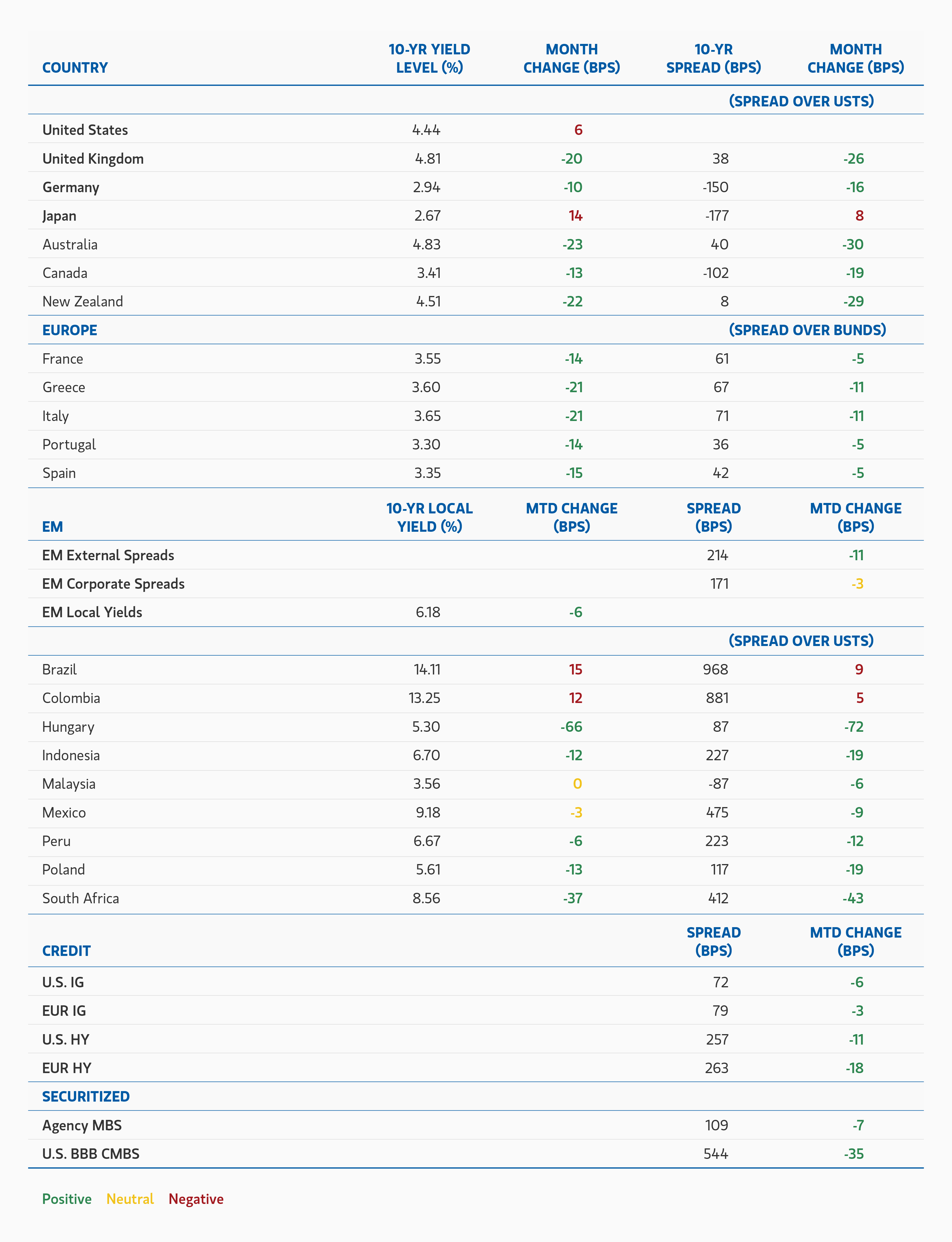
Rates markets reflected this more resilient growth and sticky inflation backdrop. The U.S. 10-year yield rose 6 basis points (bps) to 4.44%, while Japan also saw yields move higher. By contrast, several other developed markets rallied, with UK, Canada, Australia, and New Zealand yields declining. U.S. 10-year breakevens fell 9bps, suggesting some moderation in market-implied inflation expectations even as inflation risks remained central to the macro discussion. The U.S. dollar strengthened modestly, with ICE U.S. Dollar Index up 0.9%.

Credit markets remained resilient despite tight valuations. U.S. investment grade (IG) spreads tightened 6 bps to 72 bps, while Euro IG tightened 3 bps to 79 bps. Carry remained the dominant driver of returns, supported by exceptionally strong technicals and continued demand for all-in yield. Both U.S. and European markets absorbed record issuance with little disruption, as strong inflows and healthy investor demand offset elevated supply. In Europe, May marked the largest issuance month on record, while U.S. issuance also exceeded expectations, with the vast majority of new deals tightening in secondary trading. A notable theme was the continued acceleration of AI-related financing, particularly among large technology and hyperscale issuers, reinforcing expectations that infrastructure spending will remain an important driver of corporate issuance. High yield also performed well, with U.S. High Yield (HY) tightening 11 bps to 257 bps and Euro HY tightening 18 bps to 263 bps. Despite the constructive backdrop, valuations remain tight and dispersion persists across sectors, reinforcing the importance of security selection.

Leveraged loans delivered solid performance, supported by strong earnings and healthy CLO demand. Software loans stabilized after earlier weakness tied to AI disruption concerns, though the sector continued to lag year-to-date. Investors remained focused on higher-quality, mission-critical issuers, while housing, lower-income consumer, and packaging exposures showed more strain.

Securitized markets were supported by strong demand and improving technicals. Agency Mortgage-Backed Securities (MBS) spreads tightened as rate volatility eased, while bank and GSE demand helped offset Fed balance sheet runoff. Securitized credit issuance remained robust across Residential MBS (RMBS), Asset-Backed Securities (ABS), and Commercial MBS (CMBS), with residential credit continuing to stand out on stable collateral performance and strong investor demand.

Emerging markets (EM) were mixed but broadly constructive. EM external spreads tightened 11 bps to 215 bps, with support from select Latin American markets and improving political developments in Colombia. Asia faced more inflation and currency pressure, including Indonesia’s rate hike and export restrictions. Oil-linked risk premia remained relevant given still-low vessel traffic through the Strait of Hormuz.

Municipals continued to perform strongly, supported by substantial inflows and favorable technicals despite record issuance. High yield munis remained one of the stronger areas of U.S. fixed income, helped by limited supply and strong demand.

Overall, May reinforced the resilience of risk markets despite sticky inflation, tighter policy expectations, and ongoing geopolitical uncertainty. Technical demand remained a powerful support, but tight valuations and rising dispersion continued to place a premium on sector allocation and security selection.


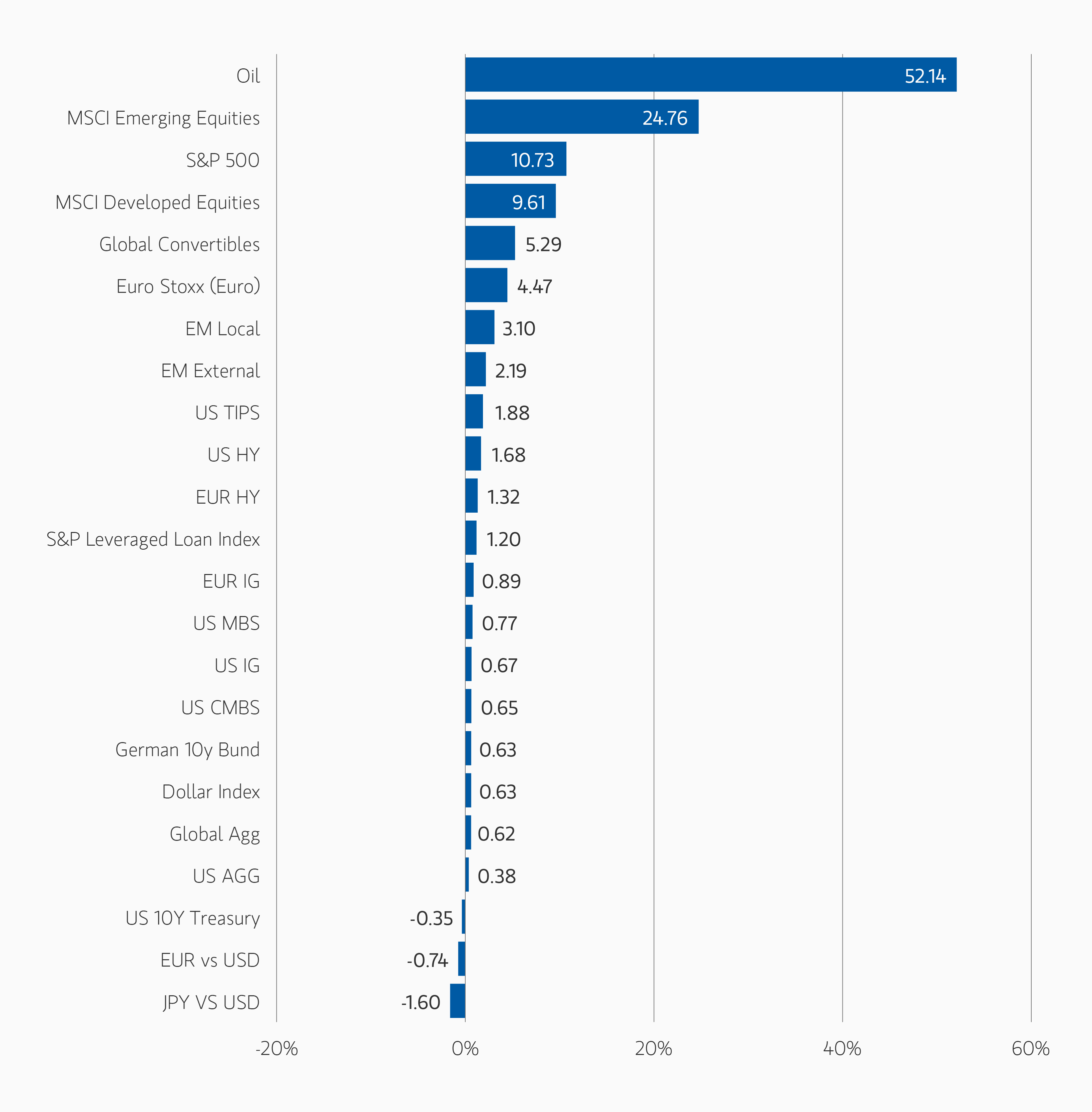
Asset Performance Year-to-Date
DISPLAY 1
insight_risk-assets-persist_display1.png

Note: USD-based performance. Source: Bloomberg. Data as of May 31, 2026. The indexes are provided for illustrative purposes only and are not meant to depict the performance of a specific investment. Past performance is no guarantee of future results. See below for index definitions.

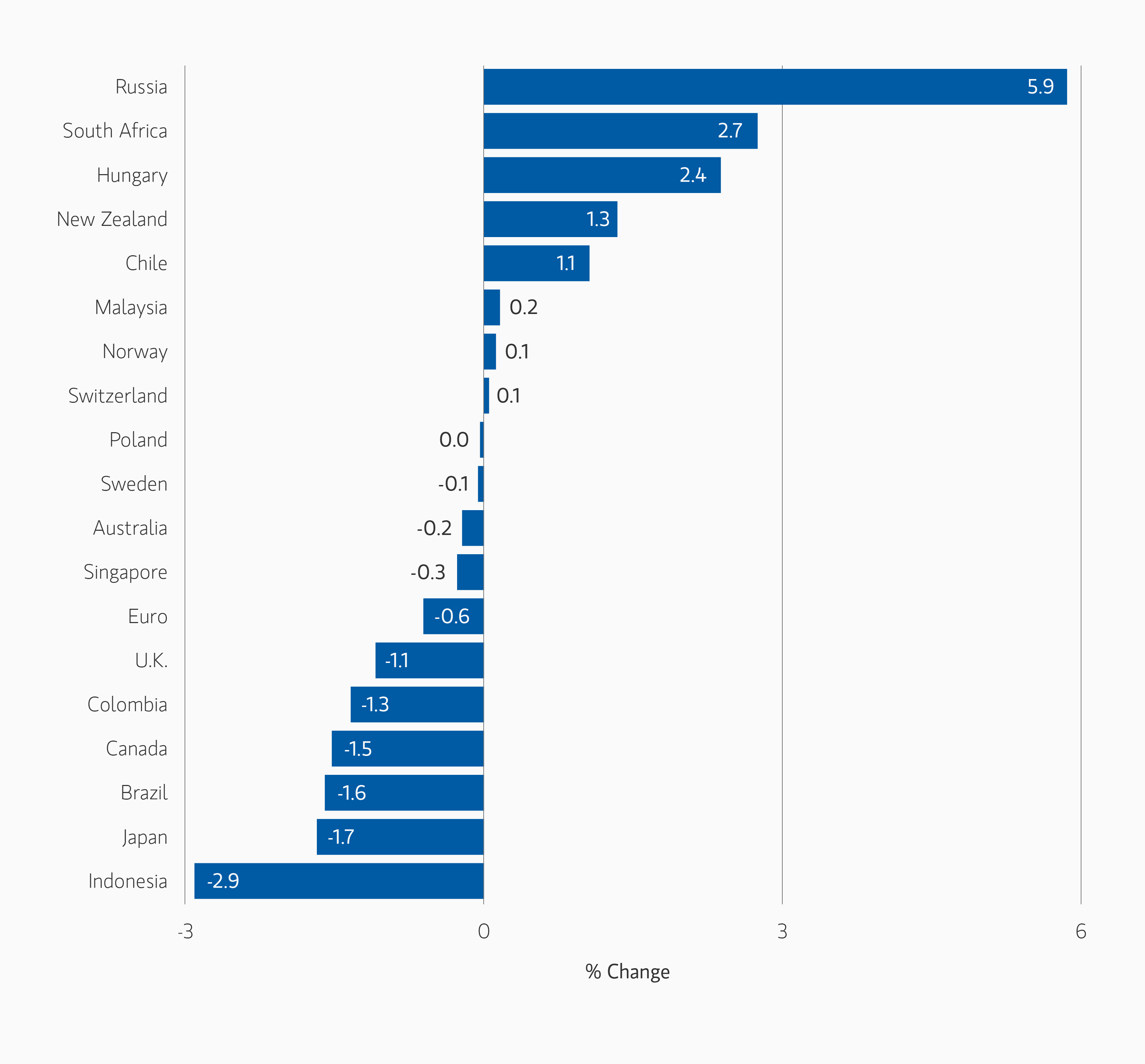
Currency Monthly Changes versus USD

DISPLAY 2
insight_risk-assets-persist_display2.png

Note: Positive change means appreciation of the currency against the USD. Source: Bloomberg. Data as May 31, 2026.

Major Monthly Changes in 10-Year Yields and Spreads
DISPLAY 3
insight_risk-assets-persist_display3.png

Source: Bloomberg, JPMorgan. Data as of May 31, 2026.

Broad Markets Fixed Income Global Asset Allocation and Outlook

Developed Market Rate/Foreign Currency
(Long duration, neutral curve positioning)
The market narrative has continued to shift away from recession concerns and toward the durability of growth and inflation. In the United States, stronger-than-expected labor market data, resilient consumption, and firm inflation readings have led investors to significantly reprice monetary policy expectations, with markets now anticipating a much more restrictive policy path than was expected at the beginning of the year. Elsewhere in developed markets, much of this repricing occurred earlier in the year, though inflation and energy-related risks continue to influence central bank expectations. While geopolitical developments remain an important driver of sentiment, the dominant macro question has become whether inflation proves sufficiently persistent to delay or reverse the easing cycle.

Against this backdrop, we continue to maintain a long duration stance across developed markets, though positioning remains highly selective and focused on regions where growth appears more vulnerable to tighter financial conditions. Exposure is concentrated in front-end rates markets outside the United States, alongside a long position in U.S. Treasuries. We have moderated some exposure in Canada following recent developments and weaker growth data, while continuing to favor markets where economic momentum appears less robust than in the U.S. Duration exposure remains partially offset by short positions in markets where policy normalization and technical dynamics create asymmetric upside risks to yields.

Inflation remains the primary macro risk. Although longer-dated inflation expectations retraced modestly during May, core inflation measures have continued to move higher and producer price pressures remain firm. We therefore maintain meaningful exposure to U.S. inflation-linked markets, where we continue to see value in hedging portfolios against the risk that inflation remains above central bank targets for longer than currently anticipated.

Curve dynamics have generally stabilized following the sharp repricing seen earlier in the year, and we remain neutral on outright curve positioning. While elevated fiscal deficits, AI-related investment spending, and energy market uncertainty continue to support higher term premia over the medium term, recent moves have reduced the attractiveness of directional curve expressions.

In foreign exchange, we continue to favor selective high-carry currencies where fundamentals and valuation remain supportive. Positioning is focused on the Mexican peso and Hungarian forint against the euro, reflecting attractive carry characteristics and differentiated domestic drivers. More broadly, we expect currency markets to remain highly sensitive to evolving central bank expectations, energy prices, and geopolitical developments, with relative growth and inflation dynamics continuing to drive performance across developed and emerging markets.

Emerging Market Debt
(Overweight)
Emerging market sovereign and corporate debt remains an attractive opportunity, supported by elevated real yields, resilient technicals, and improving fundamentals in select countries. Despite persistent geopolitical uncertainty and a more hawkish global policy backdrop, EM credit markets have remained broadly resilient, with spreads continuing to retrace toward pre-conflict levels in several regions.

Carry and income remain central drivers of expected returns, though country selection remains critical given elevated dispersion across regions. Higher energy prices continue to create divergence between commodity exporters and importers, while local political developments remain an important source of idiosyncratic opportunity and risk. Recent developments in markets such as Colombia, Hungary, Indonesia, and the Philippines highlight the increasingly differentiated nature of the opportunity set.

Valuations remain attractive across select local and hard-currency markets, and many EM currencies continue to offer compelling carry relative to developed markets. While tighter global financial conditions and persistent inflation remain important risks, we continue to favor countries with credible monetary frameworks, improving fundamentals, and attractive real yield differentials. In an environment where global growth remains positive and default risks remain contained, we believe the asset class continues to offer attractive risk-adjusted return potential.

Corporate Credit
(Underweight IG, small overweight HY)
Our base case remains cautiously constructive for credit, even as inflation risks, tighter monetary policy expectations, and geopolitical uncertainty continue to shape the macro backdrop. Despite these headwinds, resilient economic growth, strong labor markets, and continued fiscal support have helped sustain corporate fundamentals and support demand for risk assets.

We continue to believe that a meaningful demand destruction scenario is unlikely to be the base case. Expectations for low but positive economic growth—supported by ongoing fiscal support, energy-related spending, and continued AI and infrastructure investment—remain consistent with a broadly benign default environment. Corporate balance sheets also remain healthy, though the market is increasingly entering a late-cycle phase characterized by elevated M&A activity, AI- and infrastructure-related capex, and higher shareholder distributions. This backdrop reinforces the importance of sector and security selection.

At current spread levels, we continue to view carry as the primary driver of expected returns, supported by strong technical demand for high-quality credit and resilient corporate fundamentals. Demand for all-in yield remains robust, helping absorb elevated issuance volumes and supporting spread stability despite tight valuations. While broad-based spread compression appears increasingly limited, we continue to see opportunities for excess return through sector allocation and security selection. Regionally, we continue to prefer Europe over the U.S., supported by relatively more balanced supply dynamics and stronger demand for high-quality carry.

We maintain a modest overweight to select high-yield issuers in both the U.S. and Europe. Although spreads remain historically tight and issuance has accelerated, fundamentals remain supportive, with improved average credit quality, manageable leverage, and contained default expectations. Elevated dispersion across sectors and issuers continues to create opportunities for selective positioning, particularly in businesses with resilient cash flows, stronger pricing power, and less exposure to refinancing risk.

Leveraged Loans
(Neutral)
We view leveraged loans more favorably than earlier in the year as increased dispersion and spread widening have improved valuations across portions of the market. While the asset class remains characterized by elevated dispersion and increasingly selective technicals, valuations are becoming more attractive, particularly relative to high yield corporates. CLO demand continues to provide an important source of support, and investor preference remains focused on higher-quality issuers and more resilient sectors.

Software and technology-linked issuers remain an area of caution given ongoing uncertainty surrounding AI-related disruption. However, the broad-based selloff across parts of the sector has also created selective opportunities where market pricing appears disconnected from underlying fundamentals. In several cases, investors have indiscriminately reduced exposure to software and technology credits, creating attractive entry points in higher-quality, mission-critical businesses with durable cash flows, proprietary data advantages, and high switching costs.

More broadly, economically sensitive sectors continue to face pressure from elevated financing costs, inflation uncertainty, and rising input costs, even as overall corporate fundamentals remain relatively stable. CLO issuance and demand for floating-rate exposure remain supportive, helping to offset more mixed retail flows.

Given the improvement in valuations and the growing opportunity set created by elevated dispersion, we have moved to a more neutral stance on the asset class. While selectivity remains paramount, we believe current valuations increasingly compensate investors for refinancing risk and macro uncertainty, particularly in higher-quality segments of the market.

Securitized Product
(Overweight)
Agency mortgage-backed securities (MBS) and non-agency residential mortgage-backed securities (RMBS) remain a high-conviction overweight for 2026. Although agency MBS experienced periods of volatility during May as rates markets adjusted to changing inflation and policy expectations, spreads ultimately retraced much of their widening as demand remained strong and mortgage rates moved off recent highs. Relative valuations across agency MBS continue to appear attractive versus both historical levels and other core fixed income sectors.

Technical conditions remain highly supportive across securitized markets. Demand for high-quality collateral continues to benefit from attractive all-in yields, strong money manager demand, and increasing participation from banks and Government-Sponsored Enterprises (GSEs) as balance sheet constraints ease and relative value improves. At the same time, the Federal Reserve’s measured balance sheet runoff continues to limit net supply pressure. Despite elevated issuance across securitized sectors, spreads have remained well contained, highlighting the strength of underlying demand and market liquidity.

Non-agency RMBS continues to offer one of the more attractive opportunity sets within structured credit. Stable home prices, low loan-to-value ratios, improving collateral performance, and limited refinancing risk continue to support fundamentals. Strong issuance growth has been met with equally robust investor demand, particularly in residential credit sectors where recent vintages continue to demonstrate favorable performance characteristics.

Within CMBS, fundamentals remain resilient, particularly in higher-quality segments. Strong technical demand and improving sentiment continue to support selective opportunities across hospitality, logistics, storage, and high-quality multifamily assets. Issuance across ABS, RMBS, and CMBS markets has remained robust, with many transactions heavily oversubscribed, reinforcing the strength of investor demand despite the higher-rate environment.

We also remain constructive on Danish covered bonds, where defensive characteristics, strong legal frameworks, and attractive USD-hedged yields continue to support relative value.

Broad Markets Fixed Income Team

Our team provides exposure to what we consider the best ideas in fixed income. Leveraging the expertise of our specialized teams, we use a team-based, rigorous and disciplined process that seeks out superior and repeatable results.

Risk Considerations
Diversification neither assures a profit nor guarantees against loss in a declining market.

There is no assurance that a portfolio will achieve its investment objective. Portfolios are subject to market risk, which is the possibility that the market values of securities owned by the portfolio will decline and that the value of portfolio shares may therefore be less than what you paid for them. Market values can change daily due to economic and other events (e.g., natural disasters, health crises, terrorism, conflicts, and social unrest) that affect markets, countries, companies, or governments. It is difficult to predict the timing, duration, and potential adverse effects (e.g., portfolio liquidity) of events. Accordingly, you can lose money investing in a portfolio. Fixed-income securities are subject to the ability of an issuer to make timely principal and interest payments (credit risk), changes in interest rates (interest rate risk), the creditworthiness of the issuer and general market liquidity (market risk). In a rising interest-rate environment, bond prices may fall and may result in periods of volatility and increased portfolio redemptions. In a declining interest-rate environment, the portfolio may generate less income. Longer-term securities may be more sensitive to interest rate changes. Certain U.S. government securities purchased by the strategy, such as those issued by Fannie Mae and Freddie Mac, are not backed by the full faith and credit of the U.S. It is possible that these issuers will not have the funds to meet their payment obligations in the future. Public bank loans are subject to liquidity risk and the credit risks of lower-rated securities. High-yield securities (junk bonds) are lower-rated securities that may have a higher degree of credit and liquidity risk. Sovereign debt securities are subject to default risk. Mortgage- and asset-backed securities are sensitive to early prepayment risk and a higher risk of default and may be hard to value and difficult to sell (liquidity risk). They are also subject to credit, market, and interest rate risks. The currency market is highly volatile. Prices in these markets are influenced by, among other things, changing supply and demand for a particular currency; trade; fiscal, money and domestic or foreign exchange control programs and policies; and changes in domestic and foreign interest rates. Investments in foreign markets entail special risks such as currency, political, economic and market risks. The risks of investing in emerging market countries are greater than the risks generally associated with foreign investments. Derivative instruments may disproportionately increase losses and have a significant impact on performance. They also may be subject to counterparty, liquidity, valuation, and correlation and market risks. Restricted and illiquid securities may be more difficult to sell and value than publicly traded securities (liquidity risk). Due to the possibility that prepayments will alter the cash flows on collateralized mortgage obligations (CMOs), it is not possible to determine in advance their final maturity date or average life. In addition, if the collateral securing the CMOs or any third-party guarantees are insufficient to make payments, the portfolio could sustain a loss.

DEFINITIONS
Basis point (bp): One basis point = 0.01%.

INDEX DEFINITIONS
The indexes shown in this report are not meant to depict the performance of any specific investment, and the indexes shown do not include any expenses, fees, or sales charges, which would lower performance. The indexes shown are unmanaged and should not be considered an investment. It is not possible to invest directly in an index.

“Bloomberg®” and the Bloomberg Index/Indices used are service marks of Bloomberg Finance L.P. and its affiliates and have been licensed for use for certain purposes by Morgan Stanley Investment Management (MSIM). Bloomberg is not affiliated with MSIM, does not approve, endorse, review, or recommend any product, and does not guarantee the timeliness, accurateness, or completeness of any data or information relating to any product.

The Bloomberg Euro Aggregate Corporate Index (Bloomberg Euro IG Corporate) is an index designed to reflect the performance of the euro-denominated investment-grade corporate bond market.

The Bloomberg Global Aggregate Corporate Index is the corporate component of the Bloomberg Global Aggregate index, which provides a broad-based measure of the global investment-grade fixed income markets.

The Bloomberg US Corporate High Yield Index measures the market of USD-denominated, non-investment grade, fixed-rate, taxable corporate bonds. Securities are classified as high yield if the middle rating of Moody’s, Fitch, and S&P is Ba1/BB+/BB+ or below. The index excludes emerging market debt.

The Bloomberg US Corporate Index is a broad-based benchmark that measures the investment grade, fixed-rate, taxable, corporate bond market.

The Bloomberg US Mortgage-Backed Securities (MBS) Index tracks agency mortgage-backed pass-through securities (both fixed-rate and hybrid ARM) guaranteed by Ginnie Mae (GNMA), Fannie Mae (FNMA) and Freddie Mac (FHLMC). The index is constructed by grouping individual TBA-deliverable MBS pools into aggregates or generics based on program, coupon, and vintage. Introduced in 1985, the GNMA, FHLMC and FNMA fixed-rate indexes for 30- and 15-year securities were backdated to January 1976, May 1977, and November 1982, respectively. In April 2007, agency hybrid adjustable-rate mortgage (ARM) pass-through securities were added to the index.

Consumer Price Index (CPI) is a measure that examines the weighted average of prices of a basket of consumer goods and services, such as transportation, food, and medical care.

Euro vs. USD—Euro total return versus U.S. dollar.

German 10YR bonds—Germany Benchmark 10-Year Datastream Government Index; Japan 10YR government bonds—Japan Benchmark 10-Year Datastream Government Index; and 10YR US Treasury—US Benchmark 10-Year Datastream Government Index.

The ICE BofAML European Currency High-Yield Constrained Index (ICE BofAML Euro HY constrained) is designed to track the performance of euro- and British pound sterling-denominated below investment-grade corporate debt publicly issued in the Eurobond, sterling.

The ICE BofAML US Mortgage-Backed Securities (ICE BofAML US Mortgage Master) Index tracks the performance of US dollar-denominated, fixed-rate and hybrid residential mortgage pass-through securities publicly issued by US agencies in the US domestic market.

The ICE BofAML US High Yield Master II Constrained Index (ICE BofAML US High Yield) is a market value-weighted index of all domestic and Yankee high-yield bonds, including deferred-interest bonds and payment-in-kind securities. Its securities have maturities of one year or more and a credit rating lower than BBB-/Baa3 but are not in default.

The ISM Manufacturing Index is based on surveys of more than 300 manufacturing firms by the Institute of Supply Management. The ISM Manufacturing Index monitors employment, production inventories, new orders, and supplier deliveries. A composite diffusion index is created that monitors conditions in national manufacturing based on the data from these surveys.

Italy 10-Year Government Bonds—Italy Benchmark 10-Year Datastream Government Index.

The JP Morgan CEMBI Broad Diversified Index is a global, liquid corporate emerging markets benchmark that tracks US-denominated corporate bonds issued by emerging markets entities.

The JPMorgan Government Bond Index—emerging markets (JPM local EM debt) tracks local currency bonds issued by emerging market governments. The index is positioned as the investable benchmark that includes only those countries that are accessible by most of the international investor base (excludes China and India as of September 2013).

The JPMorgan Government Bond Index Emerging Markets (JPM External EM Debt) tracks local currency bonds issued by emerging market governments. The index is positioned as the investable benchmark that includes only those countries that are accessible by most of the international investor base (excludes China and India as of September 2013).

The JP Morgan Emerging Markets Bond Index Global (EMBI Global) tracks total returns for traded external debt instruments in the emerging markets and is an expanded version of the EMBI+. As with the EMBI+, the EMBI Global includes US dollar-denominated Brady bonds, loans, and Eurobonds with an outstanding face value of at least $500 million.

The JP Morgan GBI-EM Global Diversified Index is a market-capitalization weighted, liquid global benchmark for US-dollar corporate emerging market bonds representing Asia, Latin America, Europe, and the Middle East/Africa.

JPY vs. USD—Japanese yen total return versus US dollar.

The Markit ITraxx Europe Index comprises 125 equally weighted credit default swaps on investment grade European corporate entities, distributed among 4 sub-indices: Financials (Senior & Subordinated), Non-Financials and HiVol.

The Nikkei 225 Index (Japan Nikkei 225) is a price-weighted index of Japan’s top 225 blue-chip companies on the Tokyo Stock Exchange.

The MSCI AC Asia ex-Japan Index (MSCI Asia ex-Japan) captures large- and mid-cap representation across two of three developed markets countries (excluding Japan) and eight emerging markets countries in Asia.

The MSCI All Country World Index (ACWI, MSCI global equities) is a free float-adjusted market capitalization weighted index designed to measure the equity market performance of developed and emerging markets. The term “free float” represents the portion of shares outstanding that are deemed to be available for purchase in the public equity markets by investors. The performance of the Index is listed in US dollars and assumes reinvestment of net dividends.

MSCI Emerging Markets Index (MSCI emerging equities) captures large- and mid-cap representation across 23 emerging markets (EM) countries.

The MSCI World Index (MSCI developed equities) captures large and mid-cap representation across 23 developed market (DM) countries.

Purchasing Managers Index (PMI) is an indicator of the economic health of the manufacturing sector.

The Refinitiv Convertible Global Focus USD Hedged Index is a market weighted index with a minimum size for inclusion of $500 million (US), 200 million (Europe), 22 billion Yen, and $275 million (Other) of Convertible Bonds with an Equity Link.

The Russell 2000® Index is an index that measures the performance of the 2,000 smallest companies in the Russell 3000 Index.

The S&P 500® Index (US S&P 500) measures the performance of the large-cap segment of the US equities market, covering approximately 75 percent of the US equities market. The index includes 500 leading companies in leading industries of the U.S. economy.

S&P CoreLogic Case-Shiller US National Home Price NSA Index seeks to measure the value of residential real estate in 20 major US metropolitan areas: Atlanta, Boston, Charlotte, Chicago, Cleveland, Dallas, Denver, Detroit, Las Vegas, Los Angeles, Miami, Minneapolis, New York, Phoenix, Portland, San Diego, San Francisco, Seattle, Tampa and Washington, D.C.

The S&P/LSTA US Leveraged Loan 100 Index (S&P/LSTA Leveraged Loan Index) is designed to reflect the performance of the largest facilities in the leveraged loan market.

The S&P GSCI Copper Index (Copper), a sub-index of the S&P GSCI, provides investors with a reliable and publicly available benchmark for investment performance in the copper commodity market.

The S&P GSCI Softs (GSCI soft commodities) Index is a sub-index of the S&P GSCI that measures the performance of only the soft commodities, weighted on a world production basis. In 2012, the S&P GSCI Softs Index included the following commodities: coffee, sugar, cocoa, and cotton.

Spain 10-Year Government Bonds—Spain Benchmark 10-Year Datastream Government Index.

The Thomson Reuters Convertible Global Focus USD Hedged Index is a market weighted index with a minimum size for inclusion of $500 million (US), 200 million euro (Europe), 22 billion yen, and $275 million (Other) of convertible bonds with an equity link.

U.K. 10YR government bonds—U.K. Benchmark 10-Year Datastream Government Index. For the following Datastream government bond indexes, benchmark indexes are based on single bonds. The bond chosen for each series is the most representative bond available for the given maturity band at each point in time. Benchmarks are selected according to the accepted conventions within each market. Generally, the benchmark bond is the latest issue within the given maturity band; consideration is also given to yield, liquidity, issue size and coupon.

The US Dollar Index (DXY) is an index of the value of the United States dollar relative to a basket of foreign currencies, often referred to as a basket of US trade partners’ currencies.

The Chicago Board Options Exchange (CBOE) Market Volatility (VIX) Index shows the market’s expectation of 30-day volatility.

There is no guarantee that any investment strategy will work under all market conditions, and each investor should evaluate their ability to invest for the long-term, especially during periods of downturn in the market.

A separately managed account may not be appropriate for all investors. Separate accounts managed according to the particular strategy may include securities that may not necessarily track the performance of a particular index. Please consider the investment objectives, risks and fees of the Strategy carefully before investing. A minimum asset level is required. For important information about the investment managers, please refer to Form ADV Part 2.

The views and opinions and/or analysis expressed are those of the author or the investment team as of the date of preparation of this material and are subject to change at any time without notice due to market or economic conditions and may not necessarily come to pass. Furthermore, the views will not be updated or otherwise revised to reflect information that subsequently becomes available or circumstances existing, or changes occurring, after the date of publication. The views expressed do not reflect the opinions of all investment personnel at Morgan Stanley Investment Management (MSIM) and its subsidiaries and affiliates (collectively “the Firm”) and may not be reflected in all the strategies and products that the Firm offers.

Forecasts and/or estimates provided herein are subject to change and may not actually come to pass. Information regarding expected market returns and market outlooks is based on the research, analysis and opinions of the authors or the investment team. These conclusions are speculative in nature, may not come to pass and are not intended to predict the future performance of any specific strategy or product the Firm offers. Future results may differ significantly depending on factors such as changes in securities or financial markets or general economic conditions.

This material has been prepared on the basis of publicly available information, internally developed data and other third-party sources believed to be reliable. However, no assurances are provided regarding the reliability of such information and the Firm has not sought to independently verify information taken from public and third-party sources.

This material is a general communication, which is not impartial, and all information provided has been prepared solely for informational and educational purposes and does not constitute an offer or a recommendation to buy or sell any particular security or to adopt any specific investment strategy. The information herein has not been based on a consideration of any individual investor circumstances and is not investment advice, nor should it be construed in any way as tax, accounting, legal or regulatory advice. To that end, investors should seek independent legal and financial advice, including advice as to tax consequences, before making any investment decision.

Charts and graphs provided herein are for illustrative purposes only. Past performance is no guarantee of future results.

The indexes are unmanaged and do not include any expenses, fees, or sales charges. It is not possible to invest directly in an index. Any index referred to herein is the intellectual property (including registered trademarks) of the applicable licensor. Any product based on an index is in no way sponsored, endorsed, sold, or promoted by the applicable licensor and it shall not have any liability with respect thereto.

This material is not a product of Morgan Stanley’s Research Department and should not be regarded as a research material or a recommendation.

The Firm has not authorized financial intermediaries to use and to distribute this material unless such use and distribution is made in accordance with applicable law and regulation. Additionally, financial intermediaries are required to satisfy themselves that the information in this material is appropriate for any person to whom they provide this material in view of that person’s circumstances and purpose. The Firm shall not be liable for, and accepts no liability for, the use or misuse of this material by any such financial intermediary.

This material may be translated into other languages. Where such a translation is made this English version remains definitive. If there are any discrepancies between the English version and any version of this material in another language, the English version shall prevail.

The whole or any part of this material may not be directly or indirectly reproduced, copied, modified, used to create a derivative work, performed, displayed, published, posted, licensed, framed, distributed, or transmitted or any of its contents disclosed to third parties without the Firm’s express written consent. This material may not be linked to unless such hyperlink is for personal and non-commercial use. All information contained herein is proprietary and is protected under copyright and other applicable law.

Eaton Vance is part of Morgan Stanley Investment Management. Morgan Stanley Investment Management is the asset management division of Morgan Stanley.

DISTRIBUTION
This material is only intended for and will only be distributed to persons resident in jurisdictions where such distribution or availability would not be contrary to local laws or regulations.

MSIM, the asset management division of Morgan Stanley (NYSE: MS), and its affiliates have arrangements in place to market each other’s products and services. Each MSIM affiliate is regulated as appropriate in the jurisdiction it operates. MSIM’s affiliates are: Calvert Research and Management, Eaton Vance Management, Parametric Portfolio Associates LLC, Parametric SAS, and Atlanta Capital Management LLC.

This material has been issued by any one or more of the following entities:

EMEA
This material is for Professional Clients/Accredited Investors only.

In the EU, MSIM materials are issued by MSIM Fund Management (Ireland) Limited (“FMIL”). FMIL is regulated by the Central Bank of Ireland and is incorporated in Ireland as a private company limited by shares with company registration number 616661 and has its registered address at 24-26 City Quay, Dublin 2, DO2 NY19, Ireland.

Outside the EU, MSIM materials are issued by Morgan Stanley Investment Management Limited (MSIM Ltd) is authorised and regulated by the Financial Conduct Authority. Registered in England. Registered No. 1981121. Registered Office: 25 Cabot Square, Canary Wharf, London E14 4QA.

In Switzerland, MSIM materials are issued by Morgan Stanley & Co. International plc, London (Zurich Branch) Authorised and regulated by the Eidgenössische Finanzmarktaufsicht (“FINMA”). Registered Office: Beethovenstrasse 33, 8002 Zurich, Switzerland.

Italy: MSIM FMIL (Milan Branch), (Sede Secondaria di Milano) Palazzo Serbelloni Corso Venezia, 16 20121 Milano, Italy. The Netherlands: MSIM FMIL (Amsterdam Branch), Rembrandt Tower, 11th Floor Amstelplein 1 1096HA, Netherlands. France: MSIM FMIL (Paris Branch), 61 rue de Monceau 75008 Paris, France. Spain: MSIM FMIL (Madrid Branch), Calle Serrano 55, 28006, Madrid, Spain. Germany: MSIM FMIL Frankfurt Branch, Große Gallusstraße 18, 60312 Frankfurt am Main, Germany (Gattung: Zweigniederlassung (FDI) gem. § 53b KWG). Denmark: MSIM FMIL (Copenhagen Branch), Gorrissen Federspiel, Axel Towers, Axeltorv2, 1609 Copenhagen V, Denmark.

MIDDLE EAST
Dubai International Financial Centre
: This information does not constitute or form part of any offer to issue or sell, or any solicitation of any offer to subscribe for or purchase, any securities or investment products in the UAE (including the Dubai International Financial Centre and the Abu Dhabi Global Market) and accordingly should not be construed as such. Furthermore, this information is being made available on the basis that the recipient acknowledges and understands that the entities and securities to which it may relate have not been approved, licensed by or registered with the UAE Central Bank, the Dubai Financial Services Authority, the UAE Securities and Commodities Authority, the Financial Services Regulatory Authority or any other relevant licensing authority or government agency in the UAE. The content of this report has not been approved by or filed with the UAE Central Bank, the Dubai Financial Services Authority, the UAE Securities and Commodities Authority or the Financial Services Regulatory Authority.

Abu Dhabi Global Market (“ADGM”): This material is sent strictly within the context of, and constitutes, an Exempt Communication. This material relates to (strategy) which is not subject to any form of regulation or approval by the Financial Services Regulatory Authority of the Abu Dhabi Global Market (the “FSRA”).

Saudi Arabia
This financial promotion was issued and approved for use in Saudi Arabia by Morgan Stanley Saudi Arabia, Al Rashid Tower, Kings Sand Street, Riyadh, Saudi Arabia, authorized and regulated by the Capital Market Authority license number 06044-37.

US
NOT FDIC INSURED. OFFER NO BANK GUARANTEE. MAY LOSE VALUE. NOT INSURED BY ANY FEDERAL GOVERNMENT AGENCY. NOT A DEPOSIT.

Latin America (Brazil, Chile Colombia, Mexico, Peru, and Uruguay)
This material is for use with an institutional investor or a qualified investor only. All information contained herein is confidential and is for the exclusive use and review of the intended addressee and may not be passed on to any third party. This material is provided for informational purposes only and does not constitute a public offering, solicitation, or recommendation to buy or sell for any product, service, security and/or strategy. A decision to invest should only be made after reading the strategy documentation and conducting in-depth and independent due diligence.

ASIA PACIFIC
Hong Kong
: This document has been issued by Morgan Stanley Asia Limited, CE No. AAD291, for use in Hong Kong and shall only be made available to “professional investors” as defined under the Securities and Futures Ordinance of Hong Kong (Cap 571). The contents of this document have not been reviewed nor approved by any regulatory authority including the Securities and Futures Commission in Hong Kong. Accordingly, save where an exemption is available under the relevant law, this document shall not be issued, circulated, distributed, directed at, or made available to, the public in Hong Kong. Singapore: This material is disseminated in Singapore by Morgan Stanley Investment Management Company, Registration No. 199002743C. This material should not be considered to be the subject of an invitation for subscription or purchase, whether directly or indirectly, to the public or any member of the public in Singapore other than (i) to an institutional investor under section 304 of the Securities and Futures Act, Chapter 289 of Singapore (“SFA”), (ii) to a “relevant person” (which includes an accredited investor) pursuant to section 305 of the SFA, and such distribution is in accordance with the conditions specified in section 305 of the SFA; or (iii) otherwise pursuant to, and in accordance with the conditions of, any other applicable provision of the SFA. This material has not been reviewed by the Monetary Authority of Singapore. Australia: This material is provided by Morgan Stanley Investment Management (Australia) Pty Ltd ABN 22122040037, AFSL No. 314182 and its affiliates and does not constitute an offer of interests. Morgan Stanley Investment Management (Australia) Pty Limited arranges for MSIM affiliates to provide financial services to Australian wholesale clients. This material will not be lodged with the Australian Securities and Investments Commission.

Japan
For professional investors, this material is circulated or distributed solely for informational purposes. For non-professional investors, this material is provided in connection with Morgan Stanley Investment Management (Japan) Co., Ltd. (“MSIMJ”)’s business with respect to discretionary investment management agreements (“IMA”) and investment advisory agreements (“IAA”). This does not constitute a recommendation or solicitation of transactions nor offers any particular financial instruments. Under an IMA, with respect to the management of client assets, the client prescribes basic management policies in advance and commissions MSIMJ to make all investment decisions based on an analysis of the value, etc. of the securities, and MSIMJ accepts such commission. The client shall delegate to MSIMJ the authorities necessary to make such investment decisions. MSIMJ exercises these delegated authorities accordingly, and the client shall not make individual instructions. All investment profits and losses belong to the clients; principal is not guaranteed. Please consider the investment objectives and nature of risks before investing. As an investment advisory fee for an IAA or an IMA, the amount of assets subject to the contract multiplied by a certain rate (the upper limit is 2.20% per annum (including tax)) shall be incurred in proportion to the contract period. For some strategies, a contingency fee may be incurred in addition to the fee mentioned above. Indirect charges also may be incurred, such as brokerage commissions for underlying securities. Since these charges and expenses vary by contract and other factors, MSIMJ cannot present the rates, upper limits, etc. in advance. All clients should read thoroughly the Documents Provided Prior to the Conclusion of a Contract carefully before executing an agreement. This material is distributed in Japan by MSIMJ, Registered No. 410 (Director of Kanto Local Finance Bureau (Financial Instruments Firms)), Membership: the Japan Securities Dealers Association, the Investment Management Association of Japan and the Type II Financial Instruments Firms Association.