


 Top

Federal Reserve Board
On September 16, the Federal Open Market Committee (FOMC) unanimously voted 12-0 to raise the target range for the federal funds rate by 25 basis points to 3.75%-4.00%, as persistent, above-target inflation outweighed risks to the labor market. Chair Kevin Warsh highlighted the resilience of the U.S. economy, noting strength in domestic spending, productivity growth and capital investment, while job gains have kept pace with the workforce and the unemployment rate has changed little. The Committee characterized the increase as removing a dose of accommodation rather than moving policy into restrictive territory. Updated projections showed 2026 core personal consumption expenditures (PCE) inflation at 3.4% and real gross domestic product (GDP) growth at 2.3%, while the median policy rate projection implied one additional 25 basis point increase this year. Officials did not pre-commit to a particular rate path, with future decisions remaining dependent on incoming inflation and labor market data.
European Central Bank
On September 10, the European Central Bank (ECB) unanimously raised the Deposit Rate by 25 basis points to 2.50%, as inflation risks associated with the Middle East conflict outweighed concerns about the growth outlook. Policymakers cited higher energy prices as the most immediate source of inflation pressure and also highlighted the risk of broader second-round effects on prices and wages. The euro area economy has remained resilient, providing additional support for the decision. The ECB revised its projections higher for both inflation and growth, with headline inflation expected at 3.0% in 2026, 2.5% in 2027 and 2.1% in 2028, while GDP growth is projected at 0.9%, 1.4% and 1.5%, respectively. The Governing Council reiterated that decisions will be made meeting-by-meeting and that it is not pre-committing to a particular rate path, with future policy dependent on inflation and activity data, energy prices, and broader financial conditions.
Bank of England
On September 17, the Bank of England's Monetary Policy Committee (MPC) voted 6-3 to leave the Bank Rate unchanged at 3.75%, with three members preferring a 25 basis point increase to 4.00%. The MPC judged that higher energy prices stemming from the Middle East conflict have increased upside risks to inflation, while evidence of second-round effects on wages and prices remains limited. Economic activity has been somewhat stronger than expected, with the central bank projecting around 0.4% GDP growth in the third quarter, while labor market conditions remain soft. Consumer price index inflation rose to 3.1% in August, and the official forecast expects inflation could exceed 4% in early 2027 before gradually moderating. The MPC also unanimously continued its balance-sheet reduction, setting out a multi-year plan for gilt holdings to decline to zero at an average pace of £46 billion per year through 2034. Future policy decisions remain data dependent, with particular focus on the persistence of inflation, wage developments and geopolitical risks.
Monthly Interest Rate Summary
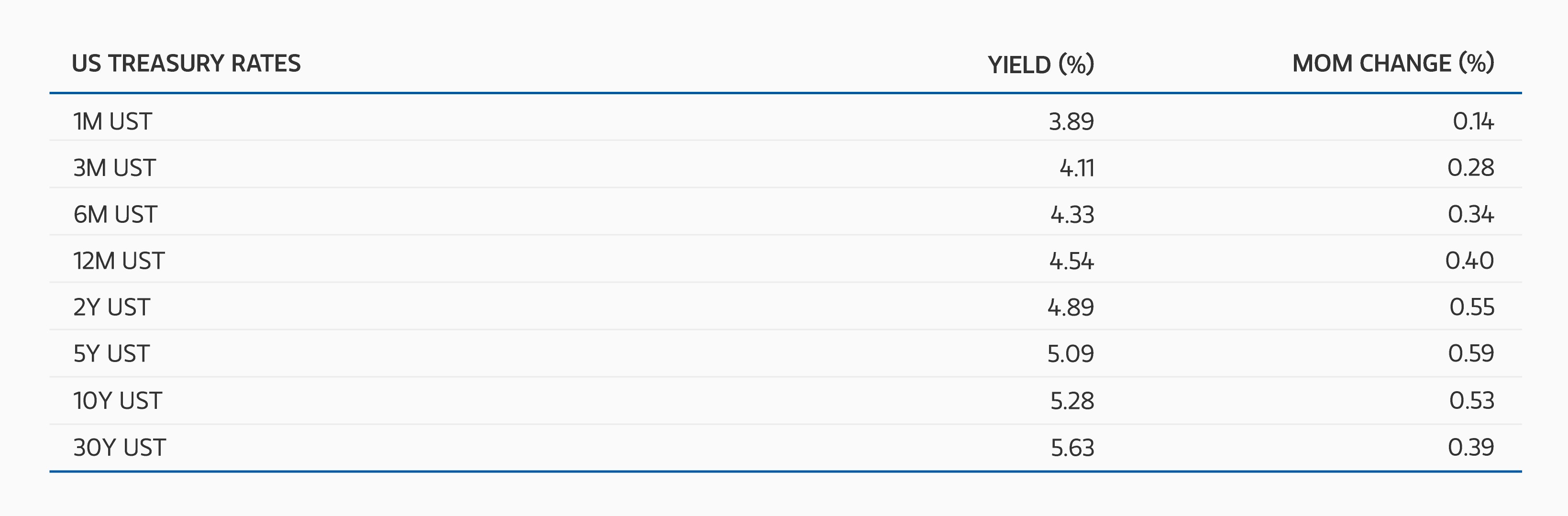
Source: Bloomberg
Monthly Interest Rate Summary
As of 9/30/26
MSILF Weighted Average Maturities (WAM) Summary
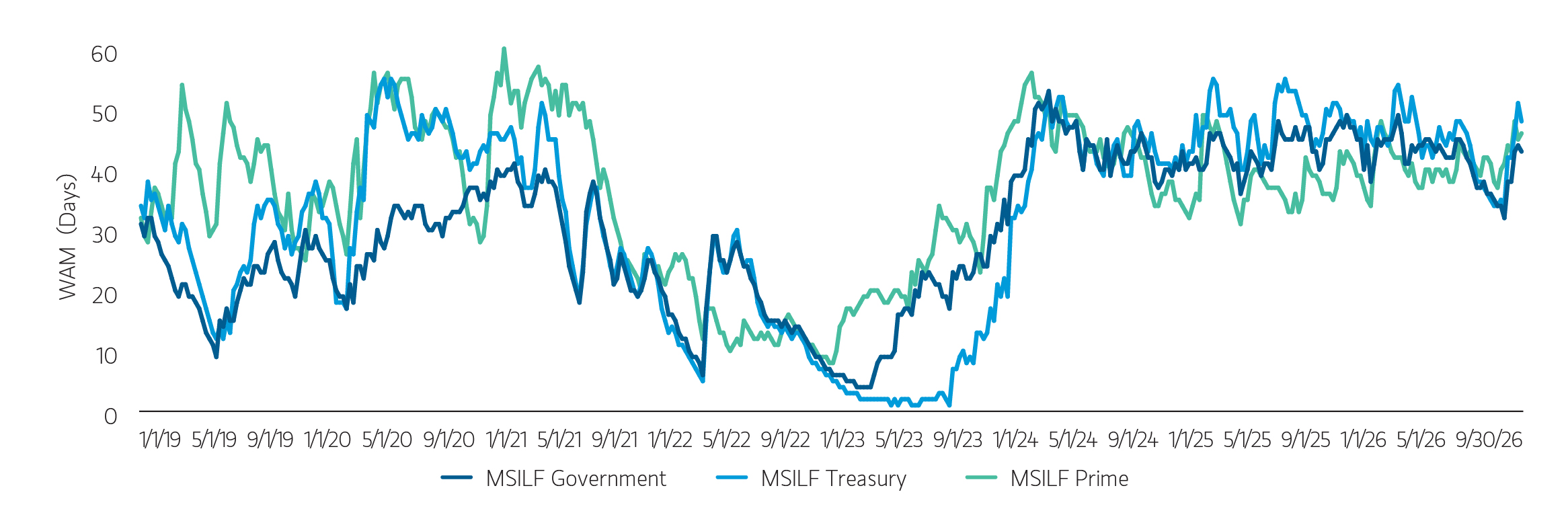
Source: iMoneyNet
MSILF Weighted Average Maturities (WAM) Summary
As of 9/30/26
PORTFOLIO STRATEGY
Government/Treasury Strategy
The FOMC raised interest rates by 25 basis points at its September meeting, reiterating the Committee’s commitment to returning inflation to its 2% target. Updated dot plots were also released, with the median projection now indicating one additional 25bp rate hike by year-end. During his press conference, Chair Warsh highlighted the continued strength of the U.S. economy while acknowledging that inflation has not moderated as quickly as desired. He continued to refrain from providing specific forward guidance on the path of future policy moves. The market is currently pricing approximately 25 basis points of additional tightening by the December FOMC meeting, while October remains a “live” meeting.
Markets remain volatile as expectations continue to evolve around the timing and pace of potential interest rate hikes through year-end. Given the uncertainty surrounding a potential October rate increase, we allowed the portfolios to naturally roll down while selectively adding floating-rate exposure that we believe can benefit from higher interest rates. Our funds remain well positioned if rate hikes occur sooner or at a faster pace than currently anticipated.
Treasury bill supply turned negative heading into corporate tax day but is expected to increase again in October and November before decreasing in December. While reserve management purchases remain on hold for the time being, funding markets could experience increased pressure in the coming weeks as Treasury auction sizes rise.
Currently, we have no concerns on liquidity to note.
Prime Strategy
September was characterized by a shifting monetary policy backdrop as markets assessed resilient economic activity, still-elevated inflation and the implications for the path of Federal Reserve policy. At its September meeting, the FOMC raised the federal funds target range by 25 basis points to 3.75%-4.00%, emphasizing the need to support a timely return of inflation to its 2% objective. Against this backdrop, front-end rates repriced higher, with Treasury bill yields moving up through the month as investors adjusted expectations for the policy path. Credit fundamentals remained healthy, though we continue to be selective in extending the portfolio as spreads are still relatively tight with continued front-end demand. We continue to position weighted average maturity (WAM) and weighted average life (WAL) toward the longer end of the peer group, as fixed starting yields offer attractive current accruals and floating-rate notes allow the portfolio to fully capture any additional rate hikes.
We remain constructive on high-quality credit, with relative value most evident in select wholesale funding instruments, which continue to offer what we consider attractive spread and income relative to comparable financial corporate bonds. We are also finding opportunities in high-quality non-financial corporates, which provide additional diversification1 and access to issuers less active in short-term funding markets. With policy uncertainty persisting, we continue to favor a balanced mix of fixed- and floating-rate exposure while maintaining a disciplined focus on liquidity, credit quality and relative value.
Liquidity conditions remain healthy, in our view, supported by solid dealer balance sheet capacity and consistent demand across high-quality, short-duration assets.
1 Diversification neither assures a profit nor guarantees against a loss in a declining market.
Featured Insights




One basis point = 0.01%
The index performance is provided for illustrative purposes only and is not meant to depict the performance of a specific investment.
The views and opinions and/or analysis expressed are those of the author or the investment team as of the date of preparation of this material and are subject to change at any time without notice due to market or economic conditions and may not necessarily come to pass. Furthermore, the views will not be updated or otherwise revised to reflect information that subsequently becomes available or circumstances existing, or changes occurring, after the date of publication. The views expressed do not reflect the opinions of all investment personnel at Morgan Stanley Investment Management (MSIM) and its subsidiaries and affiliates ("collectively the Firm”) or the views of the firm as a whole, and may not be reflected in all the strategies and products that the Firm offers.
Forecasts and/or estimates provided herein are subject to change and may not actually come to pass. Information regarding expected market returns and market outlooks is based on the research, analysis and opinions of the authors or investment team. These conclusions are speculative in nature, may not come to pass and are not intended to predict the future performance of any specific strategy or product the Firm offers. Future results may differ significantly depending on factors such as changes in securities or financial markets or general economic conditions.
This material has been prepared on the basis of publicly available information, internally developed data and other third-party sources believed to be reliable. However, no assurances are provided regarding the reliability of such information and the Firm has not sought to independently verify information taken from public and third-party sources.
This material is a general communication, which is not impartial and all information provided has been prepared solely for informational and educational purposes and does not constitute an offer or a recommendation to buy or sell any particular security or to adopt any specific investment strategy. The information herein has not been based on a consideration of any individual investor circumstances and is not investment advice, nor should it be construed in any way as tax, accounting, legal or regulatory advice. To that end, investors should seek independent legal and financial advice, including advice as to tax consequences, before making any investment decision.
Charts and graphs provided herein are for illustrative purposes only. Past performance is no guarantee of future results.
The indexes are unmanaged and do not include any expenses, fees or sales charges. It is not possible to invest directly in an index. Any index referred to herein is the intellectual property (including registered trademarks) of the applicable licensor. Any product based on an index is in no way sponsored, endorsed, sold or promoted by the applicable licensor and it shall not have any liability with respect thereto.
This material is not a product of Morgan Stanley’s Research Department and should not be regarded as a research material or a recommendation.
Current and future portfolio holdings are subject to change. The forecasts in this piece are not necessarily those of Morgan Stanley, and may not actually come to pass.
Certain information herein is based on data obtained from third party sources believed to be reliable. However, we have not verified this information, and we make no representations whatsoever as to its accuracy or completeness.
Please consider the investment objectives, risks, charges and expenses of the portfolios carefully before investing. The prospectus contains this and other information about the portfolios. To obtain a prospectus, download one at www.morganstanley.com/liquidity or call 1.800.236.0992. Please read the prospectus carefully before investing.
There is no assurance that a portfolio will achieve its investment objective. Portfolios are subject to market risk, which is the possibility that the market values of securities owned by the portfolio will decline and that the value of portfolio shares may therefore be less than what you paid for them. Market values can change daily due to economic and other events (e.g. natural disasters, health crises, terrorism, conflicts and social unrest) that affect markets, countries, companies or governments. It is difficult to predict the timing, duration, and potential adverse effects (e.g. portfolio liquidity) of events.
STABLE NAV
You could lose money by investing in the Fund. Although the Fund seeks to preserve the value of your investment at $1.00 per share, it cannot guarantee it will do so. An investment in the Fund is not a bank account and is not insured or guaranteed by the Federal Deposit Insurance Corporation or any other government agency. The Fund’s sponsor is not required to reimburse the Fund for losses, and you should not expect that the sponsor will provide financial support to the Fund at any time, including during periods of market stress.
FLOATING NAV
You could lose money by investing in the Fund. Because the share price of the Fund will fluctuate, when you sell your shares they may be worth more or less than what you originally paid for them. The Fund may impose a fee upon sale of your shares. The Fund generally must impose a fee when net sales of Fund shares exceed certain levels. An investment in the Fund is not a bank account and is not insured or guaranteed by the Federal Deposit Insurance Corporation or any other government agency. The Fund’s sponsor is not required to reimburse the Fund for losses, and you should not expect that the sponsor will provide financial support to the Fund at any time, including during periods of market stress. The Portfolio will be required to price and transact in their shares at a floating Net asset value (“NAV”). The Portfolio will be required to impose a mandatory liquidity fee when the Fund experiences daily net redemptions that exceed 5% of net assets, unless the Fund’s liquidity costs are de minimis.
Morgan Stanley Investment Management is the asset management division of Morgan Stanley.
NOT FDIC INSURED. OFFER NO BANK GUARANTEE. MAY LOSE VALUE. NOT INSURED BY ANY FEDERAL GOVERNMENT AGENCY.


