


 Top
Top

Federal Reserve Board
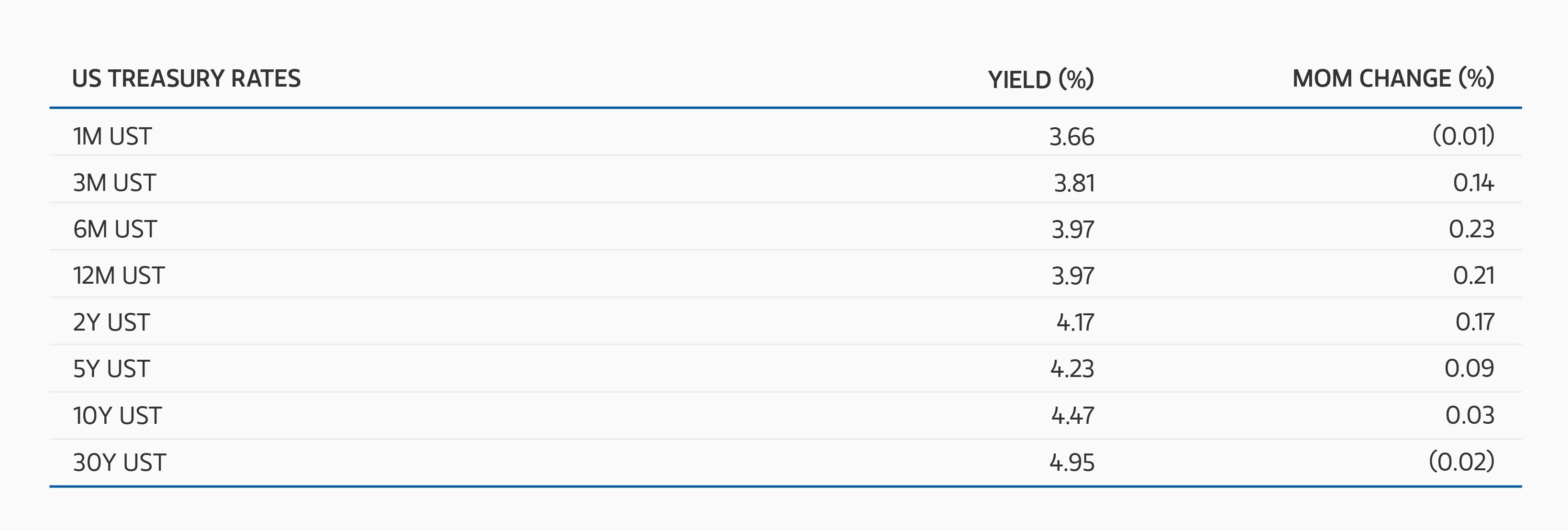
On June 17, the Federal Open Market Committee (FOMC) unanimously voted to maintain the federal funds rate at its target range of 3.50%-3.75%. While the decision was widely expected, the Committee adopted a more hawkish tone by removing language that had previously suggested an easing bias. In the statement, the Committee emphasized solid economic growth, a resilient labor market, elevated inflation and its commitment to restoring price stability. Chair Kevin Warsh's first FOMC meeting featured a notably shorter policy statement with significantly less forward guidance, reinforcing that future policy decisions will depend on incoming economic data. Updated economic projections also pointed to a higher-for-longer rate outlook, with inflation forecasts revised upward and policymakers no longer expecting rate cuts as the most likely path.
European Central Bank
On June 11, the European Central Bank (ECB) raised its deposit facility rate by 0.25% to 2.25%, citing elevated inflation pressures driven by the conflict in the Middle East and reaffirming its commitment to returning inflation to its 2% medium-term target. While acknowledging a weaker growth outlook, the ECB Governing Council noted that higher energy prices have increased inflation risks and justified a more restrictive policy stance. Updated projections point to higher inflation and slower economic growth over the near term, while the ECB reiterated that future policy decisions will continue to be data-dependent and made on a meeting-by-meeting basis, without pre-committing to a specific rate path.
Bank of England
On June 18, the Bank of England's Monetary Policy Committee (MPC) voted 7-2 to leave the Bank Rate unchanged at 3.75%, with two members favoring a 0.25% increase. While recent declines in energy prices have eased some near-term inflation pressures, the Committee emphasized that inflation risks remain elevated and reiterated that it stands ready to act as necessary should higher energy costs feed through to wages, prices and inflation expectations. The MPC maintained its data-dependent, meeting-by-meeting approach, noting that future policy decisions will depend on the evolution of inflation, labor market conditions and the broader economic outlook. The Committee continues to expect inflation to rise modestly in the near term before easing back toward its 2% target over the medium term.
Monthly Interest Rate Summary
Source: Bloomberg
Monthly Interest Rate Summary
As of 6/30/26
MSILF Weighted Average Maturities (WAM) Summary1
Source: iMoneyNet
MSILF Weighted Average Maturities (WAM) Summary1
As of 6/30/26
PORTFOLIO STRATEGY
Government/Treasury Strategy
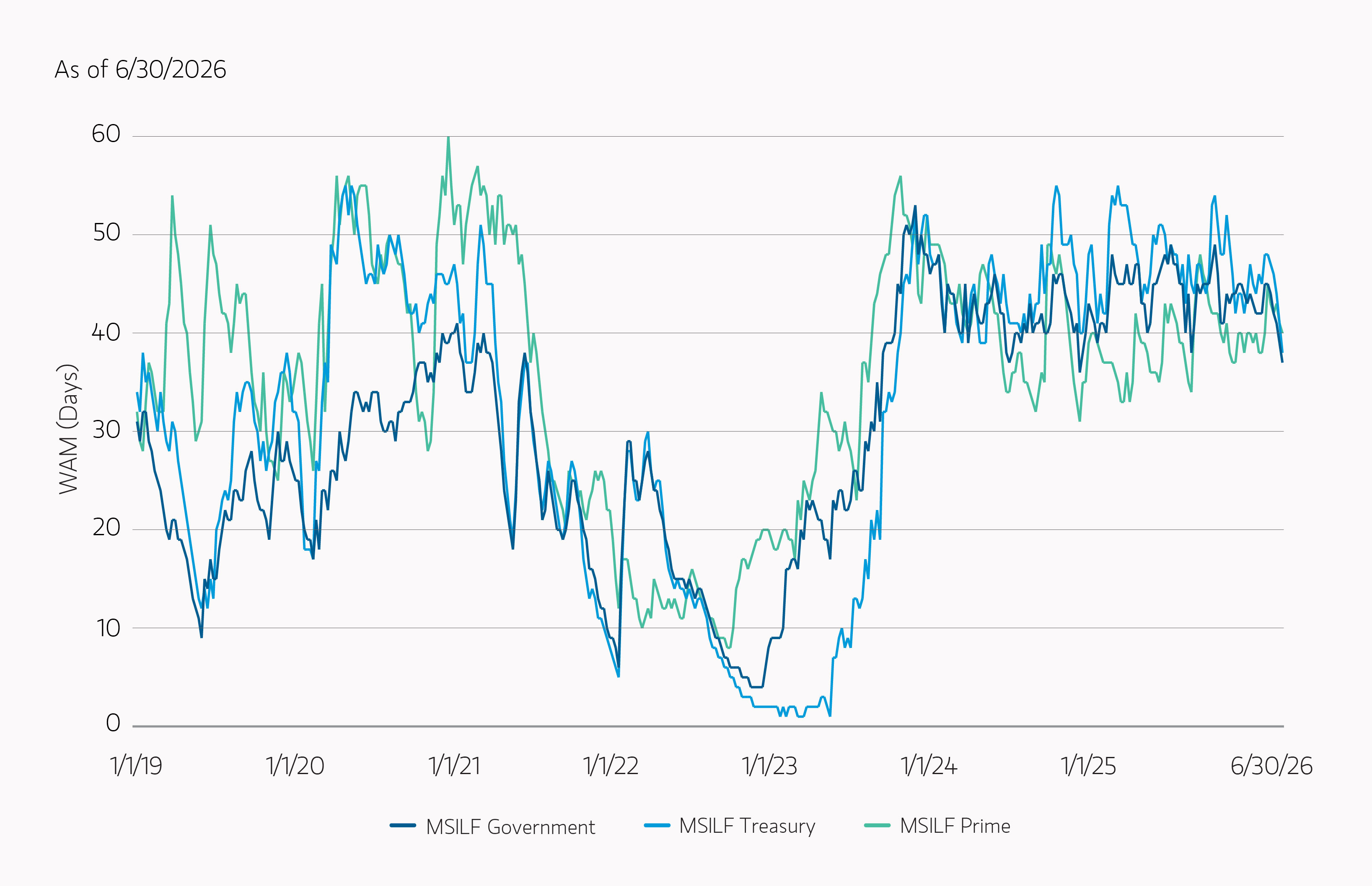
Markets have been volatile as they reassess the outlook for interest rates, with expectations shifting toward potential rate hikes by year-end. As a result, we have let the portfolios organically roll down, while strategically increasing exposure to floating-rate instruments that stand to benefit if rates move higher.
A short-term U.S.-Iran peace agreement reopened the Strait of Hormuz, alleviating some fears of a prolonged disruption to global trade and the inflationary pressures that would have followed. At the June FOMC meeting, newly appointed Chair Warsh held rates steady while reaffirming the Fed's commitment to restoring price stability, though he offered little forward guidance on future policy adjustments. Markets are currently pricing in a 0.25% rate increase by December, with the possibility of earlier action if inflation data warrants it.
As expected, Treasury bill supply was mostly negative in June due to corporate tax day. Combined with reserve management purchases (RMPs), repo markets saw little volatility outside of large coupon settlement days and quarter-end. Bill issuance will start increasing again in July, which has the potential to add more volatility into repo markets on settlement days.
Currently, we have no concerns on liquidity to note. The Federal Reserve Bank of New York reduced the amount of RMPs by more than expected, from $40 billion per month to $10 billion per month, but it has not resulted in funding pressures in the repo market.
Prime Strategy
June was characterized by a meaningful repricing of the Fed path, with markets increasingly pricing in the possibility of additional rate hikes this year as inflation remained firm and economic data continued to demonstrate resilience. While geopolitical risks persisted, credit fundamentals remained healthy and demand for high-quality, front-end spread products continued to support relatively stable spreads. As rate expectations shifted higher, yields further out the curve became increasingly attractive. During the month of June, we selectively extended into fixed-rate wholesale funding structures to lock in elevated yields while maintaining flexibility through a balanced allocation to floating-rate securities that provide a rate-resetting feature if Fed hikes come to fruition.
The repricing of the front end of the curve has created attractive opportunities to deploy cash into fixed-rate wholesale structures further out the curve, offering incremental yield and favorable roll-down. Wholesale funding products continue to offer attractive relative value versus many financial corporate bonds, while corporate bonds continue to provide access to high-quality, non-financial issuers not available in the commercial paper market.
1 Weighted Average Maturity (WAM): Measures the weighted average of the maturities of the portfolio’s individual holdings, taking into account reset dates for floating rate securities.
The views and opinions expressed are those of the Portfolio Management team as of June 30, 2026 and are subject to change based on market, economic and other conditions. Past performance is not indicative of future results.
Featured Insights





One basis point = 0.01%
The index performance is provided for illustrative purposes only and is not meant to depict the performance of a specific investment.
The views and opinions and/or analysis expressed are those of the author or the investment team as of the date of preparation of this material and are subject to change at any time without notice due to market or economic conditions and may not necessarily come to pass. Furthermore, the views will not be updated or otherwise revised to reflect information that subsequently becomes available or circumstances existing, or changes occurring, after the date of publication. The views expressed do not reflect the opinions of all investment personnel at Morgan Stanley Investment Management (MSIM) and its subsidiaries and affiliates (collectively the Firm”) or the views of the firm as a whole, and may not be reflected in all the strategies and products that the Firm offers.
Forecasts and/or estimates provided herein are subject to change and may not actually come to pass. Information regarding expected market returns and market outlooks is based on the research, analysis and opinions of the authors or investment team. These conclusions are speculative in nature, may not come to pass and are not intended to predict the future performance of any specific strategy or product the Firm offers. Future results may differ significantly depending on factors such as changes in securities or financial markets or general economic conditions.
This material has been prepared on the basis of publicly available information, internally developed data and other third-party sources believed to be reliable. However, no assurances are provided regarding the reliability of such information and the Firm has not sought to independently verify information taken from public and third-party sources.
This material is a general communication, which is not impartial and all information provided has been prepared solely for informational and educational purposes and does not constitute an offer or a recommendation to buy or sell any particular security or to adopt any specific investment strategy. The information herein has not been based on a consideration of any individual investor circumstances and is not investment advice, nor should it be construed in any way as tax, accounting, legal or regulatory advice. To that end, investors should seek independent legal and financial advice, including advice as to tax consequences, before making any investment decision.
Charts and graphs provided herein are for illustrative purposes only. Past performance is no guarantee of future results.
The indexes are unmanaged and do not include any expenses, fees or sales charges. It is not possible to invest directly in an index. Any index referred to herein is the intellectual property (including registered trademarks) of the applicable licensor. Any product based on an index is in no way sponsored, endorsed, sold or promoted by the applicable licensor and it shall not have any liability with respect thereto.
This material is not a product of Morgan Stanley’s Research Department and should not be regarded as a research material or a recommendation.
Current and future portfolio holdings are subject to change. The forecasts in this piece are not necessarily those of Morgan Stanley, and may not actually come to pass.
Certain information herein is based on data obtained from third party sources believed to be reliable. However, we have not verified this information, and we make no representations whatsoever as to its accuracy or completeness.
Please consider the investment objectives, risks, charges and expenses of the portfolios carefully before investing. The prospectus contains this and other information about the portfolios. To obtain a prospectus, download one at www.morganstanley.com/liquidity or call 1.800.236.0992. Please read the prospectus carefully before investing.
There is no assurance that a portfolio will achieve its investment objective. Portfolios are subject to market risk, which is the possibility that the market values of securities owned by the portfolio will decline and that the value of portfolio shares may therefore be less than what you paid for them. Market values can change daily due to economic and other events (e.g. natural disasters, health crises, terrorism, conflicts and social unrest) that affect markets, countries, companies or governments. It is difficult to predict the timing, duration, and potential adverse effects (e.g. portfolio liquidity) of events.
STABLE NAV
You could lose money by investing in the Fund. Although the Fund seeks to preserve the value of your investment at $1.00 per share, it cannot guarantee it will do so. An investment in the Fund is not a bank account and is not insured or guaranteed by the Federal Deposit Insurance Corporation or any other government agency. The Fund’s sponsor is not required to reimburse the Fund for losses, and you should not expect that the sponsor will provide financial support to the Fund at any time, including during periods of market stress.
FLOATING NAV
You could lose money by investing in the Fund. Because the share price of the Fund will fluctuate, when you sell your shares they may be worth more or less than what you originally paid for them. The Fund may impose a fee upon sale of your shares. The Fund generally must impose a fee when net sales of Fund shares exceed certain levels. An investment in the Fund is not a bank account and is not insured or guaranteed by the Federal Deposit Insurance Corporation or any other government agency. The Fund’s sponsor is not required to reimburse the Fund for losses, and you should not expect that the sponsor will provide financial support to the Fund at any time, including during periods of market stress. The Portfolio will be required to price and transact in their shares at a floating Net asset value (“NAV”). The Portfolio will be required to impose a mandatory liquidity fee when the Fund experiences daily net redemptions that exceed 5% of net assets, unless the Fund’s liquidity costs are de minimis.
Morgan Stanley Investment Management is the asset management division of Morgan Stanley.
NOT FDIC INSURED. OFFER NO BANK GUARANTEE. MAY LOSE VALUE. NOT INSURED BY ANY FEDERAL GOVERNMENT AGENCY.


