


 Top
Top


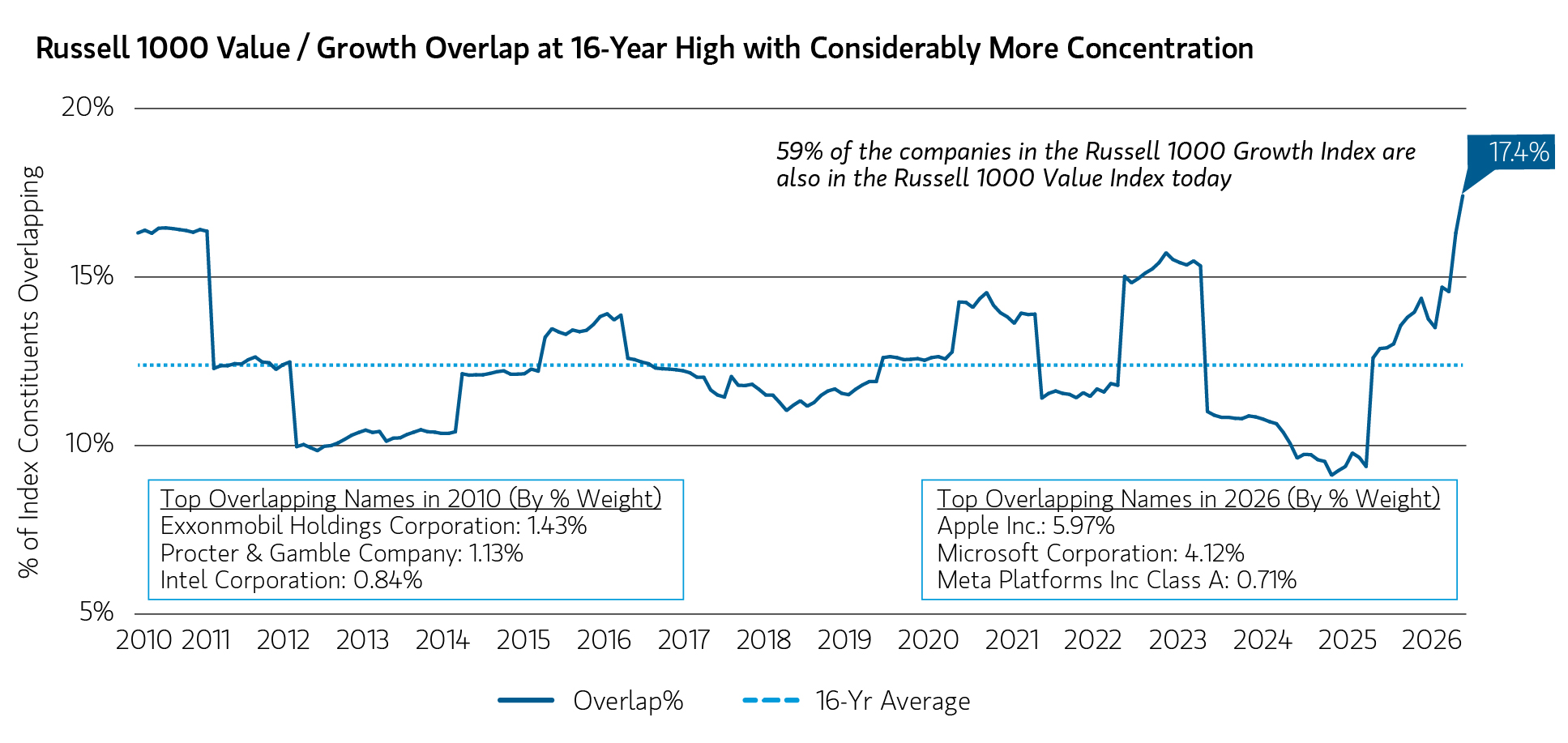
The annual Russell Reconstitution often prompts investors to revisit portfolio allocations, but this year's rebalance sparked an especially interesting conversation about style investing. With several mega-cap technology companies now appearing in both the Russell 1000® Growth and Russell 1000® Value indexes, traditional distinctions between "growth" and "value" appear less clear than ever.
For our Large-Cap Growth and Large-Cap Value teams, however, the reconstitution didn't change how they invest. Instead, it reinforced a philosophy long shared by both teams: indexes classify companies, but fundamentals drive investment opportunities and decisions.
We sat down with Brad Galko and Jason Kritzer, Co-Heads of the Value Equity team and Doug Rogers, Co-Head of the Core/Growth Equity team to discuss what this year's rebalance means for investors.
Has this year’s reconstitution changed what it means to be a "growth" or "value" stock?
Brad: Not in our view. A company's inclusion in a growth or value index does not change its underlying business or intrinsic value. Style classifications evolve over time, but they are not permanent labels.
Our Opportunistic Value philosophy has always been driven by fundamentals rather than index labels. We seek high-quality companies trading below our estimate of intrinsic value. We evaluate companies on balance-sheet strength, returns on invested capital, free cash flow, leverage – and whether the market is appropriately valuing the company's long-term prospects.
Doug: We view it similarly. Our objective is not to own "growth stocks" simply because they appear in the growth index. It is to identify businesses capable of delivering durable, differentiated growth over long periods. We look for growth outliers—companies that continue to innovate, expand their addressable markets and compound earnings over time – regardless of how they are classified.
The Russell Reconstitution may shift style labels, but it does not change what makes a great business.
If traditional style boxes are becoming less distinct, how should investors think about diversification?
Doug: Diversification today requires looking beyond sectors. Increasingly, it means understanding the end markets companies serve and the underlying drivers of their businesses.
Artificial intelligence (AI) is a good example. While often viewed as a technology theme, its applications extend well beyond the tech sector. Industrial companies building electrical infrastructure, utilities meeting rising power demand and software companies embedding AI into their products are all participating in the same long-term, secular growth theme.
Simply owning companies across multiple sectors does not necessarily provide meaningful diversification if they are all exposed to the same economic driver.
Brad: The same principle applies from a value perspective. We believe investors should be intentional about the risks they take. It’s possible to gain diversified exposure to a long-term investment theme while managing concentration risk by investing in businesses with different customers, competitive dynamics and sources of cash flow.
How has the rebalance changed the opportunity set for active managers?
Doug: One of the biggest implications is a broader opportunity set for active managers. Rather than concentrating exposure in a handful of mega-cap tech stocks, we can express our highest convictions across a wider range of businesses benefiting from similar secular trends – for companies outside the AI theme that fit our growth-outlier philosophy.
For example, semiconductors remain central to the AI story, but they are not the only way to invest in it. Memory manufacturers, semiconductor equipment providers, foundries and infrastructure companies are all benefiting from many of the same long-term demand drivers while offering different risk-return characteristics.
More broadly, AI is becoming a productivity tool across industries. Consumer companies are using it to improve marketing, enhance operations and increase efficiency. Over time, those gains can become meaningful drivers of future earnings growth, even for businesses not traditionally viewed as AI companies.
Jason: That last point is key. Health care companies, for example, are using AI to make their sales organizations more efficient. With so much attention on hyperscalers and the companies most directly tied to AI, investors can overlook businesses where AI is quietly improving operations and long-term earnings power. We see the potential for many of these companies to close the gap between market price and their true intrinsic value.
Many of today's largest technology companies now exhibit characteristics traditionally associated with value investing. How do you think about that?
Brad: The characteristics we have always valued – strong free cash flow, high returns on invested capital and disciplined balance sheets – are increasingly found in many of today’s largest tech companies. At the same time, these businesses are continuing to invest aggressively for future growth.
That does not automatically make them value stocks, nor does it exclude them from consideration.
We apply the same investment framework to every company, regardless of style label: Can it continue compounding intrinsic value? Are current expectations appropriately reflected in the stock price? Does the potential reward justify the risk? Those questions matter far more than which index a company happens to sit in.
Beyond technology, where are you finding compelling opportunities?
Jason: Health care continues to stand out. The sector’s weighting in the Russell 1000 Value Index is near multidecade lows despite attractive valuations, improving pipelines and strong balance sheets across many pharmaceutical companies. As in any sector, selectivity remains critical. We see a disconnect between current market sentiment and long-term fundamentals.
We are also finding opportunities in industrials and materials, as companies continue investing in reshoring, infrastructure and supply-chain resilience. Given the shifting geopolitical landscape, we believe those trends are likely to outlast short-term market rotations.
Has this year's reconstitution changed how you think about portfolio risk?
Doug: The rebalance has reinforced the importance of understanding where portfolio risk truly resides. We do not simply look at sectors; we look at how individual positions contribute to overall portfolio risk and whether multiple holdings are exposed to the same end markets.
Take semiconductors, for example. Rather than concentrating risk in a single company or sub-industry, we can gain exposure to many of the same secular growth drivers through adjacent businesses such as memory, storage, semiconductor equipment and infrastructure providers. While these companies may serve similar customers or benefit from the same AI investment cycle, they often have distinct business models and risk profiles.
Ultimately, we want our active risk to come from our highest-conviction investment ideas—not from unintended portfolio concentrations.
Brad: We think about risk in much the same way. Every investment begins with weighing the potential reward against the risk. Whether we are overweight or underweight a company relative to the benchmark, those are active decisions that should reflect our fundamental conviction.
The Russell Reconstitution has not changed that framework. It has reinforced the importance of looking beyond traditional classifications. Companies may sit in different sectors or industries yet still be driven by the same underlying economic forces. Understanding those relationships helps ensure the risks we take are intentional and consistent with our investment thesis.
Featured Insights





Index definitions:
Russell 1000® Value Index: An unmanaged index of U.S. large-cap value stocks.
Russell 1000® Growth Index: An unmanaged index of U.S. large-cap growth stocks.
Risk Considerations:
The value of investments held by the Strategy may increase or decrease in response to economic and financial events (whether real, expected or perceived) in the U.S. and global markets. The value of equity securities is sensitive to stock market volatility.
The views and opinions and/or analysis expressed are those of the author or the investment team as of the date of preparation of this material and are subject to change at any time without notice due to market or economic conditions and may not necessarily come to pass. Furthermore, the views will not be updated or otherwise revised to reflect information that subsequently becomes available or circumstances existing, or changes occurring, after the date of publication. The views expressed do not reflect the opinions of all investment personnel at Morgan Stanley Investment Management (MSIM) and its subsidiaries and affiliates (collectively “the Firm”) and may not be reflected in all the strategies and products that the Firm offers.
Forecasts and/or estimates provided herein are subject to change and may not actually come to pass. Information regarding expected market returns and market outlooks is based on the research, analysis and opinions of the authors or the investment team. These conclusions are speculative in nature, may not come to pass and are not intended to predict the future performance of any specific strategy or product the Firm offers. Future results may differ significantly depending on factors such as changes in securities or financial markets or general economic conditions.
This material has been prepared on the basis of publicly available information, internally developed data and other third-party sources believed to be reliable. However, no assurances are provided regarding the reliability of such information and the Firm has not sought to independently verify information taken from public and third-party sources.
This material is a general communication, which is not impartial, is for informational and educational purposes only, not a recommendation to purchase or sell specific securities, or to adopt any particular investment strategy. Information does not address financial objectives, situation or specific needs of individual investors.
The indexes are unmanaged and do not include any expenses, fees or sales charges. It is not possible to invest directly in an index. Any index referred to herein is the intellectual property (including registered trademarks) of the applicable licensor. Any product based on an index is in no way sponsored, endorsed, sold or promoted by the applicable licensor and it shall not have any liability with respect thereto.
Any charts and graphs provided are for illustrative purposes only.
This material is not a product of Morgan Stanley’s Research Department and should not be regarded as a research material or a recommendation.
The Firm has not authorised financial intermediaries to use and to distribute this material, unless such use and distribution is made in accordance with applicable law and regulation. Additionally, financial intermediaries are required to satisfy themselves that the information in this material is appropriate for any person to whom they provide this material in view of that person’s circumstances and purpose. The Firm shall not be liable for, and accepts no liability for, the use or misuse of this material by any such financial intermediary.
This material may be translated into other languages. Where such a translation is made this English version remains definitive. If there are any discrepancies between the English version and any version of this material in another language, the English version shall prevail.
The whole or any part of this material may not be directly or indirectly reproduced, copied, modified, used to create a derivative work, performed, displayed, published, posted, licensed, framed, distributed or transmitted or any of its contents disclosed to third parties without the Firm’s express written consent. This material may not be linked to unless such hyperlink is for personal and non-commercial use. All information contained herein is proprietary and is protected under copyright and other applicable law.
DISTRIBUTION
This material is only intended for and will only be distributed to persons resident in jurisdictions where such distribution or availability would not be contrary to local laws or regulations.
MSIM, the asset management division of Morgan Stanley (NYSE: MS), and its affiliates have arrangements in place to market each other’s products and services. Each MSIM affiliate is regulated as appropriate in the jurisdiction it operates. MSIM’s affiliates are: Calvert Research and Management, Eaton Vance Management, Parametric Portfolio Associates LLC, Parametric SAS, and Atlanta Capital Management LLC.
This material has been issued by any one or more of the following entities:
EMEA
This material is for Professional Clients/Accredited Investors only.
In the EU, MSIM materials are issued by MSIM Fund Management (Ireland) Limited (“FMIL”). FMIL is regulated by the Central Bank of Ireland and is incorporated in Ireland as a private company limited by shares with company registration number 616661 and has its registered address at 24-26 City Quay, Dublin 2, DO2 NY19, Ireland.
Outside the EU, MSIM materials are issued by Morgan Stanley Investment Management Limited (MSIM Ltd) is authorised and regulated by the Financial Conduct Authority. Registered in England. Registered No. 1981121. Registered Office: 25 Cabot Square, Canary Wharf, London E14 4QA.
In Switzerland, MSIM materials are issued by Morgan Stanley & Co. International plc, London (Zurich Branch) Authorised and regulated by the Eidgenössische Finanzmarktaufsicht ("FINMA"). Registered Office: Beethovenstrasse 33, 8002 Zurich, Switzerland.
Italy: MSIM FMIL (Milan Branch), (Sede Secondaria di Milano) Palazzo Serbelloni Corso Venezia, 16 20121 Milano, Italy. The Netherlands: MSIM FMIL (Amsterdam Branch), Rembrandt Tower, 11th Floor Amstelplein 1 1096HA, Netherlands. France: MSIM FMIL (Paris Branch), 61 rue de Monceau 75008 Paris, France. Spain: MSIM FMIL (Madrid Branch), Calle Serrano 55, 28006, Madrid, Spain. Germany: MSIM FMIL Frankfurt Branch, Große Gallusstraße 18, 60312 Frankfurt am Main, Germany (Gattung: Zweigniederlassung (FDI) gem. § 53b KWG). Denmark: MSIM FMIL (Copenhagen Branch), Gorrissen Federspiel, Axel Towers, Axeltorv2, 1609 Copenhagen V, Denmark.
MIDDLE EAST
Dubai International Financial Centre: This information does not constitute or form part of any offer to issue or sell, or any solicitation of any offer to subscribe for or purchase, any securities or investment products in the UAE (including the Dubai International Financial Centre and the Abu Dhabi Global Market) and accordingly should not be construed as such. Furthermore, this information is being made available on the basis that the recipient acknowledges and understands that the entities and securities to which it may relate have not been approved, licensed by or registered with the UAE Central Bank, the Dubai Financial Services Authority, the UAE Securities and Commodities Authority, the Financial Services Regulatory Authority or any other relevant licensing authority or government agency in the UAE. The content of this report has not been approved by or filed with the UAE Central Bank, the Dubai Financial Services Authority, the UAE Securities and Commodities Authority or the Financial Services Regulatory Authority.
Abu Dhabi Global Market ("ADGM"): This material is sent strictly within the context of, and constitutes, an Exempt Communication. This material relates to emerging markets debt, which is not subject to any form of regulation or approval by the Financial Services Regulatory Authority of the Abu Dhabi Global Market (the “FSRA”).
Saudi Arabia
This financial promotion was issued and approved for use in Saudi Arabia by Morgan Stanley Saudi Arabia, Al Rashid Tower, Kings Sand Street, Riyadh, Saudi Arabia, authorized and regulated by the Capital Market Authority license number 06044-37.
U.S.
NOT FDIC INSURED | OFFER NO BANK GUARANTEE | MAY LOSE VALUE | NOT INSURED BY ANY FEDERAL GOVERNMENT AGENCY | NOT A DEPOSIT
Latin America (Brazil, Chile Colombia, Mexico, Peru, and Uruguay)
This material is for use with an institutional investor or a qualified investor only. All information contained herein is confidential and is for the exclusive use and review of the intended addressee, and may not be passed on to any third party. This material is provided for informational purposes only and does not constitute a public offering, solicitation or recommendation to buy or sell for any product, service, security and/or strategy. A decision to invest should only be made after reading the strategy documentation and conducting in-depth and independent due diligence.
ASIA PACIFIC
Hong Kong: This document has been issued by Morgan Stanley Asia Limited, CE No. AAD291, for use in Hong Kong and shall only be made available to “professional investors” as defined under the Securities and Futures Ordinance of Hong Kong (Cap 571). The contents of this document have not been reviewed nor approved by any regulatory authority including the Securities and Futures Commission in Hong Kong. Accordingly, save where an exemption is available under the relevant law, this document shall not be issued, circulated, distributed, directed at, or made available to, the public in Hong Kong. Singapore: This material is disseminated in Singapore by Morgan Stanley Investment Management Company, Registration No. 199002743C. This material should not be considered to be the subject of an invitation for subscription or purchase, whether directly or indirectly, to the public or any member of the public in Singapore other than (i) to an institutional investor under section 304 of the Securities and Futures Act, Chapter 289 of Singapore (“SFA”), (ii) to a “relevant person” (which includes an accredited investor) pursuant to section 305 of the SFA, and such distribution is in accordance with the conditions specified in section 305 of the SFA; or (iii) otherwise pursuant to, and in accordance with the conditions of, any other applicable provision of the SFA. This material has not been reviewed by the Monetary Authority of Singapore. Australia: This material is provided by Morgan Stanley Investment Management (Australia) Pty Ltd ABN 22122040037, AFSL No. 314182 and its affiliates and does not constitute an offer of interests. Morgan Stanley Investment Management (Australia) Pty Limited arranges for MSIM affiliates to provide financial services to Australian wholesale clients. This material will not be lodged with the Australian Securities and Investments Commission.
Japan
For professional investors, this material is circulated or distributed solely for informational purposes. For non-professional investors, this material is provided in connection with Morgan Stanley Investment Management (Japan) Co., Ltd. (“MSIMJ”)’s business with respect to discretionary investment management agreements (“IMA”) and investment advisory agreements (“IAA”). This does not constitute a recommendation or solicitation of transactions nor offers any particular financial instruments. Under an IMA, with respect to the management of client assets, the client prescribes basic management policies in advance and commissions MSIMJ to make all investment decisions based on an analysis of the value, etc. of the securities, and MSIMJ accepts such commission. The client shall delegate to MSIMJ the authorities necessary to make such investment decisions. MSIMJ exercises these delegated authorities accordingly, and the client shall not make individual instructions. All investment profits and losses belong to the clients; principal is not guaranteed. Please consider the investment objectives and nature of risks before investing. As an investment advisory fee for an IAA or an IMA, the amount of assets subject to the contract multiplied by a certain rate (the upper limit is 2.20% per annum (including tax)) shall be incurred in proportion to the contract period. For some strategies, a contingency fee may be incurred in addition to the fee mentioned above. Indirect charges also may be incurred, such as brokerage commissions for underlying securities. Since these charges and expenses vary by contract and other factors, MSIMJ cannot present the rates, upper limits, etc. in advance. All clients should read thoroughly the Documents Provided Prior to the Conclusion of a Contract carefully before executing an agreement. This material is distributed in Japan by MSIMJ, Registered No. 410 (Director of Kanto Local Finance Bureau (Financial Instruments Firms)), Membership: the Japan Securities Dealers Association, the Investment Management Association of Japan and the Type II Financial Instruments Firms Association.


