

 Top
Top

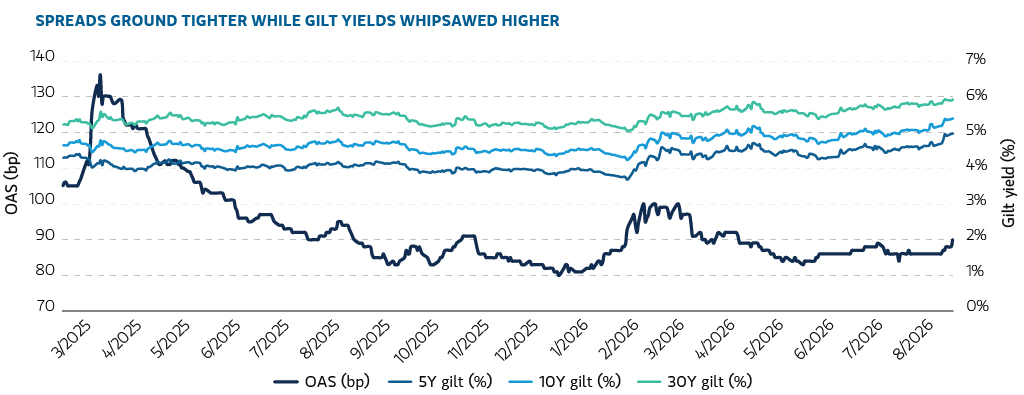
A consequential shift in the UK political backdrop defined the British Summer, as Andy Burnham succeeded Keir Starmer as Prime Minister on 20 July, pledging a “circuit breaker for Britain.” Burnham’s agenda of reindustrialisation and putting “life’s essentials back under stronger public control” has reset the risk calculus for regulated sectors, particularly the water sector, where Burnham has openly favoured public ownership. Yet the market reaction landed almost entirely in gilts, not in credit.
Market review
The gilt market has been highly sensitive to political risk and bore the brunt of the recent headlines. Thirty-year yields pushed higher to 5.91% as of 11 September, while the 10-year sits near 5.34% and the two-year at 4.81%. The drivers remain fiscal and technical (a restored term premium, elevated issuance of roughly £275–300bn annually and recurring political catalysts) rather than anything to do with corporate fundamentals. This is a rates story, and it continues to be a volatile one.
Sterling credit has told a different story. The combination of strong corporate fundamentals, reasonable valuations and supportive technicals has kept credit resilient in the face of political and geopolitical risk. The Bloomberg Sterling Aggregate Corporate index posted an option-adjusted spread (OAS) of 88 basis points (bps) as of 11 September, only five bps wider than where we started the year, while the 10-year gilt moved 87 bps higher. Over the trailing twelve months, realised gilt-yield volatility has run roughly five times that of sterling investment-grade (IG) spreads (Exhibit 1). Credit technicals have provided remarkable support as relentless demand from buy-and-maintain/fixed maturity mandates, insurer bulk-annuity flows and LDI real-money continues to anchor spreads.
Viewed over the full cycle (Exhibit 2), the contrast is stark. Spreads have compressed from the ~260 bps peak during the autumn 2022 mini-budget/LDI crisis (peak 13 Oct 2022) to today’s 88 bps, absorbing successive gilt sell offs with only a handful of short-lived widenings. Crucially, credit was flat-to-tighter even as gilts sold off into the leadership change. We expect this resilience to persist and believe the forces driving gilt volatility, including fiscal supply and term premium, differ largely from the technical and fundamental factors anchoring credit spreads.
There are idiosyncratic risks in the credit market, however. The clearest risk sits in UK water. Thames Water continues its restructuring saga as the senior-creditor rescue plan would write off roughly £9.4bn of debt and inject approximately £3.35bn of new equity, with a “golden share” now proposed to government. But the company has warned it could exhaust liquidity by November without a deal, leaving the Special Administration Regime (temporary nationalisation) a possible outcome. Burnham’s stated preference for public ownership increases that tail risk. We view this as an idiosyncratic and highly dispersed problem, specific to Thames and to stressed capital structures. However, the sentiment around UK water remains negative, and recent headlines about a legally binding gearing cap of 55% have deepened feelings.
Sterling credit offers a compelling investment opportunity: strong fundamentals, high starting yields and resilience that gilts have not shown.
Display 1: Rate vs. spread volatility—spreads range-bound as gilts whipsaw
Display 1: Rate vs. spread volatility—spreads range-bound as gilts whipsaw
Spreads have stayed range-bound while rate volatility has run roughly 5x higher
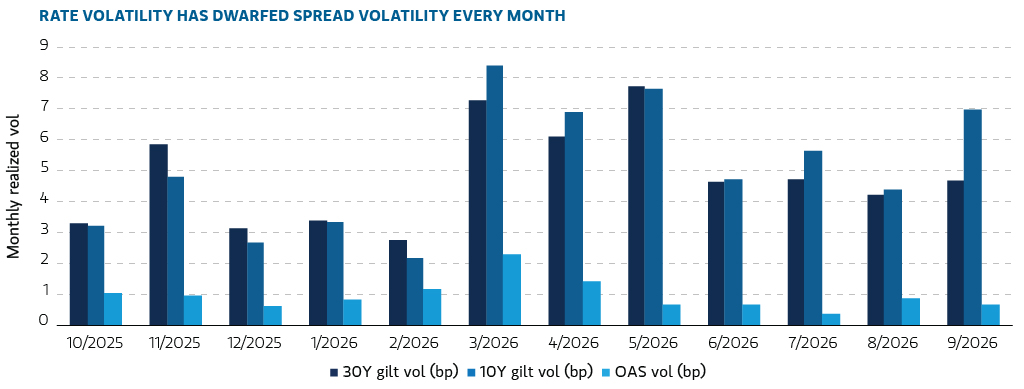
Source: Bloomberg as of September 2026. Monthly volatility = standard deviation of daily changes within each calendar month, in bps. Trailing-12m average: rate volatility ≈ 5x spread volatility. Past performance is no guarantee of future results.
Display 2 Sterling credit OAS vs. gilt yields
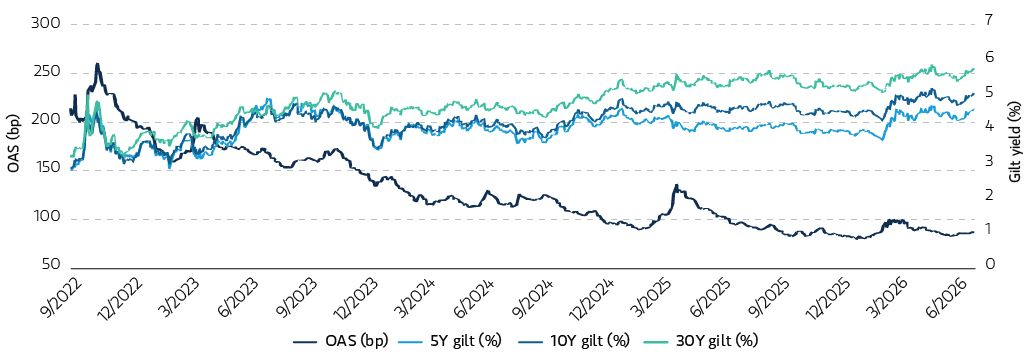
Source: Bloomberg (Sep 2022 – 11 Sep 2026). Credit OAS on left axis (bps); 5/10/30y gilt yields on right axis (%). Past performance is no guarantee of future results.
Display 2 Sterling credit OAS vs. gilt yields
Credit spreads have ground tighter through every gilt sell-off since 2022
Sterling credit: positioning and outlook
We remain constructive on sterling IG spreads, as strong technical demand and robust corporate fundamentals underpin them. Financials and large, regulated utilities (ex-water) remain our preferred sectors to invest in with a preference for subordinated risk (tier 2s and corporate hybrids). We are highly selective on industrials as we see late-cycle, shareholder-friendly behaviour increasing (M&A, large capex, buybacks and dividends). We like heavy assets, low obsolescence (HALO) sectors including telecommunications, transportation and energy while remaining alert to AI-disruption risk to identify unfairly punished companies. We are also cautious on the hyperscaler and related space given the amount of capex they plan to finance over the next few years as the AI arms race heats up.
Looking forward, we expect returns to come from carry. We are underweight to spread duration as we view the opportunity for further spread compression to be limited. Given the strong fundamentals in corporates, we are long credit risk measured by duration-times-spread.
UK water (underweight, selective value in higher-quality names)
We remain underweight on the water sector overall, reflecting elevated political and regulatory tail risk and ongoing Thames headline risk. Within that underweight, we see value in the higher-quality, better-capitalised names with lower leverage and strong operational performance. We prefer taking risk at the operating-company level and avoiding stressed, complex or highly-levered structures such as Thames.
Regulatory pressure on balance sheets is also building at the sector level. The government is drawing up plans for legally binding debt limits, framing a company’s gearing (net debt as a percentage of its Ofwat-determined regulatory capital value) against the notional approximately 55% assumption used in PR24. A legally binding limit may disincentivise additional equity injections at a time when large capex programmes need equity support. Sentiment around the water sector remains negative overall, and we remain highly selective.
Regulated utilities ex-water (small overweight, watching political risk premium)
While Burnham’s “essentials under public control” rhetoric argues for a higher political-risk premium across the broader regulated utility complex, we expect the focus to remain on water in the near-term. The non-water utilities also operate well and have strong balance sheets. We are a small overweight for now given the attractive valuations in the space but alert to negative read-across should intervention rhetoric turn into policy.
Financials (overweight, strong fundamentals and attractive valuations)
Financials are the largest sector in the sterling index, and strong capital, benign asset quality and resilient net interest margins support them. We are overweight, with a preference for national-champion banks across senior and tier 2. The key tail risk to monitor is a windfall bank levy or tax from the government seeking to fund cost-of-living measures.
Hyperscalers and ai-adjacent issuers (underweight, ai arms race with lots of supply)
We are underweight the hyperscalers and AI-adjacent complex. As Exhibit 3 shows, public IG debt issuance from this cohort has stepped up sharply since 2025. Total volumes have risen from roughly $20–48bn per year over 2020–24 to approximately $135bn in 2025 and $275bn in 2026, as data centre and large-technology financing drove the increase. We focus our concern on the volume and pace of supply. With AI- and infrastructure-related capital expenditure showing no sign of slowing, we expect these issuers to remain heavy, repeat borrowers across all major currency markets. What began as a predominantly U.S.-dollar phenomenon has broadened into EUR, GBP, JPY, CHF and CAD tranches.
The spread evidence already points this way. The hyperscaler cohort (AMZN, GOOGL, META, MSFT, NVDA) has repriced from trading materially inside the broader A-or-better industrials index to trading wide of it, with the gap widening into mid-2026 as issuance accelerated. We expect that relative underperformance to persist as record supply meets finite demand, and we see scope for it to spill across the EUR and GBP curves where these names are increasingly active. The concessions hyperscalers offer at new issue to print large size are also weighing on valuations in the broader A-rated industrial universe.
Display 3: Public IG Debt Issuance & Spread Impacts
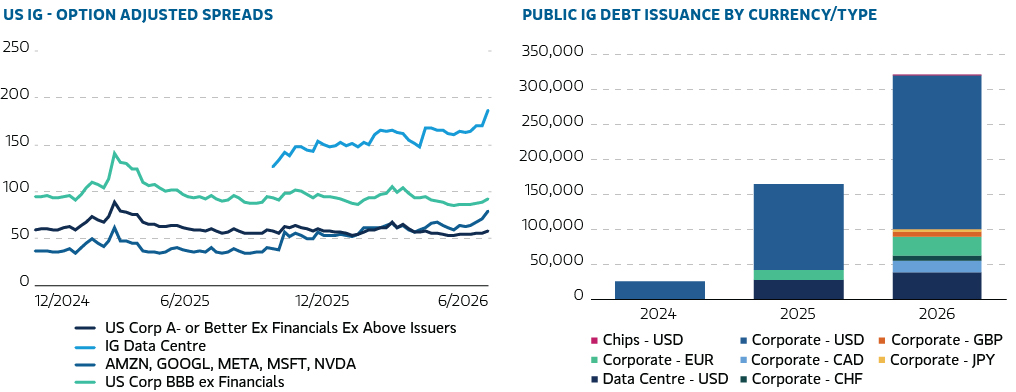
Source: Bloomberg data as of 13 July 2026. Left: U.S. IG option-adjusted spreads, hyperscalers vs. broader A-or-better industrials. Right: IG bond issuance by currency / type ($mn). This is for informational purposes only and does not constitute a recommendation to buy or sell any particular security. The index performance is provided for illustrative purposes only and is not meant to depict the performance of a specific investment. Past performance is no guarantee of future results.
Display 3: Public IG Debt Issuance & Spread Impacts
Hyperscalers and AI-adjacent issuers have driven a sharp increase in IG bond issuance since 2025
RISK CONSIDERATIONS
There is no assurance that any strategy will achieve its investment objective. Investing in companies in anticipation of a catalyst event, such as AI adoption, carries the risk that such catalysts may not occur, may be delayed, or that the market may react differently than expected. Companies focused on AI may have limited product lines, markets or financial resources, and their management and performance may be particularly impacted by events that adversely affect AI adoption, such as rapid changes in product technology cycles, product obsolescence, government regulation, cybersecurity concerns and competition. Portfolios are subject to market risk, which is the possibility that the market values of securities owned by the portfolio will decline and that the value of portfolio shares may therefore be less than what you paid for them. Accordingly, you can lose money investing in a portfolio. Fixed-income securities are subject to the ability of an issuer to make timely principal and interest payments (credit risk), changes in interest rates (interest rate risk), the creditworthiness of the issuer and general market liquidity (market risk). In a rising interest-rate environment, bond prices may fall and may result in periods of volatility and increased portfolio redemptions. In a declining interest-rate environment, the portfolio may generate less income. Longer-term securities may be more sensitive to interest rate changes.
IMPORTANT DISCLOSURES
Charts and graphs provided herein are for illustrative purposes only.
Past performance is no guarantee of future results.
There is no guarantee that any investment strategy will work under all market conditions, and each investor should evaluate their ability to invest for the long-term, especially during periods of downturn in the market.
A separately managed account may not be appropriate for all investors. Separate accounts managed according to the Strategy may include securities that may not necessarily track the performance of a particular index. Please consider the investment objectives, risks and fees of the Strategy carefully before investing. A minimum asset level is required.
For important information about the investment managers, please refer to Form ADV Part 2.
The views and opinions and/or analysis expressed are those of the author or the investment team as of the date of preparation of this material and are subject to change at any time without notice due to market or economic conditions and may not necessarily come to pass. Furthermore, the views will not be updated or otherwise revised to reflect information that subsequently becomes available or circumstances existing, or changes occurring, after the date of publication. The views expressed do not reflect the opinions of all investment personnel at Morgan Stanley Investment Management (MSIM) and its subsidiaries and affiliates (collectively “the Firm”), and may not be reflected in all the strategies and products that the Firm offers.
Forecasts and/or estimates provided herein are subject to change and may not actually come to pass. Information regarding expected market returns and market outlooks is based on the research, analysis and opinions of the authors or the investment team. These conclusions are speculative in nature,may not come to pass and are not intended to predict the future performance of any specific strategy or product the Firm offers. Future results may differ significantly depending on factors such as changes in securities or financial markets or general economic conditions.
This material has been prepared on the basis of publicly available information, internally developed data and other third-party sources believed to be reliable. However, no assurances are provided regarding the reliability of such information and the Firm has not sought to independently verify information taken from public and third-party sources.
This material is a general communication, which is not impartial and all information provided has been prepared solely for informational and educational purposes and does not constitute an offer or a recommendation to buy or sell any particular security or to adopt any specific investment strategy. The information herein has not been based on a consideration of any individual investor circumstances and is not investment advice, nor should it be construed in any way as tax, accounting, legal or regulatory advice. To that end, investors should seek independent legal and financial advice, including advice as to tax consequences, before making any investment decision.
The indexes are unmanaged and do not include any expenses, fees or sales charges. It is not possible to invest directly in an index. Any index referred to herein is the intellectual property (including registered trademarks) of the applicable licensor. Any product based on an index is in no way sponsored, endorsed, sold or promoted by the applicable licensor and it shall not have any liability with respect thereto.
This material is not a product of Morgan Stanley’s Research Department and should not be regarded as a research material or a recommendation.
The Firm has not authorised financial intermediaries to use and to distribute this material, unless such use and distribution is made in accordance
with applicable law and regulation. Additionally, financial intermediaries are required to satisfy themselves that the information in this material is appropriate for any person to whom they provide this material in view of that person’s circumstances and purpose. The Firm shall not be liable for, and accepts no liability for, the use or misuse of this material by any such financial intermediary.
This material may be translated into other languages. Where such a translation is made this English version remains definitive. If there are any discrepancies between the English version and any version of this material in another language, the English version shall prevail.
The whole or any part of this material may not be directly or indirectly reproduced, copied, modified, used to create a derivative work, performed, displayed, published, posted, licensed, framed, distributed or transmitted or any of its contents disclosed to third parties without the Firm’s express written consent. This material may not be linked to unless such hyperlink is for personal and non-commercial use. All information contained herein is proprietary and is protected under copyright and other applicable law.
Eaton Vance is part of Morgan Stanley Investment Management. Morgan Stanley Investment Management is the asset management division of Morgan Stanley.
DISTRIBUTION
This material is only intended for and will only be distributed to persons resident in jurisdictions where such distribution or availability would not be contrary to local laws or regulations.
MSIM, the asset management division of Morgan Stanley (NYSE: MS), and its affiliates have arrangements in place to market each other’s products and services. Each MSIM affiliate is regulated as appropriate in the jurisdiction it operates. MSIM’s affiliates are: Calvert Research and Management, Eaton Vance Management, Parametric Portfolio Associates LLC, Parametric SAS, and Atlanta Capital Management LLC
This material has been issued by any one or more of the following entities:
EMEA:
Outside the EU, MSIM materials are issued by Morgan Stanley Investment Management Limited (MSIM Ltd) is authorised and regulated by the Financial Conduct Authority. Registered in England. Registered No. 1981121. Registered Office: 25 Cabot Square, Canary Wharf, London E14 4QA.


